
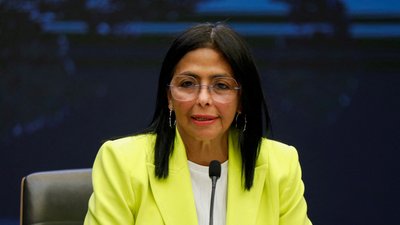
The United States has lifted sanctions on Venezuelan President Delcy Rodriguez. Washington officially recognized her as the country's leader in March and is actively cooperating with her government in the energy and investment sectors.
This was reported by Reuters, citing the website of the US Treasury Department.
Rodriguez previously served as vice president and was an ally of former President Nicolas Maduro, who was captured by US forces during a raid in the capital in January 2026. On April 1, the US Treasury Department removed Rodriguez from its sanctions list.
The administration of US President Donald Trump has sent energy and interior ministers to Caracas with potential investors. The countries have reached an agreement to sell Venezuelan oil, while Washington has approved changes to the oil and mining sectors aimed at attracting foreign capital and granted individual permits to circumvent existing sanctions.
In March, Washington officially recognized Rodriguez as the leader of Venezuela, paving the way for the resumption of embassies and consulates in the United States and the return of control over Venezuelan companies abroad.
Rodriguez welcomed the decision to lift the sanctions.
“This is a step towards normalizing and strengthening relations between our countries,” she wrote on the social network X.
She also expressed hope that this would allow sanctions to be lifted from the country as a whole and build bilateral cooperation.
The lifting of sanctions was announced after Reuters reported that the Rodriguez administration was preparing to take control of the boards of directors of US subsidiaries of state oil corporation PDVSA, including Citgo Petroleum. Since 2019, Citgo has been run by supervisory boards appointed by the opposition parliament, which is no longer in power.
Many senior officials from Maduro's former government remain under sanctions. The United States has indicted Interior Minister Diosdado Cabello and former Defense Minister Vladimir Padrino on drug trafficking and other charges, charges both deny.
US operation in Venezuela on January 3
On the night of January 3, US forces launched strikes on the Venezuelan capital, Caracas. The Venezuelan government declared a state of emergency and ordered the deployment of the Armed Forces. They added that they would complain to the UN and other organizations demanding that the US government be condemned and held accountable.
As stated by the President of neighboring Colombia, Gustavo Petro, the United States attacked a number of military and other facilities in Venezuela, as well as the country's parliament.
Venezuelan opposition leader and Nobel Peace Prize laureate Maria Corina Machado called on Venezuelans to “take power into their own hands” and be ready to “implement what is communicated through official channels.”
Trump later announced that Venezuelan leader Nicolas Maduro and his wife Cilia Flores had been captured and taken to the United States, where they were indicted. Maduro is charged with narco-terrorist conspiracy, cocaine smuggling, and illegal possession of weapons and explosives. The couple were taken to a federal detention center in Brooklyn, a borough of New York City.
In court, both denied their guilt, and Nicolas Maduro stated that he remains the legitimate president of Venezuela and is a prisoner of war. He did not ask for his release. The judge set the next hearing for March 17, 2026.
Vice President and Acting President Delcy Rodriguez made an address to the nation, during which she declared that the country “has a national government” and that Maduro remains “the sole president of Venezuela.” However, she later declared her readiness to cooperate with the United States. Trump confirmed that Rodriguez is cooperating with American officials, but if she stops, the United States may launch a second military operation in the country,
Trump had previously threatened that Rodriguez would “pay a very big price — perhaps more than Maduro” if she did not comply with Washington's demands. On January 5, Rodriguez declared her readiness to cooperate with the United States and called for dialogue instead of confrontation.
On January 10, US Treasury Secretary Scott Bessant said that some sanctions could be lifted to facilitate the sale of oil from Venezuela.