
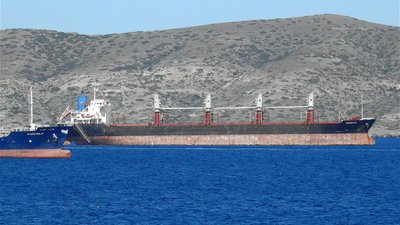
Ukrainian Ambassador to Israel Yevhen Korniychuk announced that he had filed a criminal complaint with the Israeli police and Prosecutor General's Office on behalf of the embassy. All due to Israeli companies purchasing stolen Ukrainian grain from Russia.
Yevhen Korniychuk reported this on the air of “Public Studio”.
Korniychuk reported that the Ukrainian side has recorded two cases of stolen grain being delivered to Israel. According to him, the first ship was unloaded despite Ukraine's official request for legal assistance, and the second one was refused by a private Israeli company in order to “not tarnish its reputation.”
“We believe that a criminal offense has occurred, and all parties should be punished, regardless of whether the ship entered or not, unloaded or not. The fact of the crime, under Israeli law and under international law, has occurred. Therefore, we will prove this to law enforcement agencies, we will prove this in the courts. And I am confident that we have a good opportunity, even outside the scope of the request for legal assistance, to prove that the offense was committed, and the parties who are guilty of this will be punished,” the ambassador said.
Korniychuk also noted that the European Union “is ready to support Ukraine with sanctions against Israeli grain traders” who buy stolen grain. He noted that “the majority of Israeli citizens support Ukraine” and “civil society organizations are already holding protests” against the import of stolen products.
He stated that Ukraine is providing Israel with the maximum amount of evidence regarding Russia's export of stolen Ukrainian grain from the temporarily occupied territories, which is being collected by Ukrainian law enforcement agencies and special services. The ambassador hopes that the Israeli court will support Ukraine in this case, “because it is logical and understandable.” He also added that the Israeli authorities are “driving Ukraine into a dead end” with questions – such as about the year of the grain harvest or about evidence that can only be obtained in the temporarily occupied territories.
“We are collecting additional data and will still answer the Israelis' questions to the extent that we can. We are generally in touch with our intelligence agencies. Of course, we agree with the Ministry of Foreign Affairs, with the Office of the President, and we are moving together. Therefore, if the Israeli side has a desire to cooperate more or in its absence, I am confident that we have the opportunity to achieve what we want in the legal sphere,” the ambassador said.
Yevhen Korniychuk also called on Israeli companies to buy Ukrainian grain directly from Ukraine, rather than stolen from Russia.
What is known about Russia's import of stolen Ukrainian grain to Israel?
It was previously reported that the bulk carrier Panormitis arrived at the port of the Israeli city of Haifa. On board, it is likely carrying wheat and barley from the occupied territories of Ukraine.
A source for the Public from diplomatic circles reported that the Ukrainian side warned Israel about a possible deterioration in interstate relations due to the arrival of the Panormitis ship with Ukrainian grain in Haifa.
On April 28, the Ukrainian Foreign Ministry officially invited the Israeli ambassador to deliver a note of protest over the second ship with stolen Ukrainian grain that arrived in Haifa.
Israeli Foreign Minister Gideon Saar said the country was verifying the facts presented in the investigation and maintaining contact with the Ukrainian side through diplomatic channels. Ukraine also filed an official protest over the Russian ship's admission to the port of Haifa for unloading.
On April 29, the Prosecutor General's Office of Ukraine sent the Israeli side a package of documents for the arrest of Panormitis and his cargo, which, according to the investigation, may be part of a scheme to legalize illegally exported Ukrainian grain.
The Israeli Foreign Ministry stated that Kyiv's request “is being considered by the relevant authorities.”
On April 30, the Israeli Foreign Ministry said that Ukraine's request for legal assistance regarding the bulk carrier Panormitis contained “no evidence” about the origin of the grain on board and had “significant gaps.” The Foreign Ministry noted that Israeli police had asked the Ukrainian prosecutor's office to provide additional information and relevant evidence, as required by Israeli law.
Preliminary unloading of a ship in Haifa with stolen grain from TOT Ukraine
On April 12-14, the Russian bulk carrier Abinsk with stolen Ukrainian grain was unloaded in the port of Haifa. At that time, the Ukrainian Foreign Ministry stated that it had warned the Israeli side about the possible origin of the grain on board the vessel and emphasized the inadmissibility of such operations.
Kyiv also sent Israel a request for international legal assistance to arrest this stolen shipment of Ukrainian grain.
According to the Ukrainian Foreign Intelligence Service, the Russian Federation systematically exports grain crops grown in the temporarily occupied territories of Ukraine and sells them on foreign markets as Russian exports.
To this end, the Russian Federation is using the infrastructure of the occupied ports of the Azov and Black Seas, primarily the Sevastopol seaport. During 2025, the Russian Federation exported over 2 million tons of grain crops from the Transcaucasian Sea of Ukraine. The main volumes fell in the second half of the year – about 1.4 million tons.