
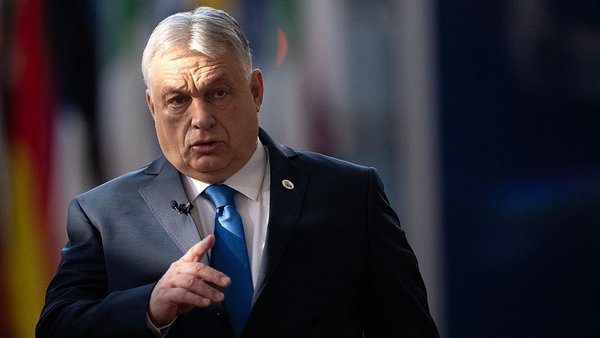
Hungarian Prime Minister Viktor Orban announced on the morning of March 25 that Budapest would gradually stop supplying gas to Ukraine. In the evening, the Hungarian Official Gazette published a package of decrees.
This is reported by the publications Telex and dpa.
“We will gradually stop gas supplies from Hungary to Ukraine and store the remaining gas at home. As long as Ukraine does not supply oil, it will not receive gas from Hungary. Since Ukraine is also attacking the southern gas pipeline supplying Hungary, we need to stock up,” Orban said.
According to experts interviewed by dpa, Hungary's blocking of gas transit to Ukraine raises serious legal issues.
Gas transportation is carried out by private companies. Some of them trade in the “blue fuel”, while others only provide its transportation. In Hungary, this is the pipeline operator FGSZ, a subsidiary of the oil and gas group MOL.
Orbán's decree prohibits Hungarian operator FGSZ from offering transit capacity to entry points into Ukraine from July.
The company has already sold capacity for the second quarter, through June. Any interference with these contracts would result in huge compensation claims for the government.
Telex notes that according to the decree, the cessation of gas supplies will not be implemented through a classic ban. Technically, the provision stipulates that the gas transmission system operator (FGSZ) cannot announce capacity auctions at crossing points across the Ukrainian border in the third quarter, i.e. from July to September. Since the basis of international gas trade is the reservation of capacities, physical transportation without it is legally and technically impossible. In other words, the gradual cessation means that the earliest when supplies can cease is mid-summer.
Another important point of the regulation is that the government mandates the mandatory internal storage of 800 million cubic meters of natural gas – approximately one-tenth of Hungary's annual natural gas consumption.
The storage obligation is distributed among several market participants. The universal service provider MVM is allocated 400 million cubic meters, the transmission system operator FGSZ is allocated 200 million, and the Hungarian Hydrocarbon Storage Association (MSZKSZ) is allocated 100 million cubic meters. Another 100 million cubic meters are allocated to competitive traders on the market. Legal enforcement of the obligations is provided by the Emergency Act.
What they say in Ukraine
Foreign Ministry spokesman Georgy Tykhy said that Hungary's decision to stop gas supplies to Ukraine will have significant economic consequences for Budapest.
He noted that according to information from relevant agencies, gas imports have not been stopped at this time.
“If Prime Minister Orban still decides to stop it, we believe that the only consequence of this will be to deprive the Hungarian economy and Hungarians of over a billion dollars that the country received, for example, last year. The only consequence will be that Viktor Orban will take this billion dollars from the pockets of Hungarians. It's his business if he wants to do it,” Tykhy said.
The Foreign Ministry spokesman stressed that Ukraine currently has the necessary volumes of gas and “knows where to get the necessary volumes of gas even if Hungary stops supplies.”
As Suspilny learned from its own sources, gas exports from Hungary to Ukraine in 2025 amounted to 3 billion cubic meters, or 45% of total imports. Currently, Hungary's share has decreased by 10%, but it still remains important, accounting for about 15% of Ukraine's total consumption.
The current situation with the Druzhba oil pipeline
On March 17, President Volodymyr Zelenskyy, in a letter to EC President Ursula von der Leyen and EU Council President Antonio Costa, confirmed that Ukraine had agreed to the European bloc's offer of financial and technical assistance in repairing the Druzhba pipeline, damaged by shelling by the Russian army.
On March 18, in a comment to Suspilny, one of the European officials reported that a technical team from the EU was already in Ukraine and was awaiting access to the oil pipeline.
On the same day, Ukrainian Foreign Ministry spokesman Heorhiy Tykhyi, commenting on the possibility of allowing European representatives to the damaged section of the Druzhba, emphasized that the SBU deals with issues of access to strategic facilities.
What is known about the Russian attack on the Druzhba oil pipeline and threats from Hungary and Slovakia?
On January 27, a Russian attack in Brody, Lviv region, damaged an infrastructure facility. Naftogaz reported that the Russian army attacked a critical infrastructure facility in the western region of Ukraine. A fire broke out, and technological processes at the facility were stopped.
According to the enkorr publication, the facility in the city of Brody, Lviv region, is connected to the Druzhba oil pipeline. This pipeline remains operational and is used to transport Russian oil to Hungary and Slovakia.
On February 12, Ukrainian Foreign Minister Andriy Sybiga said that the supply of Russian oil through the Druzhba pipeline had been suspended since January 27 due to a Russian attack. He also said that Budapest was preparing to complain about transit problems.
“Hungary did not express any protest to Russia about this. They could not even pronounce the word Russia. Double standards in all their glory,” Szibiga noted.
The governments of Hungary and Slovakia have announced the suspension of diesel exports to Ukraine until Russian oil supplies via the Druzhba pipeline are resumed.
The Ukrainian Foreign Ministry stated that Kyiv informed Budapest about the Russian shelling of the Druzhba oil pipeline in Brody, Lviv region, and the corresponding damage on January 27, and that Ukraine's accusations of delaying supplies are illogical.
The European Commission noted that they would like Ukraine to resume the operation of the Druzhba oil pipeline, but since there is a risk of repeated attacks from Russia, the decision on this should be made by Ukraine.
On February 21, Slovak Prime Minister Robert Fico said that the country would stop supplying electricity to Ukraine on February 23 if Ukraine did not resume oil transit to the country via the Druzhba oil pipeline. A similar statement was also published by the Hungarian government.
Ukraine has proposed to the European Union to use the Odesa-Brody oil pipeline as an alternative to the damaged Druzhba oil pipeline for supplying oil to the EU.
On February 27, Orban announced that Hungary and Slovakia were creating a joint investigative commission that intended to travel to Ukraine to study the condition of the Druzhba pipeline.
On March 11, it became known that a delegation from Hungary, led by State Secretary Gabor Czepek, had allegedly arrived in Ukraine to assess the condition of the Druzhba oil pipeline and resume oil transit to Hungary. Later, Zelenskyy said that he was unaware of the arrival of the delegation from Hungary to Ukraine, as the Hungarian government had not agreed with the Ministry of Foreign Affairs of Ukraine about the visit.