
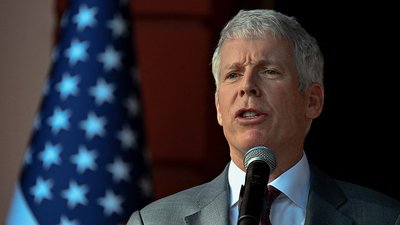
US Energy Secretary Chris Wright said on April 13 that oil prices are likely to peak in the coming weeks until shipping in the Strait of Hormuz resumes in significant volumes.
He said this at the Semafor World Economic Forum in Washington, Reuters reported.
“We will see high energy prices — and possibly even rising — until significant shipping through the Strait of Hormuz resumes. The peak in prices is likely to come in the coming weeks,” Wright said.
US President Donald Trump acknowledged on April 12 that oil and gasoline prices could remain high until the midterm elections in November. Since the start of hostilities on February 28, Iran has largely blocked the Strait of Hormuz to all but its own ships. Tehran seeks to establish permanent control over the waterway and possibly charge ships for passage, the agency notes.
Wright also reported on the situation with oil production in Venezuela. After the US detained President Nicolas Maduro on January 3, the interim government reformed the main oil law to encourage foreign investment. According to the minister, 150 million barrels of Venezuelan oil have been sold since January 3, and production has increased by 25%.
Chevron signed two agreements in Venezuela on April 13, including an asset swap that adds an extra-heavy oil production area to its main project, while returning an offshore gas field and an oil production area.
Israeli and US military operation against Iran
On February 28, Israel attacked the Iranian capital Tehran. US President Donald Trump later said that the US military had launched a “major combat operation” against Iran to “eliminate imminent threats from the Iranian regime”. He accused the Iranian government of “funding and training” militants in Syria, Lebanon, Iraq and Hamas in Palestine. According to him, the aim of the military operation is to “destroy Iran's missile industry and navy” and “ensure that the world cannot be destabilised”.
The Islamic Revolutionary Guard Corps (IRGC) said it had launched missiles and drones towards Israel, and also attacked US military bases in Qatar, Saudi Arabia and the United Arab Emirates.
The European Union said it reaffirmed its “unwavering commitment to ensuring regional security and stability” in the Middle East.
Ukrainian President Volodymyr Zelenskyy said it was fair to give the Iranians a chance to get rid of “the terrorist regime and guarantee the security of all peoples who have suffered from attacks from Iran.”
On February 28, Trump announced that Iran's Supreme Leader Ali Khamenei was dead, a claim later confirmed by the Islamic Republic News Agency (IRNA).
On March 1, the IRGC announced that it was launching “the most devastating offensive operation in the history of the Islamic Republic” against Israel and “American terrorist bases.” Trump called on the Iranian regime to abandon these plans and threatened to strike “a very strong blow” in response.
On March 6, Trump declared the need for a complete change in Iran's leadership, adding that he already had several candidates for the role of “a good leader.” On March 8, Iran's Assembly of Experts elected the son of the assassinated Ayatollah Ali Khamenei, Mojtaba Khamenei, as the third supreme leader of the Islamic Republic.
On March 26, President Trump announced that he would suspend the destruction of Iranian energy facilities until April 6. However, due to the lack of progress in concluding the agreement, Trump extended the deadline by 20 hours, until the evening of April 7.
Trump threatened to destroy all bridges and power plants in Iran, as well as take other measures that would have devastating consequences for the Iranians and provoke a dangerous response throughout the region.
On April 6, Iran provided the US and Israel with a separate 10-point plan to end the war over Pakistan.
On April 7, Trump announced that he had agreed to suspend bombing of Iran and postpone a “devastating attack” on it for two weeks if the Strait of Hormuz was unblocked. He said the ceasefire would be bilateral and that Iran's 10-point proposal was an acceptable basis for negotiations.
Iranian Foreign Minister Abbas Araqchi said that safe passage through the Strait of Hormuz within two weeks is possible “under the conditions of coordination with the Iranian armed forces and taking into account technical limitations.”
On April 11, talks between representatives of Iran and the United States were held in Pakistan. They did not agree to end the war because, according to J.D. Vance, Iran refused to shut down its nuclear program.
Trump then announced that the US Navy would begin a blockade of the Strait of Hormuz. According to Trump, the US Navy would intercept any ships that paid Iran a toll to pass through the Strait of Hormuz. He also warned that if the Iranian military began attacking American warships, the US Navy would “send the Iranians to hell.”
US Central Command announced that US forces will begin blocking all maritime traffic to and from Iranian ports on April 13 at 10:00 a.m. Eastern Time (17:00 Kyiv time).