
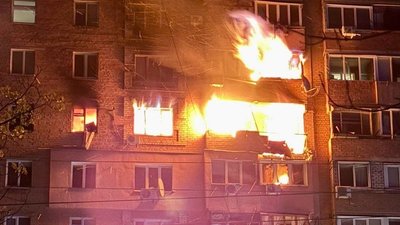
At night, the Russian army attacked the Dnieper, there are dead and wounded; Zelensky commented on the information about renaming Donetsk Oblast to “Donniland”; Budanov shared his opinion on the free sale of weapons to other countries; an evacuated Ukrainian child was illegally adopted in Italy; the SBU is investigating the executions of over 300 Ukrainian prisoners of war — Suspilne collected the main news on the morning of April 23.
Attack on the Dnieper
On the night of April 23, Russian troops struck the Dnieper River. The drone hit a residential building, a car and a store were also set on fire. The head of the regional military administration, Oleksandr Ganzha, reported the death of two people and the injury of eight others. Among the injured were two children: girls aged 9 and 14, who were taken to the hospital. Three adults were hospitalized. Doctors assess their condition as moderate.
EU ambassadors launch procedure to approve €90 billion loan for Ukraine and 20th sanctions package
Ambassadors of the European Union countries have launched a written procedure to approve the allocation of a 90 billion euro loan for Ukraine and the 20th package of sanctions against Russia. This is reported by a correspondent of Suspilny.
The format of the procedure is as follows: representatives of the European Union countries sign the approval of the loan for Ukraine and sanctions against Russia. The written procedure is expected to be completed today in the afternoon.
President Volodymyr Zelenskyy reported that the main expectations from the EU summit, which will take place on April 23, are the unblocking of a 90 billion euro loan for Ukraine, the adoption of the 20th package of sanctions against the Russian Federation, and the opening of negotiation clusters within the framework of the EU accession process.
The main thing is that it's not Putinland — Zelensky
President Volodymyr Zelenskyy commented on a New York Times article that discussed the renaming of parts of the Donetsk region to “Donnyland” and the use of this term during negotiations.
“ Well, during my negotiations, there were no other terms than Donetsk region, Luhansk region, our Donbas – the territory of Ukraine, accordingly, there are documents in which all this is stated,” Zelenskyy said.
At the same time, he added that he could not comment on any dialogues of a different nature between the parties that concern other names.
“In my opinion, the main thing is that the Donetsk region, the Luhansk region remain Ukrainian land, and that's how it is, so that there is no “Putinland”. This, I think, is the most important thing,” the president said.
Context: The New York Times previously reported, citing sources, that during the negotiations, Ukraine allegedly put forward the idea of naming the Kyiv-controlled part of Donbas “Donnieland” in honor of US President Donald Trump. According to the publication, such an idea was seen as an attempt to interest the Trump administration in “more decisively opposing Russia's territorial claims.”
Budanov — about free arms exports
Head of the Presidential Office Kyrylo Budanov stressed that in the “hot phase of the war” the free sale of weapons is impossible. At the same time, he noted that Ukraine can export only those types of weapons that are in surplus, in particular, naval drones, long-range UAVs and early models of FPV drones.
“Free sale of weapons in the hot phase of the war is impossible. Neither our military on the front lines nor our Western partners, from whom we ourselves ask for weapons, will understand this. I believe that only what is in sufficient surplus, such as naval drones, can be freely sold. We can also export weapons that are almost no longer used in our war, but are in great demand in Asian or African countries. These are, for example, some long-range UAVs or early models of FPV drones,” Budanov wrote.
According to him, it is very important to prevent uncontrolled leakage of technologies. He emphasized that Ukraine has no right to allow unique developments to enter the Russian Federation through the sale of finished products or the creation of dubious “subsidiaries.”
“I called on manufacturers to focus now on integrating artificial intelligence. Implementing AI and developing their own control systems is the only way to maintain the status of legislators in the field of unmanned technologies,” the head of the OPU wrote.
Evacuated Ukrainian child illegally adopted in Italy
The Verkhovna Rada Commissioner for Human Rights Dmytro Lubinets is demanding an appeal against the decision of the juvenile court in the Italian city of Lecce regarding the adoption by foreign citizens of a Ukrainian child who was evacuated to Italy in 2022.
“The child, a citizen of Ukraine, was evacuated to the Italian Republic in 2022. Evacuation is temporary protection. Instead, the juvenile court of Lecce (Apulia region) decided to adopt her by foreign citizens,” Lubinets wrote.
He noted that the child's father disappeared while defending Ukraine, while her mother is alive and not deprived of parental rights. The child was also separated from her siblings, who have already returned to Ukraine. He stressed that this is “a deliberate destruction of the family, a violation of the child's right to maintain family ties, and a disregard for international law.” According to him, the Italian court did not take into account the real participation of the parents in the case, limiting itself to the formal recognition of their “absent-attendance”, including the father.
Lubinets recalled that Ukraine has a moratorium on intercountry adoption to protect evacuated or forcibly displaced children. He explained that in this way the state wants to protect children whose parents are currently at the front or are considered missing under special circumstances.
In addition, the Italian court's decision was preceded, according to Lubinets, by systemic violations – the removal of Ukrainian legal representatives, the appointment of foreign guardians, and restrictions on Ukrainian diplomats' access to children. He noted that similar problems are also being recorded in Germany and Switzerland.
SBU investigates executions of Ukrainian prisoners of war
From February 2022 to April 2026, 116 criminal proceedings are being investigated on the facts of the executions of 306 Ukrainian prisoners of war on the battlefield. This was stated by the Chief Investigative Department of the Security Service of Ukraine, Andriy Shvets, in an interview with Censor.NET.
“Investigating crimes against prisoners of war is a priority and at the same time one of the most difficult areas of our work. To date, thousands of cases of violations of the laws and customs of war have been documented, specifically concerning the cruel treatment of prisoners of war, torture and, unfortunately, extrajudicial executions of our military on the battlefield and during their capture by servicemen of the aggressor's armed forces. We register all these facts with legal qualification as war crimes,” said Shvets.
According to him, the most massive and brutal cases of extrajudicial executions of servicemen are recorded in the Kursk and Donetsk directions . The most brutal methods of execution are also noted here. The investigator added that the executions of Ukrainian military personnel by Russian servicemen are systematic and large-scale, and are actually sanctioned by the Russian political leadership.
Shvets said that after the start of the Kursk operation in 2024, the Russian leader emphasized in his speech that all Ukrainian servicemen participating in this operation “are terrorists and subject to physical destruction.”
“Such actions of the aggressor's servicemen were later marked by encouragement from the Russian military leadership for their actual commission of war crimes,” Shvets noted.
As of April 15, 2026, nine Russian servicemen have been reported as suspects. Indictments have been filed against seven individuals, and five have already been convicted.