
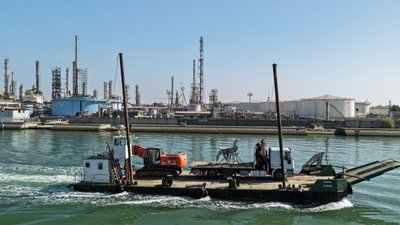
The Venice Biennale 2026 will open to the general public on May 9. Ukraine is represented this year by Zhanna Kadyrova's project “Security Guarantees”, which will be implemented in two locations – and for the first time in the history of the Ukrainian Pavilion, its main part will be shown at the entrance to the Giardini della Biennale, the main location where the event takes place.
Public Culture tells what else the pavilion will be remembered for and how it fits into the main concept of this year's biennale.
What is “Safety Guarantees” about?
Although this is Zhanna Kadyrova's first solo project within the National Pavilion of Ukraine at the Biennale, it is not the artist's first presence at the competition. The artist represented Ukraine in collective projects in 2013 and 2015. However, what is also important, in 2017 the artist took part in the main exhibition “May You Live in Interesting Times” within the framework of the 58th International Biennale (2019). Then the curator Ralph Rugoff, the current director of the Hayward Gallery in London, selected her works “Market” and Second Hand for the exhibition.
For the co-curator of the pavilion, Ksenia Malykh, this is also not the first experience of working within the framework of the Venice Biennale – before that, she had worked with various teams as a project manager for more than one year (for example, the national pavilion of Ukraine in 2019 – “The Falling Shadow of “Mriya” on the Giardini Gardens”, where the curators were the “Open Group” with the participation of Anton Varga, Yuriy Biley, Pavlo Kovach Jr. and Stanislav Turina.
This previous experience helps to better navigate the competition, but also – most importantly for a foreign audience – it works on visibility, because in conditions of extremely strong and large competition it is very easy to go unnoticed. This risk remains especially strong for countries that do not have a presence in the main locations and whose exhibitions are scattered throughout Venice.
This year, Ukraine has two locations: Arsenale, Sale d'Armi, building A, floor 1 — a familiar location for the pavilion, which Ukraine has been receiving from the Biennale since 2022 under special conditions; and at the entrance to the Giardini della Biennale — this location is the first in Ukraine. It is there that the sculpture “Origami Deer” will be placed, which Zhanna Kadyrova created for Pokrovsk in the Donetsk region in 2019, but with the escalation of hostilities was forced to evacuate to Vinnytsia — she was helped in this by the project “Museum Open for Renovation” and the project co-curator Leonid Marushchak.
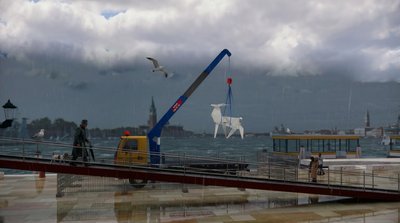 Visualization of the exhibition of the sculpture “Origami Deer” in the public space of Venice. Courtesy of the Ukrainian Pavilion team
A 2.6-meter-tall, 700-kg deer sculpture will be placed in a public space on a truck crane, symbolizing the suspense and uncertainty, fragility, and risks for art and culture in times of war.
In the artist's practice, such imagery and work with materials is not unique. Kadyrova often scales up what is lost or at risk of destruction. Notable here is her work with old tiles that previously framed the walls of factories and other iconic buildings.
The image and form of origami are also not new to the author. She turned to this idea in 2018 as part of the Porto Franko festival, where, in collaboration with Denis Ruban, she created “Origami” in the form of a swan from rebar and concrete.
“Origami Deer” was created for Pokrovsky Park “Yuvileyny” to replace a dismantled Soviet Su-7 jet aircraft that was a carrier of nuclear weapons.
The sculpture stood in the public space of the park for five years, and was removed in 2024 during the forced evacuation of the population.
This work is built on contrast – between the white, light paper from which the artist actually folded the origami deer, and the giant concrete object in space into which it has transformed. Between lightness, transience and permanence and strength.
However, the contrast concerns not only the material, but also the concept and idea itself. In the Biennale space, it will be placed on a pedestal in an unfinished state: it will not be clear to the audience whether it is in the process of being installed and should be placed/returned, or whether it is being taken away and taken back to a safer place. The ease of life turns into the heaviness of emigration and displacement; everything becomes fragile – even concrete structures of houses and entire cities; war destroys everything: stable institutional ties, urban and intercity infrastructure, everything that seems solid and immovable can suddenly turn into ashes.
This refers to the themes of loss, migration, uncertainty, and the fragility of the world, which have been actively represented at the Biennale in recent years and remain in the spotlight this year.
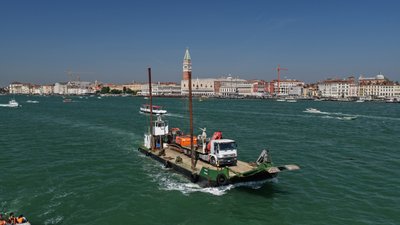 The sculpture “Origami Deer” will become the central object of the Ukrainian Pavilion at the 2026 Venice Biennale. Leonardo Mizar Vianello/courtesy of Suspilne Kultura
When thinking about “Origami Deer”, one cannot help but recall the legend of “A Thousand Cranes” and the idea of peace associated with it.
“Origami Deer” also raises questions about the consequences of war and the large-scale destruction it brings, the ever-present nuclear threat, and many other challenges.
That is why the Ukrainian Pavilion in the Arsenal will house archival materials related to the Budapest Memorandum, as well as video documentation of the evacuation of the sculpture and its journey to Venice, created with the participation of Natalka Dyachenko, Pavel Sterets, and Max Masl.
“The video production began with us filming the first day of the sculpture's dismantling from its real pedestal and departure from Pokrovsk. Based on this material, we created a short film about its evacuation (“IDP”). And then, when we decided to do a tour of Ukraine and a tour of Europe, we continued to film all this. In Venice, we plan to show this material in the format of a 28-channel video installation, where each day of the sculpture's journey will be shown on a separate screen at the same time. The main idea of this documentation is to show the movement of the sculpture and the distance it has covered,” says Kadyrova.
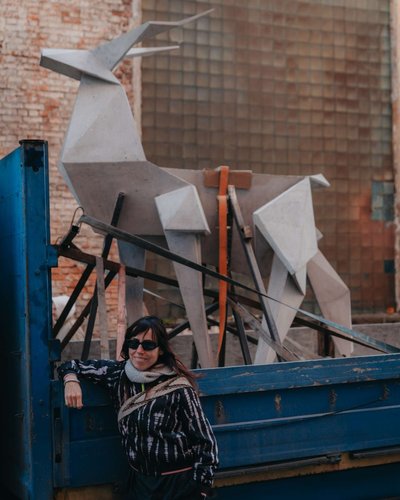 Zhanna Kadyrova and the sculpture “Origami Deer”. Facebook/Galleria Continua
“The importance of our message is that we are telling you that Russia is destroying Ukrainian cities, Ukrainian culture, people are forced to wander around the world as displaced persons, refugees. And the sculpture is such a collective example, because the sculpture was created as a permanent work and the fact that it began to travel around the world is exclusively due to circumstances related to Russian aggression. And why is it important? Because this is our reality today. The war continues, the destruction of culture, the civilian population, and cities continues. And using the example of this sculpture, using the example of its history, using the example of the fact that it was created on a pedestal from a military aircraft that carried nuclear weapons, we touch on the issues of security guarantees, the Budapest Memorandum. That is, we are talking about both the past and the future. First of all, we ask the question of what can be the guarantees of security at the present moment – not only for Ukraine, but for the whole world,” she adds.
The road to Venice
An important part of the Ukrainian project was its public program and the path of work of “Origami Deer” through Europe.
The sculpture's journey began in October 2025, when it was shown in four cities of Ukraine (Kyiv, Yasinya, Ivano-Frankivsk, Lviv). And in March 2026, the public program of the Ukrainian Pavilion at the 61st Venice Biennale “Ukrainian Pavilion: Zhanna Kadyrova's “Origami Deer” on the Way to Venice” was launched, which took place in:
- Warsaw, (Center for Contemporary Art “Ujazdowski Castle”, Foundation “Ukrainian House”);
- Vienna (MuseumsQuartier Wien);
- Prague (Galerie Rudolfinum);
- Berlin (daadgalerie, Künstlerhaus Bethanien, CTM festival, Vitsche Berlin, Cashmere radio);
- Brussels (European Parliament, Bozar, Embassy of Ukraine in the Kingdom of Belgium, Kiosk radio);
- Paris (UNESCO Headquarters, Galleria Continua, KOLO Community Space).
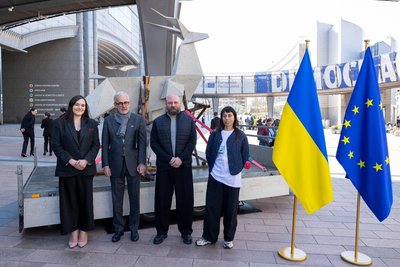 “Origami Deer” in the European Parliament. Minister of Culture Tetyana Berezhna (left) and artist Zhanna Kadyrova (right). Ukrainian Pavilion at the Venice Biennale/Ukrainian Pavilion in Venice
“In almost every city, people from Pokrovsk came to us, they came from different parts of Europe to repeat the photo they had in Pokrovsk, to touch the sculpture and make a wish to return home. It was a meeting point for people – for us it was the most important thing in this tour and very touching,” says Katya Himey, co-curator of the public program of the Ukrainian Pavilion at the 61st Venice Biennale.
“The audience was often struck by how close the consequences of the Russian offensive on Pokrovsk were to them. Through the appearance of the concrete sculpture at recognizable tourist locations, visitors were able to experience part of the forced displacement of “Origami Deer”, along with its author Zhanna Kadyrova,” adds Ivanna Kozachenko, co-curator of the public program of the Ukrainian Pavilion at the 61st Venice Biennale.
The public program, scheduled for September 2026, will focus on the disarmament processes in Ukraine in the 1990s, the transformation of nuclear power plants into an instrument of military pressure, modern nuclear blackmail, and will also problematize the priority of protecting the interests of nuclear powers in attempts to regulate global security.
How will Russia's participation affect Ukraine's presence?
“There is a threshold [of aggression] beyond which participation in the Biennale should not be normalized,” curator Koyo Kuo is quoted as saying by Oliver Basiano, editor-in-chief of ArtReview, emphasizing the impossibility of considering art without bypassing the political context.
But with the debate over the biennale, it has become clear that Russia will not be excluded. The Russian pavilion will only be open for four days during preview screenings — from May 5 to 8 and only for professionals — after which it will be closed until the end of the exhibition on November 22, according to Artslooker.
At the same time, the international jury of the Venice Biennale resigned collectively on April 30. The decision was made “in light of their previous statement of intent,” published on April 22, 2026. There, the jury announced its intention not to consider for awards the national pavilions of countries whose political leaders have been indicted by the International Criminal Court for war crimes or crimes against humanity. The media linked this decision, in particular, to Russia and Israel.
 A view of the closed Russian pavilion during a press conference at the 59th Venice Biennale, April 20, 2022. Getty Images/AFP/Vincenzo Pinto
The co-curator of the pavilion, Ksenia Malykh, emphasizes that in fact the Biennale has never denied Russia its presence: in 2022, the curators of the Russian project themselves refused to participate in the competition, and at the next Biennale, Russia handed over its pavilion to Bolivia. And this time it returned with its own project, which the Biennale cannot cancel – such regulations and rules do not currently exist, but the appearance of such rules would mean reviewing the presence of other aggressor countries in the competition. According to Malykh, threats of not receiving a European grant are also ineffective, because the Biennale has a stable financial system that relies on private funds and contributions. However, she sees a great role for solidarity among other countries, especially the Baltic region.
Despite the ambiguity of certain decisions and statements, the Biennale itself expresses its constant support for Ukraine. This is manifested, in particular, in the fact that they provide premises and spaces for the Ukrainian project free of charge.
Although the reaction to Russia's participation is already quite visible and strong, Malikh expects various protests in the days leading up to the opening of the competition, but emphasizes that there will be none from the Ukrainian pavilion. After all, the main goal of the pavilion is to draw attention to Ukraine.
“For example, the 'good' Russians said they would protest – we're talking about Pussy Riot. So I think there will be a lot of noise, and I'm already sad about it, to be honest. Because there will be a lot of attention there. We are doing it, putting all our efforts, all the media attention into the Ukrainian project,” she says.