
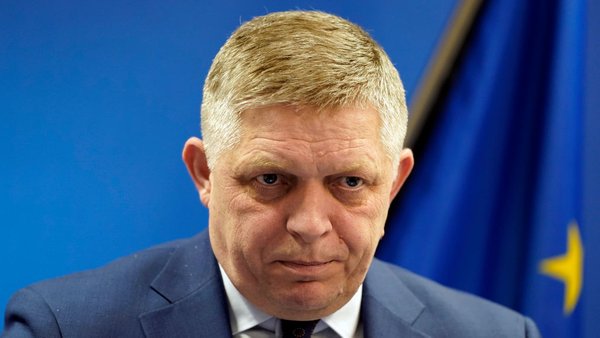
Slovak Prime Minister Robert Fico said he had accepted Volodymyr Zelensky's offer to meet to discuss “all aspects of Ukrainian-Slovak cooperation.” At the same time, he noted that he would like to do so in the territory of one of the EU member states.
He wrote about this on the social network X following a telephone conversation with Volodymyr Zelensky.
“I accepted this invitation and addressed the Administration of the Government of the Slovak Republic and the Ministry of Foreign and European Affairs of the Slovak Republic with a request to find a suitable date for such a meeting in cooperation with the Ukrainian side, although I prefer a meeting with the President of Ukraine on the territory of one of the EU member states that the President of Ukraine often visits,” Fico noted.
According to him, he asked Zelenskyy to inform him when and whether oil transit through Ukraine to Slovakia will be resumed.
“I argued that we have the legal right to such imports, based on signed agreements with suppliers, as well as the EU decision that allows the use of energy resources from Russia until the end of 2027,” the Slovak Prime Minister wrote.
At the same time, based on the results of the conversation, he got the impression that “the Ukrainian side is not interested in resuming oil transit through the territory of Ukraine.”
“I informed the president (Volodymyr Zelenskyy – ed.) that his decision to stop the oil transit is causing us logistical difficulties and economic losses. The conversation confirmed that we have different views on the condition of the pipeline. Although our intelligence confirms that the pipeline is not damaged and nothing is preventing the transit of oil, the President of Ukraine insisted that repairing the pipeline will take a long time,” Fico wrote.
He also noted that Ukraine has so far not allowed the Slovak ambassador to inspect the pipeline, denying even a European Union diplomat such access. According to him, Zelensky “rejected such inspection activities, citing the negative position of Ukrainian special services.”
“For this reason, in order to avoid misunderstandings, I informed the President of Ukraine that, together with the Prime Minister of Hungary, Viktor Orban, we propose to create an inspection group consisting of experts appointed by the European Commission and EU member states, which would directly determine on-site the actual state of technological damage to the pipeline or its ability to continue the transit of oil to the territory of the Slovak Republic,” Fico added.
As a reminder, on February 27, President Volodymyr Zelenskyy had a telephone conversation with Slovak Prime Minister Robert Fico, during which he invited him to visit Ukraine to discuss all existing issues.
What is known about the Russian attack on the Druzhba oil pipeline and threats from Hungary and Slovakia?
On January 27, a Russian attack in Brody, Lviv region, damaged an infrastructure facility. Naftogaz reported that the Russian army attacked a critical infrastructure facility in the western region of Ukraine. A fire broke out, and technological processes at the facility were stopped.
According to the enkorr publication, the facility in the city of Brody, Lviv region, is connected to the Druzhba oil pipeline. This pipeline remains operational and is used to transport Russian oil to Hungary and Slovakia.
On February 12, Ukrainian Foreign Minister Andriy Sybiga said that the supply of Russian oil through the Druzhba pipeline had been suspended since January 27 due to a Russian attack. He also said that Budapest was preparing to complain about transit problems.
“Hungary did not express any protest to Russia about this. They could not even pronounce the word Russia. Double standards in all their glory,” Szibiga noted.
The governments of Hungary and Slovakia have announced the suspension of diesel exports to Ukraine until Russian oil supplies via the Druzhba pipeline are resumed.
The Ukrainian Foreign Ministry stated that Kyiv informed Budapest about the Russian shelling of the Druzhba oil pipeline in Brody, Lviv region, and the corresponding damage on January 27, and that Ukraine's accusations of delaying supplies are illogical.
The European Commission noted that they would like Ukraine to resume the operation of the Druzhba oil pipeline, but since there is a risk of repeated attacks from Russia, the decision on this should be made by Ukraine.
On February 21, Slovak Prime Minister Robert Fico said that the country would stop supplying electricity to Ukraine on February 23 if Ukraine did not resume oil transit to the country via the Druzhba pipeline. The same statement was also published by the Hungarian government.
Ukraine has proposed to the European Union to use the Odesa-Brody oil pipeline as an alternative to the damaged Druzhba oil pipeline for supplying oil to the EU.
On February 23, Fico stated that Bratislava had stopped electricity supplies to Ukraine because the Ukrainian authorities had stopped oil transit through the Druzhba oil pipeline.
At that time, Ukrenergo stated that the probable termination of emergency electricity supplies from Slovakia would not affect the situation in the unified energy system of Ukraine. However, the company did not receive official documents on the termination of the contract from the Slovak side.