
Main points
- The situation in the Strait of Hormuz has become more complicated due to statements by the US and Iran, which has affected the global oil market.
- Donald Trump is trying to get out of the conflict with Iran, but this is impossible without a resounding victory, which has led to new tensions.
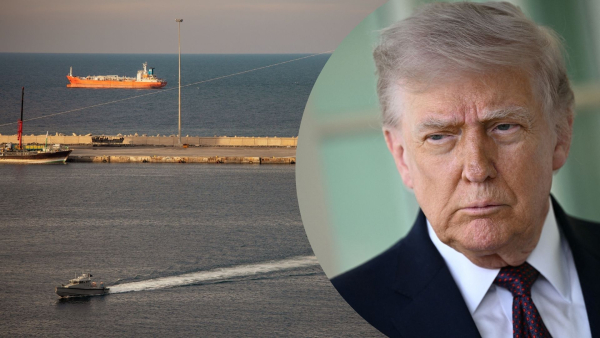
The situation around the Strait of Hormuz has become increasingly complicated after new statements by the US and Iran. Negotiations have stalled again, and the strait itself has found itself under double pressure, which is affecting not only the region but also the global oil market.
Political analyst Petro Oleschuk explained on Channel 24 that Donald Trump is trying to get out of this conflict, but he cannot do it without a resounding victory. To do this, according to him, Washington took a step that was supposed to increase pressure on Iran, but created a new dangerous game for both sides.
The Strait is simultaneously blocked by the US and Iran
There has been no global turnaround in this story yet, but the information chaos has only intensified. First, Iran announced that it was unblocking the Strait of Hormuz, then the United States made it clear that it would continue the blockade anyway, and then Tehran returned to a tougher position and explained this by the fact that Washington was violating its own ceasefire conditions.
Recall: Iran has refused a second round of talks with the US, citing Washington's excessive demands, constant changes in position, and a naval blockade. Tehran believes that the situation is heading towards a new round of escalation.
At the same time, Donald Trump was saying that the agreement was almost reached and that Iran had supposedly accepted all the demands, then he was again threatening to destroy Iranian infrastructure, and the story of the second round of negotiations was also falling apart into contradictory statements.
The reflection of this entire process in Donald Trump's statements, if it reflects reality, is perhaps one to two percent off.
– Oleshchuk noted.
If we put aside these public statements and look only at the positions of the parties, now both the US and Iran are effectively closing the strait simultaneously. The parties are not just exchanging threats, but have already created a mutual blockade, with each trying to strike at the most sensitive source of pressure for the other.
Iran blocks everyone except those with whom they have agreements, and the United States blocks those who transport Iranian oil,
– the political scientist emphasized.
Because of this, the whole story of postponed negotiations, new ultimatums, and mutual threats does not yet look like a move towards an agreement. Rather, it is a situation in which both sides are simultaneously raising the stakes and trying to force the other to give in first.
Trump is in a hurry, Iran is stalling
The main thing now is not only who is blocking the Strait of Hormuz, but also that the United States is looking for a way out of the conflict without an outright defeat. Donald Trump wants to end this war, but he cannot simply declare an exit, because he needs an outcome that can be presented as a victory. In Washington, such a victory is seen in taking away Iran's enriched uranium and reducing its ability to move towards nuclear weapons.
Trump is ready, in principle, to get out of this war. Moreover, he wants to get out of it. He is tired of it, it brings him nothing,
– Oleshchuk noted.
Iran is not making such concessions and is using the blockade of the Strait of Hormuz as its counterargument in the negotiations. In response, the US has put on additional pressure and actually tried to block the strait for Iran itself, in order to cut off its oil revenues and force it to agree more quickly. But Tehran sees a different logic: delaying the deal works for them, because the longer this game goes on, the more oil prices will rise, and this will hit Trump himself.
Now Iran believes, and rightly so, that time is running out for it, so it needs to stall for time.
– the political scientist emphasized.
Because of this, one side tries to press quickly, while the other plays for attrition and waits for the pressure to start hitting the opponent.
Trump is in a hurry and is trying to use any tools of pressure – from psychological to military or economic. And as a result, everyone loses, except for one person in the whole world, whose name is Vladimir Putin,
– the political scientist concluded.
What is known about the escalation around the Strait of Hormuz?
- Donald Trump has reacted sharply to Iran's actions in the Strait of Hormuz, threatening to destroy every power plant and bridge in the country if Tehran does not agree to US terms. He also said that closing the strait hurts Iran more than the US.
- On April 18, the Islamic Revolutionary Guard Corps threatened to target any vessel approaching the Strait of Hormuz, following reports of attacks on at least three civilian vessels following a previously announced ceasefire.
- Trump announced that the US Navy had intercepted the Iranian vessel Touska in the Gulf of Oman, which was trying to break the blockade. According to Western media, the ship could be involved in transporting chemicals for Iran's missile program.