
Main points
- American journalist Zarina Zabriskie described the horrific living conditions in Kherson under Russian attacks, including a “human safari” using drones.
- In the occupied territories of the Kherson region, there is a humanitarian crisis with a lack of food, water, and medical care, as well as the use of fear and terror as a means of population control.
- 1 “I was hunted”: shocking details of the “human safari” in Kherson
- 2 “The city is covered with fiber optics”: how does Kherson protect itself from drones?
- 3 “People are losing limbs because of them”: what kind of mines is the enemy dropping in the city?
- 4 “I prayed they wouldn't kill me”: how do the Russians intimidate civilians in the occupation?
- 5 “Bodies are lying right on the street”: what is happening on the left bank of the Kherson region?
- 6 “The Russians Beheaded Her”: About the Most Terrifying Moment in the War
- 1 “I was hunted”: shocking details of the “human safari” in Kherson
- 2 “The city is covered with fiber optics”: how does Kherson protect itself from drones?
- 3 “People are losing limbs because of them”: what kind of mines is the enemy dropping in the city?
- 4 “I prayed they wouldn't kill me”: how do the Russians intimidate civilians in the occupation?
- 5 “Bodies are lying right on the street”: what is happening on the left bank of the Kherson region?
- 6 “The Russians Beheaded Her”: About the Most Terrifying Moment in the War
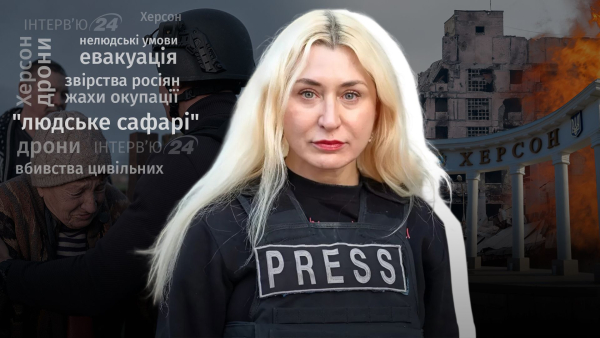
American journalist Zarina Zabriskie has been living in Kherson for over three years and has been covering the horrors of the Russian-Ukrainian war for a foreign audience. In particular, she tells foreigners how the Russians are organizing a “human safari” in Kherson, hunting civilians with drones. The journalist, living in the center of Kherson, was also targeted by the occupiers.
In an interview with Channel 24, Zarina Zabriskie told how Kherson residents survive under constant drone hunting and what horrors are happening in the occupied part of the Kherson region. Read more in the article for details.
“I was hunted”: shocking details of the “human safari” in Kherson
You are the only foreign journalist who permanently resides in Kherson. Why this city and what is the situation there now?

I am the only one who lives in Kherson. Fortunately, many of my wonderful colleagues come to us to do reporting, and I always try to help them. It is not an easy job. However, every city in Ukraine deserves and needs at least one foreign journalist to spread information in the English-speaking world. And it so happened that Kherson did not have one. And this turned out to be the right place for me.
Then, after living there for 3 years, I just fell in love with the city. Now it's a part of me, and I hope I'm a part of the city. And as the situation gets worse, we need more and more of this kind of reporting. So when I'm not traveling to present a film, information at international conferences, or to address governments to defend interests, I'm on the ground every day reporting on the worsening attacks.
This is a truly beautiful city, where, unfortunately, the Russians are conducting “human safaris.” Enemy drones are chasing cars, animals, and anything that moves in the city. What was your reaction when you first saw a drone chasing a person or a civilian car? How did this situation change your understanding of Russian brutality towards civilians?
It was one of the most extraordinary events in my life. Events developed suddenly. One month we were being shelled by a large number of artillery, guided aerial bombs, mortars, tanks, covering every street of Kherson. Then we started hearing another sound – very distinct. At first it sounded like a lot of angry wasps, and then it sounded like boards falling from a truck.
I clearly remember the first time I heard it. My friend from Kherson said, “Haven't you heard this before? It's a skyfall.” Skyfall means something literally falls from the sky. And I didn't hear it. It took me a while to believe that something like that could happen. And when I realized that it was really happening and I was investigating, I started writing about it. And no editor wanted to believe it.
Full interview with the journalist: watch the video
Later I had to talk to psychologists who explained that this is a defense mechanism of the psyche: the realization that a person can hunt like a wild animal causes such moral damage to the human psyche that the reaction is denial. And editors are people. So, except for the two newspapers for which I write regularly, Euromaidan Press and Byline Times, other editors simply could not believe it.
They wanted me to bring them evidence. They wanted a good photo or video of the drone attack on me. And I said, “That's impossible, because this will be the last photo I take, and I'm gone. I can't send it to you. They'll kill me. They can see you through the lens.”
Let me explain for those who are completely unfamiliar with this phenomenon, no one should be familiar with it, to be honest. So, on the other side of the river there are operators (Russian UAV operators, – 24 Channel), and the river in this place is only a little less than a mile, about a kilometer wide. So it is very narrow, and the operators on the other bank could clearly see their target.
They know it's a woman. They know that sometimes it's a child and sometimes it's a goat. It could be anything, because they're practicing. And it started to spread everywhere more and more often.
Of course, living in the city center, I was one of those who were hunted . We all try to avoid drones when we move. So in the summer we hide under a tree, and in the winter we look for the nearest door and learn to navigate the streets that way. That was my story of “human safari.”
This was a term that I, unfortunately, heard for the first time and translated into English. It is the newest war crime. And as reports from the United Nations and Human Rights Watch have shown, it is not just a war crime – it is a crime against humanity.
“The city is covered with fiber optics”: how does Kherson protect itself from drones?
This is the Ukrainian reality, and these are terrible things. Do you have drone detectors that beep when they fly or something like that?
We do, but technology changes every week. So in the last three months or so, our drone detectors, which are quite expensive and hard to get at first, have become obsolete because we've gotten used to them. Previously, the Russians used to send analog drones, regular FPV, that is, first-person view drones, to attack Kherson and the surrounding area. However, the military that is defending Kherson, the Ukrainian military and the authorities, have developed a very powerful defense system.
So we have anti-drone tunnels, but we also have electronic defenses called electronic warfare (EW) systems. And these systems have started to stop drones in flight, so they actually become disoriented and fall.
Important! Over the past year, the nature of attacks on Kherson has changed significantly. Since mid-2025, the Russians have been attacking the city mainly with FPV drones, partly Mavic and Molniya. To counter this threat, some streets have been covered with anti-drone nets. Special groups are also operating in the city, trying to shoot down drones with small arms.
And the next step in the evolution of drone warfare was fiber-optic drones. So now most of the drones that attack Kherson residents fly on these very thin threads. They look like a spider's web. The whole city, trees and parks are covered in this “spider's web”. Wherever you look, you can see these small thin threads everywhere, shining in the sun, especially when it shines brightly. It's very surreal.
But the problem is that drone detectors can't do anything against these fiber-optic UAVs. So they fly everywhere, attacking people. And yet we don't have a reliable way and technology to stop and detect such drones.
“People are losing limbs because of them”: what kind of mines is the enemy dropping in the city?
In one interview you mentioned that the Russians are conducting remote mining with various types of mines, right?
Yes. They use them all the time – both in Kherson on the right bank of the Dnieper and on the left bank. In the occupied territories, a separate tragedy is taking place. However, they use different types of anti-personnel mines.
At first it was mostly “Petals” because they look like petals – small, hard to see. I was shooting a scene for my second film once and I almost stepped on one because I was moving backwards. A lot of people I know have stepped on them and lost limbs.
Now the Russians often use “Gingerbread” mines, which are round. The occupiers also apply camouflage to them to make them harder to see. Often, when there are piles of leaves, it is impossible to see the mines there . So that is the danger.
Important! The Gingerbread anti-personnel mine is a more modern Russian invention than the Petal. Presumably, the occupiers began using them due to a shortage of the latter. The Gingerbread body is printed on a 3D printer, it is plastic, and inside is an explosive and a detonator. These mines are inconspicuous and almost always lead to the amputation of a limb in a person who steps on it.
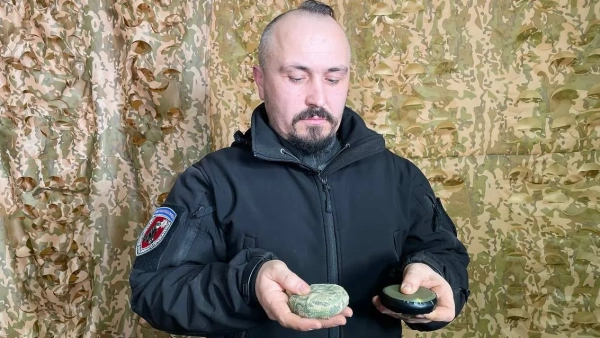
Police showed what the Russian “Pryanyk” mine looks like / Social
“I prayed they wouldn't kill me”: how do Russians intimidate civilians in occupation?
The occupied coastal areas of the Dnieper River on the left bank of the Kherson region, including Oleshky and Hola Prystan, are currently facing a humanitarian catastrophe due to constant UAV attacks. How do you assess the scale of this crisis, given the reports of a complete lack of food, drinking water, medicine, and electricity for the civilian population in these areas?
The left bank has been occupied since 2022. The right bank was occupied for 9 months after the start of the full-scale invasion, and was liberated in November 2022, pushing the Russians across the river. However, in reality, this is one territory.
The Russians are shelling the Ukrainian-controlled part of Kherson, i.e. the right bank, with FPV drones, artillery, KABs and mortars. According to the latest report, analog drones and fiber-optic ones are attacking Kherson residents 24/7 at a speed of about 20 kilometers per hour, 385 times a day, 2,700 times a week.
On the other side, in the occupied territory, which, logically, should be “a little more peaceful,” because the Russians claim this territory as theirs. They even included it in their constitution. They claim that it is now Russia, which, of course, is untrue. There was a fictitious referendum, so these are occupied territories.
However, the Russians are terrorizing the Ukrainian civilian population in these areas just as they terrorize the Ukrainians on the other side of the river. What are they doing? They are hunting with drones. Why are they doing this? There are many reasons.
First of all, we must remember that we are talking about the Russian military. All human logic does not work here. The question of “why” is a bit outdated. The Russians send their operators there, who study in schools in Moscow and Rostov-on-Don. They use these areas – Oleshki, Gola Prystan, Novaya Zbur'yovka, Staraya Zbur'yovka – for training.
I was communicating with people through my own channel from Oleshki and Holaya Prystan. It was not easy to get this information, but I have reports that Russian drone operators were attacking people with fake explosives . The drone would come in, drop the fake explosive, then the pilot would come in, pick it up, and then they would target the same vehicle or the same person.
There are many similar reports. One woman told me a story from the occupied territory in Oleshki. She was working in her garden, and at that moment a drone flew over. She fell to her knees and began to cross herself, looking up and praying that the drone would not kill her. The drone “looked” at her, that is, the operator through the lens, and flew away.
But the next day, a Russian pilot or military man passed by her garden, and he looked at her. He looked into her eyes, crossed himself, and winked. And when she told me this, she cried and trembled. And, to be honest, I did too.
There are other reasons why the Russians do this – they use fear as a weapon . They terrorize to control. They actually do it in their own country because the population of Russia lives in constant fear. So it is a tool of control.
There is also a possible scenario, as we know in other occupied territories, say, in Mariupol or Luhansk, in Donetsk region, when the Russian authorities take and transfer the property of deceased Ukrainians to Russian citizens who move to these areas. So it is actually in Russia's interests to get rid of these people (Ukrainians, – 24 Channel).
There is also a reason to keep them there under their control. They are used as human shields. This is what the military on the Ukrainian side tells me, because I just had a great interview with the commander of the 34th Brigade, who explained that it would be much easier for the Ukrainian military to attack and actually clear the occupied coastal areas of the Russian presence if there were no civilians there.
After all, the Ukrainian military does not do what the Russians do. They do not attack civilians. They do everything possible to save these lives. The Russians know this and are holding several thousand people to protect their military from Ukrainian attacks.
“Bodies are lying right on the street”: what is happening on the left bank of the Kherson region?
On April 18, the Verkhovna Rada Commissioner for Human Rights, Dmytro Lubinets, called on the international community to move from statements to concrete actions, in particular regarding access for international missions. What are the key obstacles preventing international organizations from gaining access to these occupied territories? And how can the international community ensure effective response mechanisms?
I want to comment on this statement by Dmytro Lubinets. It was based not only on drone attacks, but also on the results of drone operations. And this is exactly what we are considering in the occupied territories of the left-bank Kherson region.
Since December last year, that is, for 5 months now, several thousand people have been living without food supplies. They have no drinking water, no access to technical water. There are a few wells left in private homes, but there are no pumps because the generators cannot work. There is no gas, no gasoline for the generators, no electricity.
The hospital has long ceased to function, there is no medicine. There is a health crisis, which has led to a very high mortality rate. The winter was very harsh. The temperature was very low. Therefore, many civilians, most of whom were elderly or in poor health, died in their apartments and on the streets . And the Russians did not allow the Ukrainians to bury the dead.
We know that this is a constant practice. We saw it in Mariupol and in occupied Kherson. There is a very difficult moment, I apologize, but we must admit it: there are bodies lying on the streets of the territories occupied by Russia. The remains of which are being eaten by wild animals and stray dogs, of which there are a large number. They have no food, just as people have no food now.
The Russians have even tried to use their images for disinformation. They claim that these are Ukrainian civilians or even children being eaten by dogs, and that the Ukrainian military is supposedly not allowing Ukrainians to get close to them. This is disinformation and fake news.
There were several verified stories, including mine, where the Russians tried to hand over the body of a supposedly child because the remains were very small. It turned out to be the remains of a Russian soldier, because they don’t bury their own. There was a tag on it, and there were photos taken by Ukrainian drones. I also personally spoke to a witness who lived nearby, and he said it was the body of a Russian soldier.
There is no working morgue. There is a shed with bodies, but there is no electricity, because there is not even a generator. So you can imagine where we are going as summer approaches.
And that is why Dmytro Lubinets appealed to the world community for help on April 18. He is not the only one who has done this. I have appealed to the UN, the Human Rights Committee, and recently to the International Rescue Committee with a similar request. I have not received a response yet, and this is an official request. I really hope that we will receive some comments.
Also, together with a group of people from Kherson, we have developed a plan that I will present to Mr. Lubinets. And this is another evacuation route. Now people have to risk their lives traveling on mined roads, because all the roads around these territories are mined. Then they will have to pass through all the checkpoints in the occupied territory leading to Crimea.
In addition, many people, especially men of draft age, are mobilized into the Russian army along this route. And we are talking about Ukrainians who are mobilized to fight against their own country. This, by the way, is another war crime. There are also many people, as I already mentioned, who are sick, who are elderly or have low mobility – they simply cannot pass through the entire territory of Russia, Belarus and return to Ukraine.
Therefore, we propose a much shorter route. As I mentioned earlier, the Dnipro River is extremely narrow in this place. According to the military, it will only take about 10-30 minutes to deliver people by boat across the Konka River (the left arm of the Dnipro in its lower reaches, – 24 Channel), across the Dnipro River to Antonivka or Darivka (which is near Kherson, – 24 Channel).
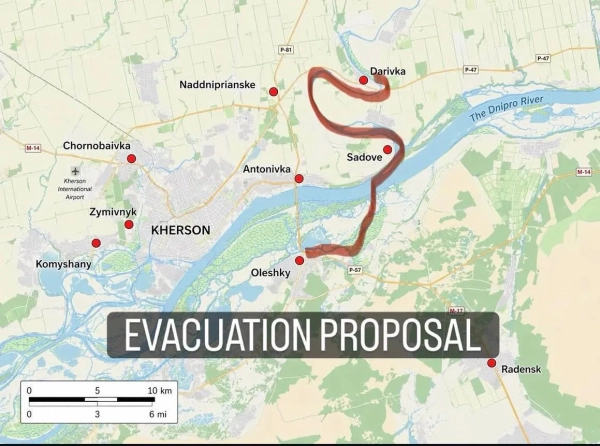
The path for evacuating Kherson residents from the occupation / Instagram of Zarina Zabriskie
The waterways are mined, but there is a way to demine them. It can be done. And such a green corridor will be possible if the Russians agree to a ceasefire. And in one or two days we can take all the people who can still move and deliver them to Ukrainian territory.
The volunteer, Ksenia Arkhipova, who is rescuing these people and helping deliver food, is in Ukrainian-controlled territory and is managing everything from there. She tells me that she has a list of about 300 people right now, and the list will grow a lot more because many Ukrainians lost their documents in the floods after the Russians blew up the dam in Novaya Kakhovka. So we are talking about saving several thousand people.
I really hope that the international community will respond. We will need monitoring teams – UN or Red Cross. International Red Cross, not Russian Red Cross teams on the ground, to ensure the smooth passage of people. We need diplomatic and political support.
And one more thing I want to add. Of course, there is a high probability that the Russians, who are using this population as human shields, will reject the offer. We have seen this many times before. In that case, it will be a very bad diplomatic move indeed, because they will really show that they are using these people as human shields, while the Ukrainians are taking care of their own people.
“The Russians beheaded her”: about the most terrible moment in the war
Could you tell me more about the Oleshkivskie Sands? They are depicted on your T-shirt.
I've never had the opportunity to visit these areas because they're occupied, but I would like to. We can't go there. And the reason I have some idea of what it looks like is because I'm a filmmaker. My first film was about the right bank of Kherson. It's called “Kherson: Safari on People” and it tells the whole story of Kherson from the beginning of the full-scale invasion to the summer of 2025.
I'm currently finishing the second film, which will also include the left bank. I'm working on it, and so I have the opportunity to virtually visit all the amazing, beautiful places, such as the Askania-Nova Park with all the wonderful rare animals that once lived there, the largest desert in Europe – Oleshkivskiy Pisky – and the wonderful pine forest that is there. In my imagination, I've already been there.
Many of my friends tell me with tears in their eyes about all the wonders of nature that the Russians destroyed there, about all the beautiful life that was there. The Kherson land is very fertile. They say that if something gets into the ground there, fruits and vegetables immediately start growing. You know, I could write a novel about the cuisine of the Kherson region. It is very famous not only for its most delicious watermelons, but also for its tomatoes. There is something in this land.
No wonder the Russians want it. Anyone can want it. It's like Crimea, like a jewel in their imperial crown. Of course they want these lands, but these lands don't belong to them. These are Ukrainian lands. I've lived there for over three years. I talk to my neighbors, my friends, every day, and I know what they know – this is Ukraine. That's why it's still standing.
On the topic. Journalist from Kherson Yevheniya Virlych said that Oleshky and Hola Prystan on the left bank of the Dnieper have been effectively blocked by the Russians for the past few months. Just six months ago, volunteers could deliver necessary things there and take out those who wanted, but for the past four months the roads have been mined. The Russians are doing everything possible to turn the region into a closed zone.
You mentioned a mechanism that we, as a global community, can use to help the people of Kherson in their difficult situation. And that is sanctions. So I just wanted to share with you another project that I'm working on, and it's called “Laura's Law.”
Laura was an 84-year-old woman who kept 20 goats in Antonivka, and so she didn’t leave. I met her in September 2025, when I was shooting my second film. She was walking in a completely apocalyptic landscape that few people get to. You know, it’s like a garbage dump with overturned cars, where drones fly. Everything is burned to the ground. It’s like you’re watching a Hollywood war movie, but this is Antonivka, the coastal zone of Kherson.
She was standing there in her starched white shirt with her bright blue eyes. She started talking to me. She had a big smile, very charming. And she asked me if I was American and if I could help you? I said that even though I was just a journalist, I wanted to do whatever I could. And she said, “Okay, do it.” Then she walked away.
Two weeks later I got the news. They wrote to me that she had been killed by a drone. She had been beheaded by a drone, along with her two beloved goats – a mother and a kid.
The military we work with sent me an aerial photo of her and the goats on the ground. It was such a shock, one of the hardest moments of this whole war. I've been to exhumations of mass graves in Izyum and so on, but this wonderful, amazing, intelligent woman who was killed by a Russian drone, it just blew my mind.
So when I went to Washington, D.C., to Capitol Hill, where I shared my findings and showed them in my film, I proposed “Laura's Law.” The first part of the law is about accountability – everyone who is responsible for these deaths, from the drone operators all the way to the Kremlin, the authorities, and Putin, is responsible.
How is this possible? The UN report from October 2025 actually established the entire chain of command and concluded that these crimes qualify not only as war crimes, but also as crimes against humanity. This means that they can be brought to justice. And we already have the evidence and everything necessary to implement these sanctions. So this is one part of punishing the guilty.
The second part is to help prevent a future “human safari.” And that's sanctions on manufacturers and sellers of drones and drone parts used by the Russian military in this area, and possibly in other areas, because it's not limited to the Kherson region.
“The human safari” is now going on all along the front line in Ukraine, anywhere they can get within 60 kilometers. They are now attacking civilians with drones. We are talking about Kharkiv, Sumy, Chernihiv regions, etc.
So, this will be useful for the world community as well, because this could be the war of the future. This could be used in other countries. I heard that there are reports that the Russians are already using this in Africa.
Continuation of the interview with Zarina Zabriskie – watch the video on Channel 24!