
Main points
- Ukrainians are urged to write down their stories about the war to preserve memory and important details.
- Personal testimonies can be used as evidence in legal proceedings against Russia.
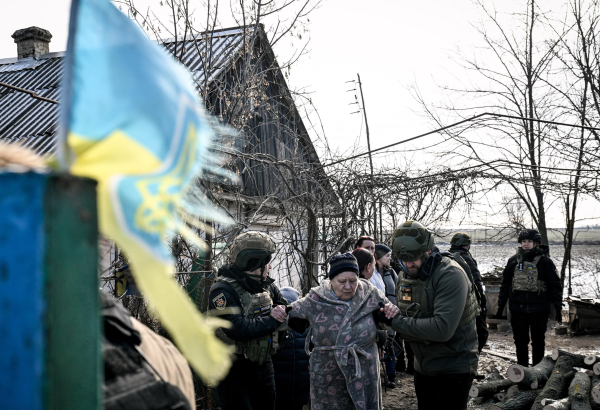
On the anniversary of Russia's full-scale invasion, the topic of preserving the memory of what happened has once again come to the fore. Ukrainians are being urged to record their own stories before their memories lose important details.
Svidok.org Content and Communications Director Olena Kuk explained on Channel 24 why this matters not only for future generations, but also for legal proceedings now. According to her, personal testimonies can become a tool of accountability for Russia.
How do testimonies become part of criminal cases?
The platform team has been collecting testimonies of Ukrainians about the war for the fourth year. Even the strongest experiences lose clarity over time, and individual details are erased. That is why dates such as February 24 become an occasion to remind us of the need to record personal experiences.
Everyone has memories, but the details are erased. It is very important, while we remember it, to write it down so that Russia cannot manipulate these facts,
– said Olena Kuk.
She said that the platform accepts a variety of stories – about occupation, shelling, evacuation, volunteering, or personal experiences. All materials are moderated to filter out disinformation and Russian narratives.
As a reminder, last year, on the anniversary of the full-scale invasion, the online platform Svidok.org launched a flash mob to collect anonymous testimonies from Ukrainians about the war. The collected stories were partly transferred to the Prosecutor General's Office and the International Criminal Court, and were also used for international exhibitions on the consequences of Russia's aggression.
According to Cook, after receiving the author's consent, the story, along with the data, is transferred to the Office of the Attorney General and the International Criminal Court. Then, investigators decide whether to include these materials in a specific proceeding. Some of such testimonies have already become evidence in criminal cases.
About 350 stories have already been attached to criminal cases and will be used in courts,
– said Cook.
She added that the team does not have access to the further course of the investigation due to the secrecy of the investigation. At the same time, the very fact that the stories are included in the cases shows that personal stories can have a real legal outcome.
Stories of Ukrainians are heard abroad
The collected testimonies work not only in the legal sphere. The platform systematically disseminates these stories outside Ukraine so that foreign audiences hear about the war not only through numbers and summaries, but through the voices of Ukrainians themselves. According to her, the format of a personal story often has a much greater emotional impact.
Sometimes first-person stories resonate with foreigners much more than what they read in the news or see in statistics,
– she noted.
Cook cited a recent event in London where British actors read testimonies from Ukrainians from a platform. Such events help explain what is happening in Ukraine and shape understanding of the war through specific human stories.
Just yesterday in London, in Trafalgar Square, actors read the stories of Ukrainians from our platform and spoke about the war through their words,
– added Cook.
She emphasized that publicity abroad is part of a broader goal – to preserve the truth about the war and bring it to the international community. That is why each testimony can be important not only for the author, but also for the country as a whole.
How to leave a testimony and what guarantees are given to the authors of the stories?
Cook explained that anyone can join the initiative. To do this, just go to the platform's website or call the hotline and dictate their story. According to her, the team has made the process as simple as possible so that people don't put off telling their story because of the complexity of the procedure.
Important! Anyone can visit the Svidok.org website or call 0800 507 480 and dictate their story.
Cook also emphasized security. All testimonies are confidential, and before transferring materials to law enforcement, the author's consent is required. The platform also has protection against cyberattacks so that the collected data is not lost.
Each testimony is confidential and anonymous. A person need not worry that their data will be made public,
– emphasized Cook.
She added that currently more than 5,500 people have registered on the platform and more than 4,000 stories have been saved. In addition, as part of a joint initiative with a charitable foundation, some testimonies about war crimes are converted into donations for interceptor drones. In this way, personal stories become not only part of memory and the evidence base, but also practical support for defense.
What is known about the latest war crimes of the Russians:
-
Donald Trump's spiritual advisor Mark Burns said during the Justice Conference that Russia must be held accountable for war crimes against civilians. He mentioned the more than 20,000 Ukrainian children he said were abducted or forced from their homes, as well as the attacks on hospitals, schools and religious sites, calling it a deliberate campaign of terror.
-
According to DeepState, Russian troops destroyed a dam near Osykovo in Donetsk Oblast after blowing up a bridge, causing flooding and disrupting logistics on the Druzhkivka-Konstyantynivka route. Analysts say this temporarily hampered movement, but did not completely halt supplies.
-
In the Velykypysarivska community in Sumy region, a Russian drone hit the car of State Emergency Service employee Pavlo Kolisnyk, who was returning from duty. The rescuer had been working since 1997 and died as a result of a UAV strike.