
Main points
- Political scientist Valeriy Dymov noted that Russia may attack not only energy and water supply systems in the summer, but also certain life support facilities in large cities.
- He recalled that at the beginning of the war, Mykolaiv was left without water for a certain period due to Russian shelling of the water supply system, then Denmark helped the city with pumps.
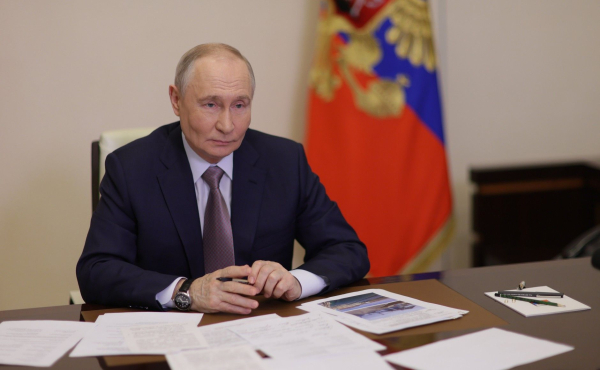
Russian dictator Putin / Photo: rosZMI
Ukrainian President Zelenskyy said that Russia may begin attacking water supply systems. The Putin regime seeks to create the most uncomfortable living conditions for Ukrainians in order to force our state to surrender.
Political scientist Valery Dymov noted this in an exclusive commentary for Channel 24 , emphasizing that Russia will also put pressure on Ukraine not to receive financial assistance from its partners.
What targets might the enemy choose for attacks in the summer?
Earlier, US President Donald Trump said that Ukrainians would not survive this winter, that Putin “kindly” agreed not to attack Ukrainian energy for a certain period. That is, Ukraine is being pressured to agree to a “peace plan”, which essentially means capitulation for it, in exchange for normal living conditions: with electricity, heating, water supply.
As the political scientist emphasized, a political regime that wants to survive, for example in Iran, moves from bombing energy facilities to threatening to attack water desalination plants. After all, the population itself would like to stop something that threatens its life.
“This is how Russia acts: “Agree to the surrender plans if you want to survive the winter,” “What's the difference who owns the Zaporizhzhia NPP, the main thing is that you will receive electricity from there.” Back in 2022, there were obvious strikes on the energy sector,” Dymov emphasized.
Ukraine has experienced one of the most difficult winters, despite not being fully prepared for it. As the political scientist noted, looking at 2022, 2023, 2024, the authorities hoped that the 2025-2026 season would be able to survive the winter, as in previous years, but this year the situation was complicated.
The energy strikes in 2022 and this winter, as the political scientist emphasized, are completely different things. It was difficult at sub-zero temperatures, but the infrastructure survived. He added that in 2022, talks about evacuating Kyiv would have been catastrophic, because no one was ready for anything, neither at the local nor at the central government level.
Now that Ukraine has survived one of its most difficult winters, Russia will strike at other targets that provide life for large cities. Dymov added that in addition to possible strikes on water supply systems, the aggressor country may resort to shelling waste incinerators.
Garbage in the summer is a problem for big cities. In the summer of the year before last, Russia also hit the energy sector, because in the summer, electricity consumption for cooling is important. Then we were forced into a so-called “energy truce” on Putin's terms so that we wouldn't hit the refineries,
– said Dymov.
Commenting on Zelensky's statement about Russia's possible intentions to shell Ukrainian water supply systems, the political scientist recalled that the Russians, attacking his native Mykolaiv at the beginning of the full-scale war, destroyed the water supply. According to him, it was not the local authorities, but Denmark, that helped with the pumps.
Russia considers its strikes a response to Ukraine's attacks, but this is not so. Is it worth delving into the question of who started the war? The Ukrainian side is only responding to the aggressor's terror and, unlike the Russian army, is striking not at maternity hospitals or residential buildings, but at what fuels the aggression – at refineries. Because these oil refineries bring the Kremlin money, which it directs into its military machine.
“Hitting infrastructure facilities is the logic, tactics, and “rational” policy of a terrorist. Russian logic comes from terror, bombings, to force surrender. Their thesis about the so-called response is “don't hit and we won't hit.” They are the aggressor and violate international law, and we are defending ourselves. After they killed children in Mariupol, we had the right to everything. But we didn't do it,” Dymov noted.
On the economic consequences
Speaking of economic consequences, it should be understood that protecting a water supply or sewage system is an expense. When people suffer from the fact that they do not have electricity and water, enterprises at least do not produce, but spend. The economic consequences are clear – these are losses for the state, pressure on the budget and the difficulty of fully protecting these facilities.
Therefore, air defense and missile defense systems require serious investments. We cannot cover all infrastructure facilities. We need to prepare for this and not assume that we will “skip through” like in previous years. In the summer, we must be ready for strikes – install pumps, create backup water supply systems,
– Dymov emphasized.
In conclusion, the political scientist noted that against the backdrop of such threats, the government should take concrete actions, not rhetoric and words that “everything is secured.” He explained that everyone should prepare for Russian terror, because the war continues, the enemy is looking for new targets to hit. He noted that hostilities will continue until victory, which cannot be on the enemy's terms.
Russia is preparing to attack water supply facilities
-
Given that the enemy may be preparing an operation against water supply systems, Zelenskyy called on local authorities to take a cautious approach to the need to protect critical infrastructure. He added that shelling could occur in the coming months.
-
The head of the Union of Consumers of Public Utilities, an expert in housing and energy issues, Oleg Popenko, said that the risk is greatest for those communities where water utilities have long-standing problems and where engineering networks are outdated. He pointed out that significant difficulties in this area exist in Mykolaiv, Chernivtsi, Lviv, and Poltava.