
Main points
- Pollution of the Black Sea was detected in Chornomorsk due to a leak of sunflower oil from a damaged tank after shelling on April 26.
- Ecologists are working on localization and assessing the environmental impacts, and risks to marine flora and fauna have been identified.
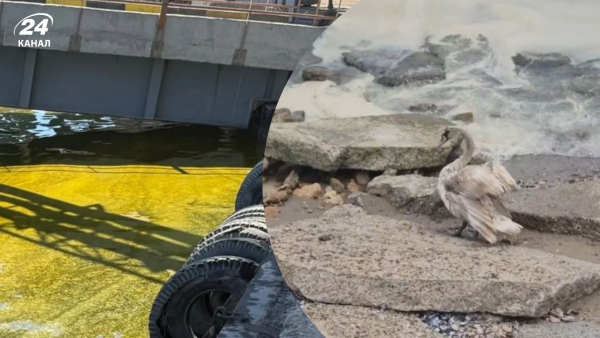
Oily stains were discovered in the sea in Chornomorsk after the attack on April 26 / Collage of Channel 24 (Photo by the State Ecological Inspectorate of the South-Western District)
In Chornomorsk, pollution of the Black Sea was discovered after an air attack on April 26. The cause was the destruction of an oil tank, which caused a leak into the water.
Specialists are already working on site, recording the scale of the environmental consequences and trying to localize the pollution. This was reported by the State Ecological Inspectorate of the South-Western District.
What happened during the shelling and how did the leak occur?
On April 26, Russian troops struck the territory of the Chornomorsk commercial seaport. The attack damaged a tank with a capacity of about 6,000 tons of sunflower oil.
During the impact, a fire broke out and part of the tank contents began to leak beyond the damaged structures. The oil entered the port area, where, due to the lack of immediate dispersion, a large stain formed on the water surface.
According to the environmental inspection, its size was approximately 400 by 200 meters. To contain the contamination, boom barriers were quickly deployed on site, and the storm sewer system was blocked to prevent further spread of the substance.
Huge oil spill in Odessa: watch the video
Specialists took samples of seawater for laboratory analysis to determine the exact level of pollution and the nature of the impact on the Black Sea ecosystem.
What is known about environmental damage?
As a result of the sunflower oil spill, the water in the port area has partially changed color, forming yellowish oily stains that have spread along the coastline and in places penetrated into the open sea. The contamination extends approximately several hundred meters along the coast and may vary depending on currents and wind.
Environmentalists are recording risks for marine flora and fauna, as the film on the water surface reduces oxygen access and affects natural processes in the coastal zone. During the survey, a bird was also found in the contaminated area and had traces of oil on its feathers. It was transferred to a specialized facility for assistance.
Consequences of an oil leak / Photo State Environmental Inspectorate


It is separately noted that due to the concrete covering on the port territory, no soil contamination has been recorded so far, however, the assessment of environmental damage is ongoing.
Representatives of the city government, the port administration, and the environmental inspection continue to work on site. The main efforts are focused on localizing the spill, preventing its expansion, and collecting data for further calculation of environmental damage.
How else is Russia destroying Ukraine's ecology?
According to the animal protection organization UAnimals, more than 6 million domestic animals have died since the start of the full-scale war. This primarily concerns confirmed losses in farms. At the same time, the real scale of the tragedy may be much greater. Due to the occupation of some territories and the lack of recording, many cases of animal deaths remain unaccounted for.
A separate blow to biodiversity was the explosion of the Kakhovka hydroelectric power station. Large-scale flooding led to the destruction of unique ecosystems. According to experts:
-
populations of two endemic ant species have been completely destroyed;
-
about 70% of the desert kandybka population died;
-
Other rare species, including the sandpiper, have been seriously affected.
Some of these species existed only in these territories, so their losses may be irreversible.