
- 1 MiG-31K and the shelling of Ukraine during a full-scale war
- 2 MiG-31 crashed in Russia: what is known?
- 3 Characteristics of the MiG-31K
- 4 Alarms about the MiG-31K can sound several times a day
- 5 Can Ukraine fight the “Daggers”?
- 6 How many MiG-31s does Russia have?
- 7 Not only “Daggers”: how dangerous is the MiG-31K
- 8 GUR identified Russians who are shelling Ukraine with “Daggers”
- 1 MiG-31K and the shelling of Ukraine during a full-scale war
- 2 MiG-31 crashed in Russia: what is known?
- 3 Characteristics of the MiG-31K
- 4 Alarms about the MiG-31K can sound several times a day
- 5 Can Ukraine fight the “Daggers”?
- 6 How many MiG-31s does Russia have?
- 7 Not only “Daggers”: how dangerous is the MiG-31K
- 8 GUR identified Russians who are shelling Ukraine with “Daggers”
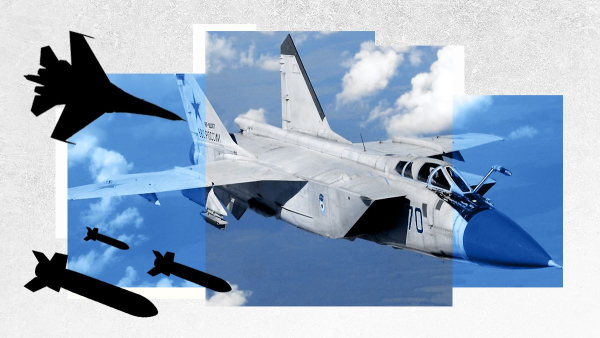
From time to time, airstrikes are declared across the country because a MiG-31K fighter jet carrying Kh-47 Kinzhal aeroballistic missiles has been launched from one Russian airfield or another. Often, these fighters are not on combat missions and do not launch missiles, but this is not always the case. Sometimes, the Russians use these fighters in combined, massive attacks.
In terms of the number of aircraft fleet, despite the losses in Ukraine, the Russian Aerospace Forces continue to hold the status of second only to the United States. However, Russia's arsenal is mostly old aircraft, including some slightly modernized MiG-31Ks. Channel 24 analyzes how dangerous these fighters are for Ukraine.
MiG-31K and the shelling of Ukraine during a full-scale war
The Russians often fly MiGs, but in most cases the sorties are not combat missions. However, alarms are sounded throughout the country, because it is impossible to predict during which sortie the Russians will launch the “Daggers”. The Russians have repeatedly attacked Ukraine with these missiles from MiG-31K fighters, in particular:
- On the evening of March 28, the enemy attacked the Khmelnytskyi region with a Kinzhal aeroballistic missile. And again, because of this threat, sirens sounded throughout Ukraine on the night of March 30.
- For the first time in March, the danger from the MiG-31K was declared on the morning of the 14th.
- On February 22, 2026, Russia took these planes into the sky again. The same happened on February 27.
- On January 4 during the day and night of the 5th, Russia took MiG-31K planes into the air, causing an air alert throughout Ukraine.
- On the night of December 27, the Russian army again used “Daggers” from MiG-31Ks, this time directing them towards Kyiv and the region.
- Several MiG-31K aircraft took to the skies in Russia on the night of December 13.
- On the night of December 6, several “Daggers” previously attacked the Kyiv region.
- In total, according to the Air Force report, 11 “Daggers” were neutralized in November.
- On November 29, the Russian army used 5 Kh-47M2 Kinzhal aeroballistic missiles from MiG-31K aircraft. One was neutralized.
- On the night of November 25, the enemy again took the MiG-31K into the air during a massive attack.
- On November 19, as the monitors write, 5 MiG-31K planes took off in the morning.
- On the night of November 14, Russian MiG-31Ks fired, according to monitors, 4 “Daggers” at Kyiv.
- On November 10, also at night, at least two MiG-31K bombers threatened Ukraine. They had previously fired two missiles.
- On the night of November 8, 2025, Russia launched several missiles from MiG-31Ks over the Kyiv, Kharkiv, and Poltava regions.
- During October 2025, the Air Defense destroyed 6 Kinzhal aeroballistic missiles. On November 3, Russia also launched these missiles – at least 3.
- During September 2025, the air defense destroyed 1 Kh-47 M2 Kinzhal aeroballistic missile. It is known that Russia used 2 such missiles against Ukraine on September 28.
- The Air Force reported that it had neutralized 5 Kh-47M2 Kinzhal aeroballistic missiles in August 2025. Russia attacked with them at least on the 4th, 21st, and 28th.
- On July 28, airstrikes were declared across Ukraine twice in the morning as Russians were taking off with MiG-31Ks. The high-speed targets were in several regions, including Kyiv, Zhytomyr, and Khmelnytskyi.
- July 8 and 9. The enemy took off 4 MiG-31Ks late in the evening of July 8, and 2 MiG-31Ks at about 2:50 a.m. on the night of July 9. The Air Force each time reported high-speed targets (towards Zhytomyr and Lutsk regions). Official information about the consequences of the attack will be released later.
- July 5. The Russian army took the MiG-31K into the air twice that day. There were also launches of hypersonic missiles of the Kinzhal type. These enemy weapons flew towards Starokostyantyniv in the Khmelnytskyi region, which caused explosions to be heard there.
- Second half of June: June 15 – 2 Kh-47M2 Kinzhal aeroballistic missiles were used, they were shot down; June 17 – 2 were also launched, 1 was shot down, 1 was lost in location; June 21 – similar statistics; and 2 missiles were used by the enemy on June 27, then the Air Force did not write about the shooting down.
- June 9 – the enemy launched 4 Kinzhal missiles from the Tambov region, all of which were neutralized.
- On June 3, 2025, Russia launched a Kinzhal aeroballistic missile towards Mykolaiv. The explosion occurred outside the city, with no casualties. This is the first instance of a Kinzhal attack on the Mykolaiv region.
- The threat of launching the Kh-47M2 Kinzhal aeroballistic missile from a MiG-31K was warned on April 9, 2025.
- On December 31, 2024, the Russians used 1 Kh-47M2 Kinzhal aeroballistic missile from a MiG-31K fighter jet from the airspace of the Tula region.
- On November 17 and December 13, 2024, the Air Force last reported the use of Kinzhal missiles by Russian aircraft.
- On the morning of November 11, the Air Force reported the takeoff of several MiG-31K aircraft.
- On the morning of October 7, an air alert was declared across Ukraine following the takeoff of a MiG-31K. Later, it became known about the launches of hypersonic missiles of the Kinzhal type. Explosions were heard in Kyiv and the Khmelnytskyi region.
- On July 8, the Russians took to the air with a MiG-31K and launched Kinzhal missiles at Kyiv.
- On the morning of June 14, an air alert was declared throughout Ukraine due to the takeoff of a MIG-31K. The Air Force of the Armed Forces of Ukraine warned of a high-speed target in the Kyiv region. A few minutes later, explosions were heard in the Khmelnytskyi region. Later, the Air Force command confirmed that the enemy had attacked with a Kinzhal missile.
- On May 20, 6 MiG-31Ks took off at once. 4 fighters took off from the Savasleyka airfield and 2 more from Astrakhan.
- On May 8, during a morning massive attack, a MiG-31K took off, from which the Russians launched “Daggers”, the number of enemy air targets is currently unknown.
- On April 27, after 5:00 a.m., a MiG-31K took off from Savasleyka airfield in the Nizhny Novgorod region of Russia. There were launches of “Daggers”, the number of which is currently unknown.
- On April 11, during a massive attack, the Russians launched 6 MiG-31K fighters and, accordingly, 6 Kinzhal aeroballistic missiles into Ukraine. The Stryi district of the Lviv region was again under attack.
- On March 29, 2024, the Russians launched 3 aeroballistic missiles from MiG-31K fighters towards the western regions of Ukraine. The Lviv region was again under attack.
- On March 24, 2024, after a massive night attack, in the morning the Russians launched “Daggers” and re-attacked a facility in the Lviv region, which had been hit by a Kh-101/Kh-555 missile during the night. Rescuers working at the scene of the attack were warned in time about the second strike, so they managed to avoid casualties.
- On March 22, 2024, the Russians used 7 Kinzhal aeroballistic missiles to strike Ukraine's energy infrastructure during a massive attack.
- On March 21, 2024, the enemy launched 2 Kinzhal missiles, but both missiles were destroyed by air defense forces.
- On January 13, 2024, the Russians launched 6 missiles of this type. Although they were not intercepted by air defense systems, the Air Force noted that those missiles that could not be destroyed, including the “Daggers”, did not reach their targets due to the operation of electronic warfare equipment.
- On January 8, 2024, the Russians used 4 Kinzhal missiles in a massive attack.
- On January 2, 2024, during one of the largest attacks on Kyiv, the Russians launched 10 “Daggers”, but all were destroyed by air defense forces. This was the largest attack with these missiles.
- On December 29, 2023, out of 158 air attack assets launched by the Russians during the massive attack, there were 5 Kinzhal aeroballistic missiles.
- On December 14, 2023, the Russians attacked Kyiv and the Khmelnytskyi region with three Kinzhal missiles, one of which was destroyed by air defense forces.
- On August 11, 2023, the Russians attacked Ukraine with four “Daggers”. One missile was destroyed by air defense forces, 3 attacked Ivano-Frankivsk region and killed a child.
- On August 6, 2023, the Russians used 3 Kinzhal missiles.
- On July 26, 2023, 4 Kinzhal aeroballistic missiles attacked the Khmelnytskyi region.
- On June 22, 2023, the Russians launched “Daggers” towards the Dnipropetrovsk region. None of the three missiles reached their target.
- On June 16, 2023, during another attack by “Daggers”, air defense forces destroyed 6 aeroballistic missiles.
- On May 16, 2023, air defense forces successfully destroyed 6 of the 6 “Daggers” launched by the Russians;
- On May 6, 2023, Ukrainian sky defenders managed to destroy a Kinzhal aeroballistic missile for the first time in history.
- On March 9, 2023, during a massive attack on energy, the Russians launched 6 Kinzhal missiles.
- On January 26, 2023, the Russians used 2 aeroballistic missiles to attack Ukraine;
- On August 7, 2022, the Russians attacked the Vinnytsia region with Kinzhal missiles. Previous uses of these missiles are unknown, but the Air Force notes that they have recorded several Kinzhals so far. We are talking about 10-12 missiles.
MiG-31 crashed in Russia: what is known?
On the evening of October 9, it became known that a MiG-31 fighter-interceptor belonging to the Russian Aerospace Forces crashed during a training flight in the Lipetsk region of Russia.
Previously, the accident was caused by a malfunction in the landing gear release system during the approach. According to Russian media, the pilots managed to eject from the fighter.
The plane crashed in a forest in the Chaplygin district of the Lipetsk region, after which a fire broke out. Propaganda media outlets note that the fire from the burning fighter jet has now been extinguished.
MiG-31K characteristics
MiG-31 – was the first Soviet 4th generation fighter. According to Defence Express, the MiG-31 was originally intended to intercept cruise missiles and other complex air targets. The aircraft has the following outstanding characteristics:
- speed up to 3,400 kilometers per hour,
- ceiling 20 kilometers,
- range of 720 kilometers,
- weight 46.75 tons.
For example, no fighter jet that Ukraine has is capable of reaching such a speed.
Various modifications of the MiG-31 have been used as carriers of advanced weapons and even for launching satellites into orbit. In the early 2010s, there was discussion about terminating the MiG-31's service, but it was decided to keep the aircraft as a modernized MiG-31BM interceptor, and later to modify it to the MiG-31K.
The Defence Express review states that in the first version of the MiG-31K with the Kinzhal missile system, a new communication and targeting system was installed on the aircraft instead of the radar.
Due to the size and weight of the missile, the center of gravity of the aircraft changed. This required retraining of pilots . Until now, only highly qualified crews could use the Kinzhal missile – this required very precise maintenance of the speed regime and flight trajectory.
In fact, the modified MiG-31K performs the function of the “1st stage” of the rocket. It accelerates and gains high altitude, after which it performs the launch. The guidance system allows you to enter the flight task directly from the aircraft.
Alarms about the MiG-31K can sound several times a day
If a Russian MiG-31K takes off in Russia, an air alert is definitely declared in Ukraine.
The fact is that the Kh-47 Kinzhal missile carried by this aircraft poses a threat to all regions of the country. This missile can hit targets at a distance of up to 2,000 kilometers.
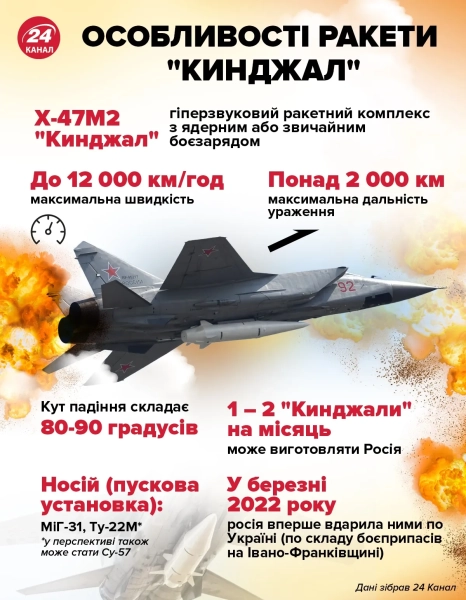
What is known about the Kinzhal missiles / Infographics by Channel 24
The maximum speed of the “Dagger” is Mach 10, which is about 12,000 kilometers per hour. They are dangerous because they can maneuver on the flight path.
Sometimes air alerts involving MiG-31Ks are short-lived. The Air Force explained that in some places the Russians take these planes up for training flights.
For example, on May 8, a MiG-31K took off from Savasleyka airfield in Russia. The MiG-31K could also have been accompanied by Su-30SM fighters.
Also, the fleet of aircraft that Russia keeps in Belarus needs routine maintenance, which the occupiers can carry out on Russian territory.
In Ukraine, MiG-31Ks were used in the sky to announce air alerts on December 25, 26, 27, and 28, 2023. Each time, the planes took off from the Savasleyka airfield (Nizhny Novgorod region). Fortunately, there were no missile launches.
Air raids can last for several hours, and they paralyze all life in Ukraine, negatively affecting both the economy and the mental health of Ukrainians. However, Ukrainians have found a way out: they treat the Russian threat with irony, and the aircraft itself, the carrier of the “Daggers”, began to be called “Myt” (the Ukrainian translation of the Russian word “myg”, which is consonant with the name of the aircraft). The noun “Myt” is usually added with a strong adjective “y**ana” to emphasize the attitude towards the Russian genocidal aviation. Also, Ukrainians actively curse the pilots of “Myt” during air raids and personally wish all sorts of misfortunes to the “Savasleytsy”, where they are based.
Can Ukraine fight the “Daggers”?
- Until recently, Ukraine did not have the means to combat hypersonic missiles of the Kinzhal type. But the situation changed after the partners transferred the Patriot air defense system to Ukraine in April 2023.
- On the night of May 4, a Russian Kinzhal missile was shot down over Kyiv for the first time thanks to a Patriot air defense system. The Air Force noted that the Russians, unfortunately, learned too early about Ukraine's ability to shoot down this type of missile.
- In addition, Yuriy Ignat, a spokesman for the Ukrainian Air Force, stressed that there was no need to get too excited. The fact is that Ukraine still needs to have more air defense systems to resist Russian attacks.
- Missiles such as the Kinzhal can only be shot down in automatic mode. In addition to the Patriot air defense system, these missiles can potentially be shot down by the FSAF SAMP/T system, which Ukraine is also to receive.
- At the same time, the West believes that the downing of the Russian “Dagger” thanks to the Patriot air defense system has called into question the capabilities of Russia's new generation of weapons.
- Kremlin propaganda has touted the Kinzhal as a missile without equal. But now the Kinzhal may not be as maneuverable or fast when approaching its target.
How many MiG-31s does Russia have?
As of early 2021, the Russian Air Force had 131 MiG-31 interceptors . This is a Soviet two-seat supersonic all-weather long-range fighter-interceptor. The MiG-31K is a modification with the ability to carry the Kinzhal missile.
The number of Russian aircraft is frightening, but the resource of a significant part of the occupiers' aircraft has been exhausted. The reason is that the aircraft are inherited from the times of the former Soviet Union, which ceased to exist in 1991.
The production of the MiG-31 ended in 1994, and they have been produced since 1975, meaning they are all at least 30 years old now.
These aircraft are being upgraded (with huge problems due to sanctions) to the MiG-31BM or MiG-31K variants. Most of these aircraft are over 30 years old and their further operation, even despite the upgrade (which is actually only maintenance and repair), has been exhausted. Potentially, these aircraft should be replaced by the MiG-41.
The fact that the MiG-31 is already an outdated aircraft is evidenced by numerous disasters and accidents. In 2022, at least 5 such incidents occurred:
- On October 9, 2025, a MiG-31 crashed in the Lipetsk region of Russia during a training flight.
- On January 29, 2022, in the Novgorod region, a MiG-31 overran the runway and crashed;
- On April 8, 2022, a MiG-31 crashed in the Leningrad Region, the crew ejected;
- On October 1, 2022, at the Belbek airfield in occupied Crimea, a MiG-31K rolled off the runway during takeoff and exploded;
- On December 2, 2022, a MiG-31 crashed during a training flight in Primorsky Krai, the pilots ejected;
- On December 25, 2022, an engine fire occurred on one of the MiG-31Ks in Belarus.
Watch the video of a MiG-31 burning in Primorsky Krai
Another similar incident occurred in January 2023. During a flight of a Russian MiG-31K fighter jet near Minsk, an “explosion” occurred, which was recorded by local residents living near the military airfield.
Now, the MiG-31, which caught fire and sank in the Murmansk region, will join this list.
The Ukrainian military portal Defense Express, analyzing Russian aircraft, wrote that Russia has about 20 MiG-31Ks . At the same time, the enemy has only three crews capable of using Kinzhal missiles on the MiG-31Ks.
Not only “Daggers”: how dangerous is the MiG-31K
The modernized MiG-31K is the main carrier of the Russian hypersonic aircraft missile system Kh-47M2 “Dagger”. Vladimir Putin first announced the MiG-31K as carriers of the new “Dagger” missiles in his address to the Federal Assembly in 2018.
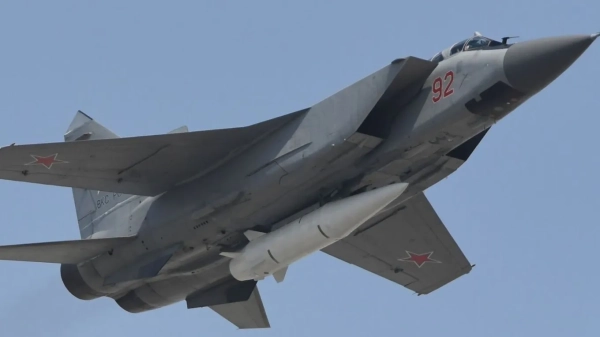
MiG-31K with “Kinzhal” / Photo from Russian media
The aircraft also carries the R-37M long-range air-to-air missile, which is considered one of the longest-range aircraft missiles. The missile has a maximum speed of up to 6M and is capable of hitting targets at ranges of up to 300 kilometers.
The number of MiG-31Ks in Russia is estimated to be insignificant compared to over a hundred “line” MiG-31s. The MiG-31 as a conventional interceptor is a rather dangerous machine due to the presence of powerful radar equipment.
Defence Express stresses that the Kinzhal missiles will only pose a real threat when they can be launched from MiG-31I aircraft, rather than MiG-31Ks. However, the threat should not be dismissed in any case.
GUR identified Russians who are shelling Ukraine with “Daggers”
The Main Intelligence Directorate of the Ministry of Defense of Ukraine successfully identified 29 members of the command, flight and technical staff of the 44th separate special-purpose aviation regiment of long-range aviation of the Aerospace Forces of the Russian Armed Forces.
Seven officers from the regiment's technical staff were also identified.
Please note! The list of identified Russian war criminals can be found at the link.
According to intelligence, the 44th separate aviation regiment was formed on December 1, 2021. The place of permanent deployment of the Russian group is the Savasleyka airfield in the Nizhny Novgorod region of Russia.
The regiment has a two-squadron structure, with up to 24 aircraft on staff – MiG-31K long-range fighter-interceptors,
– emphasized the GUR.
The tail numbers of the MiG-31K aircraft from the regiment have also been established:
- RF-20862;
- RF-03230;
- RF-20882;
- RF-03231;
- RF-03234;
- RF-19275;
- RF-94268;
- RF-42251;
- RF-42253;
- RF-20867;
- RF-20883.
Intelligence representatives recalled that there will be fair retribution for every war crime committed against Ukraine.