
Main points
- Discontent is growing in Russia due to the worsening economic situation, which could lead to mass protests.
- The Kremlin is concerned because citizens are allowing for the possibility of protests due to falling living standards.
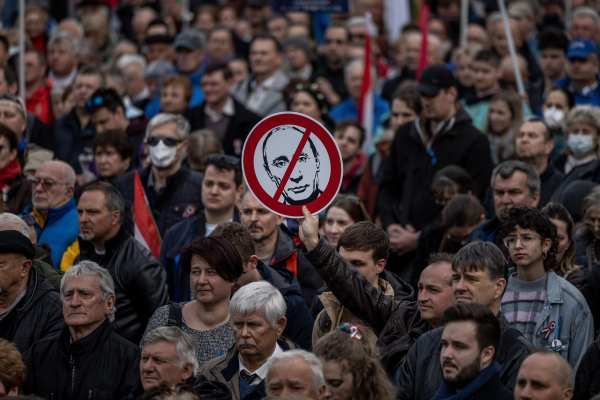
Russians are considering mass protests / GettyImage
Discontent is building in Russia due to the falling standard of living and the worsening economic situation. Even according to Russian sociologists, some citizens already believe that this could lead to mass protests in the country.
Political scientist and head of the Center for Analysis and Strategies Igor Chalenko explained on Channel 24 that such an indicator in itself does not mean that people will quickly take to the streets. At the same time, the Kremlin has more and more reasons to be nervous, as discontent in Russia is gradually accumulating.
Mass protests in Russia
The idea of mass protests in Russia no longer seems completely unrealistic, even for Russians themselves. According to local polls, one in five people admit such a possibility due to falling living standards, and for a tightly controlled system, this is already a noticeable signal, even if Russian sociology is distorted by fear, self-censorship, and a reluctance to speak out.
By the way! Russia has already begun to openly say that the economy is finding it increasingly difficult to withstand the war. State Duma deputy Renat Suleimanov stated that 40% of the federal budget goes to defense and security, which is accelerating inflation, cutting social and investment spending, and he called the conflict itself protracted.

A majority is not needed to launch protest processes. 10-15% of the most active part of society is enough, but in Russia the problem is different: this charge of discontent is divided between two different camps. One is made up of hooray-patriots who think Putin is not tough enough, the other is those who oppose his militaristic policies, and it is their sentiments that are being strengthened by the worsening socio-economic situation.
The problem for Russians is that these passionaries have moved into the right-wing radical niche,
– said Chalenko.
So far, it doesn't look like there are any prerequisites for a large simultaneous explosion across Russia.
The money factor may pull Russians out of the kitchen, but it won't happen all at once, it will have a cumulative effect,
– explained the political scientist.
Rather, we are talking about situational and local actions that can fade just as quickly, but the very fact of their probability shows that discontent in the country is no longer confined to kitchens.
By the way! Valery Klochok also spoke about the decline in Putin's support and explained that the Kremlin does not dare to carry out a general mobilization due to fear of public opposition. According to him, a thesis about a “kitchen revolution” has already appeared in Russia, when dissatisfaction with the war, the economy and the government's policies is increasingly turning into private conversations.
Chalenko suggested that this dissatisfaction could become more noticeable in early autumn, when Russia is approaching pseudo-elections to the State Duma. That is when socio-economic problems could hit the Kremlin even harder.
Putin is playing the “people's” leader again
Discontent in Russia is already forcing Putin to return to the old set of public gestures with which he usually props up his image of closeness to the people.
Important! On May 15, 2026, the Foreign Intelligence Service of Ukraine reported that Russian business began to more actively withdraw money abroad through schemes with “loans” to foreign companies. In the first 4 months of the year, the hole in the Russian budget grew to 5.9 trillion rubles, and by the end of the year the deficit could reach 18 trillion.
In the public space, staged conversations with “ordinary Russians” reappear, familiar faces are drawn into the frame, and all this familiar spectacle, which is turned on in moments of internal tension.
Putin has to show again that he communicates with the people there: he dragged his teacher out, talked to some random passerby who turned out to be a decoy for the Russian special services,
– said Chalenko.
With such scenes, the authorities are trying to maintain support and create the impression that the situation remains under control, although crisis phenomena are already accumulating within the country.
A political scientist explained why Putin is nervous: watch the video
The problem for Russia is that this television picture does not remove irritation, but only masks it, and so far it does not appear that the authorities have managed to truly channel this negativity into a safe channel for themselves.
What is known about Russia's war fatigue and economic problems?
Pavlo Palisa noted that after the May 9 parade, people in Russia themselves began to wonder more about where the country was heading. According to him, Putin became more concerned about his own security, and dissatisfaction with the war was growing more noticeable among his entourage and among the population.
Alexander Morozov noted that even Kremlin-controlled pollsters showed a drop in Putin's ratings, after which they decided not to publish such data. He attributed this to the population's fatigue from the unclear prospects of war, a weaker economy, and discontent that already extends beyond the opposition.