
Main points
- Iranian missiles, such as the Khorramshahr, Sejjil, Ghadr, and Emad, are capable of hitting targets at ranges of up to 2,000 kilometers, and with a reduced payload even up to 3,000 kilometers.
- A number of European states may be under threat from potential Iranian attacks.
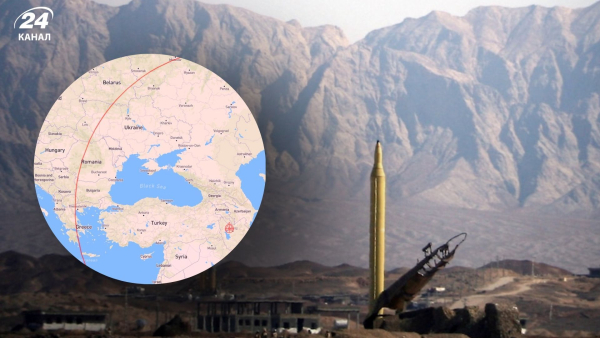
Iranian missiles can reach Ukraine and Moldova / Collage of Channel 24
The situation in the Middle East continues to escalate, with Iran openly attacking Iraq, Kuwait, the UAE, Qatar, Israel, and other states with ballistic missiles and drones. At the same time, the threat from Iranian weapons also exists for Europe.
Ukraine is also at risk from potential attacks. Experts from Defence Express have analyzed what makes Iranian missiles special and how far they can fly.
What is known about Iranian weapons?
Experts note that Iran has already used more than 771 ballistic missiles and more than 906 drones during the strikes. At the same time, one of the most powerful intercontinental ballistic missiles, the Khorramshahr, also has a super-powerful warhead of 1,800 kilograms.
It is worth noting that Iranian weapons have already reached Cyprus, where the UK has a military base. So European countries could theoretically become targets for Iran.
Experts explained that the most powerful Iranian ballistic missiles in terms of range are currently considered to be liquid-fueled, Sejjil, Ghadr, and Emad.
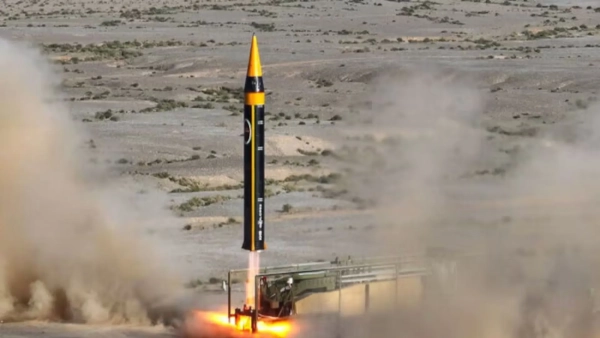
Iranian ballistic missile Khorramshahr / The Islamic Republic News Agency
At the same time, the declared characteristics, in particular the range and mass of the warhead, are mainly based on official reports from Tehran, so they may be inflated.
However, even the announced parameters are enough to hit targets at a distance of about 2,000 kilometers. For Khorramshahr, a warhead weighing up to 1,800 kilograms is declared at a range of 2,000 kilometers, and with a reduced load, this figure can supposedly reach up to 3,000 kilometers.
Which European countries could be targeted?
The Emad, Ghadr and Sejjil warheads weigh an estimated 750-850 kilograms and have a range of approximately 1,700-2,000 kilometers. Under these conditions, medium-range missiles from northwestern Iran could theoretically reach Greece, Bulgaria, Romania, as well as Ukraine and Moldova.
If Khorramshahr does indeed have a range of up to 3,000 kilometers, then a significant part of Europe, including Germany and Italy, could be at risk. At the same time, the actual number of such missiles in Tehran is likely limited.
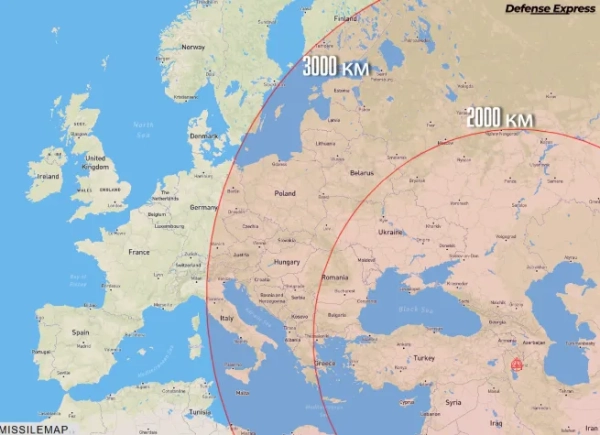
Range of Iranian missiles / Infographics from Defence Express
In addition, the American Aegis Ashore missile defense component with SM-3 interceptors operates in Europe, primarily at a base in Romania. Arleigh Burke-class destroyers are also on duty in the Mediterranean Sea.
In addition, in the event of a threat, Germany could use the new Israeli Arrow 3 missile defense system, which reached initial operational readiness at the end of 2025.
Separately, Iran has cruise missiles, in particular the Soumar, which are said to have a range of 2,000–3,000 kilometers. However, their use is limited and their interception efficiency is quite high, which reduces their real threat.
Is there a threat from Iranian drones?
Defence Express noted that drones could become one of the key means of long-range attack. For example, the Shahed 136 is capable of covering up to 2,500 kilometers and is the longest-range drone in this segment.
But the Arash-2 (Kian 2) drone has a radius of 1,000-1,600 kilometers, while the Karrar jet drone has a range of about 1,000 kilometers. However, to reach Europe, they would have to cross the airspace of Iraq, Syria, Jordan, or take a route through Armenia, Georgia, or Turkey, which significantly complicates their unhindered flight and increases the risk of interception.
What is happening in the Middle East?
-
Recall that on Saturday, February 28, the United States and Israel launched a large-scale military operation against Iran after the failure of negotiations over its nuclear program. During the first waves of attacks, part of Iran's military and political leadership was eliminated, including the country's supreme leader, Ali Khamenei.
-
In response, Tehran launched missile and drone strikes on US bases and allied facilities in the region. Targets in Iraq, Jordan, the UAE, Qatar, Kuwait and Bahrain were targeted, as well as infrastructure linked to the military of the UK, France and Germany.
-
Hezbollah joined the escalation. On March 2, the group launched a missile and drone strike on northern Israel, particularly in the Haifa area, calling it revenge for Khamenei's death. In response, the Israel Defense Forces attacked the group's facilities in Lebanon.
-
For his part, US Secretary of War Pete Hegseth stated that Iran has been waging a conflict against the United States for 47 years, and stressed that Washington intends to put an end to it.