
Main points
- Russia is manipulating American negotiators, trying to avoid new sanctions and stalling for the continuation of hostilities.
- Ukraine is ready for certain concessions in the negotiations, but does not see Russia's willingness to compromise, since Russia's conditions are a demand for surrender.
- 1 What about the negotiations to end the war?
- 2 How is Trump and Witkoff being manipulated in the Kremlin?
- 3 What plan for Ukraine could be on the table in the White House?
- 4 Why does Budanov believe in negotiations with Russia?
- 5 Are Russians ready for protests?
- 6 Will Putin be able to end the war without risking himself?
- 7 What will guarantee Ukraine's security in the event of the end of the war?
- 1 What about the negotiations to end the war?
- 2 How is Trump and Witkoff being manipulated in the Kremlin?
- 3 What plan for Ukraine could be on the table in the White House?
- 4 Why does Budanov believe in negotiations with Russia?
- 5 Are Russians ready for protests?
- 6 Will Putin be able to end the war without risking himself?
- 7 What will guarantee Ukraine's security in the event of the end of the war?
Russia is successfully manipulating both the US special representative for the war in Ukraine, Steve Witkoff, and President Donald Trump. Witkoff has already traveled to Russia 8 times and has never been to Ukraine, which may indicate a pro-Russian stance. In addition, Witkoff actually advised a Putin aide on how the dictator could best communicate with Trump to get what he wanted.
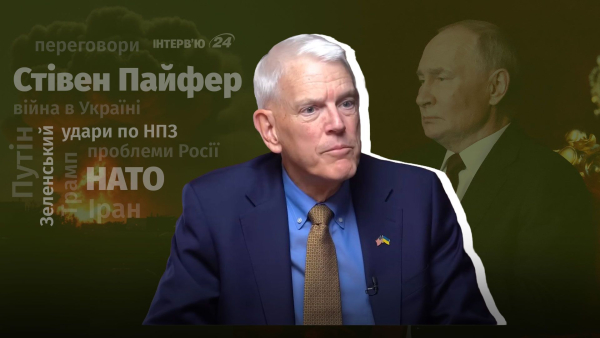
Now the negotiation process has stalled, in particular due to ultimatums from Russia, which is not ready for compromise, and because the United States is more interested in a war with Iran. Diplomat and former US Ambassador Extraordinary and Plenipotentiary to Ukraine Steven Pifer told Channel 24 at the Kyiv Security Forum about Russia's manipulation of the negotiations and what the real US plan for Ukraine and Russia might be.
What about the negotiations to end the war?
Let's start our conversation with the Kyiv Security Forum. How do you assess General Kirill Budanov's speech? And what are your conclusions from this conference?
Kirill Budanov described a very difficult situation in the war with Russia, presented his own vision of the current state of affairs and possible scenarios for the development of events. And I understand that there is still a lot of uncertainty. Wars are unpredictable by their nature, especially when you are dealing with a very difficult “partner” in Moscow, because of which it is difficult to determine the further algorithm of actions.
President Volodymyr Zelenskyy said that the US and Israel's war against Iran has now focused all attention on the Middle East, not on Ukraine. Do you expect any further movement from the US administration? Where are we now in this diplomatic process and is Donald Trump concerned about Ukraine?
The US war on Iran had four key consequences for Ukraine and the level of American support. Three of these consequences matter. One factor that I don’t think matters much is the negotiations. Steve Witkoff is not only the chief negotiator on Russia and Ukraine, but he is also the chief negotiator with the US vice president on Iran, so he is focused on the Iranian issue right now.
However, I don't really see this as a big loss for Ukraine, because I don't think the negotiations mediated by Witkoff have really made any significant progress. In my opinion, over the past 5-6 months, the Ukrainian side has demonstrated a willingness to show some flexibility in order to reach a compromise.
I hear from Ukrainians that they are tired of the war and would like it to end, but they are not ready to capitulate to Russia. However, there is a certain feeling that Ukraine is ready to make some concessions in an attempt to find a path to peace. I see no evidence that the Russian side is ready to move towards an agreement.
So if we go back to, say, late January or early February, Russian Foreign Minister Sergei Lavrov gave a speech outlining Russia's conditions and demands for ending the war. They were an almost verbatim rehash of what Putin had said back in the summer of 2024, and these conditions are not the result of negotiations. They are actually a demand for Ukraine's surrender .
Full interview with Steven Pifer: watch the video
Since I don't see any progress in the negotiations, I understand Ukraine's dissatisfaction with the fact that Witkoff has been to Moscow eight times and never to Kyiv. This may explain his position, which has an obvious pro-Russian slant . However, you know, I'm not sure that this has much of an impact on Ukraine, because I don't think the negotiation process has made much progress.
One of the main reasons for the lack of progress in the negotiations is that President Trump, for some reason, has decided not to use the leverage on the Russians to engage in more serious negotiations, even though he could have, for example, tightened sanctions. However, in fact, we have recently seen that he has done the exact opposite with regard to oil sanctions – loosened them.
Important! According to the forecast of economist Oleksandr Savchenko, if the war in Iran continues and oil prices remain high, then by the end of the year Russia will be able to receive about 40-45 billion dollars in its budget.
Trump could have taken other steps to make it clear that the Ukrainian military would have the resources to purchase weapons to continue the war for another 2 to 4 or even 5 years. However, he did none of these things, and such inaction will not change the position of Vladimir Putin, who, in my opinion, still believes that he can achieve his goals on the battlefield.
I don't think the negotiations will move in a more positive direction without US pressure. Therefore, the fact that Witkoff is currently busy with Iran, in my opinion, is unlikely to significantly harm Ukraine's interests.
How is the Kremlin manipulating Trump and Witkoff?
In your opinion, are the Russians manipulating American negotiators?
I think the Russians are really trying to manipulate the US president. As far as I understand, Putin wants to continue to send signals or hint that he is ready to participate in negotiations. However, again, this is only an imitation of negotiations , and his goal is to prevent the US from imposing new sanctions against Russia, as well as to buy time to continue hostilities.
So this is, in my opinion, a frivolous negotiation campaign. And I think so far he is successfully deceiving the American president , because Trump seems to agree and accept it. I think that is a mistake. In my opinion, it actually undermines Trump's chances of a successful mediation, because he has enormous leverage that he could have applied to Russia, but he chose not to.
Also, as far as I know, Witkoff has stated several times that he takes what the Russians say literally. And that is, at best, a naive approach to negotiating with the Russians on such an issue.
Consider this relationship between Witkoff and Putin. They did meet several times in the Kremlin, and Witkoff said, “Putin is my friend.” What are the main reasons behind this?
I find it hard to understand. It was back in March of last year when Witkoff met with Putin for the first time. Then he gave an interview in the United States and said, “Maybe those territories occupied by Russia in Eastern Ukraine should be Russian, because the people there speak Russian.” I said confidently then that Witkoff doesn't understand Ukraine.
Don't miss it! American Studies Professor Scott Lucas told Channel 24 that Trump had been dreaming of doing business in Russia since the 1990s, but he was unable to realize his dream. The Kremlin's attempts to draw Trump into its game began back in the days of the Soviet Union. And in 2013, Trump made considerable efforts to meet Putin in person. What is known about the relationship between the US president and the Russian dictator – read the link.
As you know, in the East of Ukraine there are many Ukrainians, including ethnic Ukrainians, who speak Russian from birth. This does not mean that they want to be Russian. And such a blunder really worried me. As did the fact that every time Witkoff goes to meet with Putin, there is not a single expert on Russia with him. For Putin, this is the perfect scenario.
He gets the opportunity to manipulate Witkoff, play his own game, and mislead him. In many cases, Witkoff probably doesn't have a sufficient knowledge base, and there's no one around to point out a potential trap. This is a serious concern.
We saw this, I think, in the 28-point peace proposals that came out last November, which were largely in line with the interests of the Russian side. And that may reflect the fact that Witkoff is only talking to the Russians, not the Ukrainians.
Do you remember that telephone conversation between Yuri Ushakov and Steve Witkoff, the recording of which was probably leaked by European intelligence agencies? Bloomberg reported this. How do you understand such diplomatic tactics, such an approach?
It was, I think, last October. President Zelensky was going to Washington to meet with President Trump. I don't remember the exact date. And the day before, Putin calls Trump and talks to him for about an hour or an hour and a half.
When Zelensky was preparing to leave, Trump even suggested that they could discuss transferring Tomahawk missiles to Ukraine. He said that maybe he was tired of Russia. Then there was that call on Thursday, and on Friday Zelensky and Trump met: no Tomahawks, no tough US position on Russia.
So I think something happened on the phone call on Thursday. And then we see the report of the call between Witkoff and Ushakov and we learn that Witkoff was actually advising Ushakov on how Putin should have this conversation with Trump. You know, it's an interesting approach.
Some say that Witkoff is a Russian asset, at least unintentionally. Do you agree with that?
I think the Russians see him as a Russian asset.
What plan for Ukraine could be on the table in the White House?
Regarding President Trump and his relationship with President Zelensky. We saw the White House ambush in February 2025. There were many insults from President Trump towards President Zelensky. What is your assessment of the reasons for this approach?
First, I regret the approach that Trump has taken towards President Zelensky. I can't say that I fully understand it. I've heard two theories. One is that Trump sees himself as a strong leader, and looking at Putin, he sees him as a strong leader, and on that basis they are attracted to each other. It's more of a psychological explanation.
But the geopolitical explanation that I've heard, and I think Secretary of State Marco Rubio hinted at about a year ago, is the idea that there might be a plan in Washington: if the United States abandons Ukraine to its fate, effectively writes it off, and takes a big step back from Europe, then they can somehow mend relations with Putin and tear Russia away from China.
If this is indeed the plan, then, in my opinion, it is based on a fundamental misunderstanding of the relationship between Russia and China, as well as between Vladimir Putin and Chinese leader Xi Jinping.
Russia is now deeply dependent on China on a number of issues. Why would Putin want to spoil the relationship? Or, you know, actually break off or cool the relationship with Xi to bet on Trump? After all, he is, first of all, unpredictable, and secondly, in two and a half years he will no longer be president. It makes no sense. And even if he could do it, it would still not affect anything.
However, if the US were to distance itself from Europe at that time, we would find that the Europeans would be much less willing to help us confront China. So, if this is the geopolitical plan, I think it is deeply flawed, and if implemented, it would actually harm, not help, American interests.
Can Ukraine reach an agreement with Russia without the United States?
I believe that it is in Ukraine's interest to try to keep the US involved. However, Ukraine should also have lower expectations for the volume of American aid than it was, say, a few years ago. At the same time, the American channel of communication remains. One can hope that at some point Trump will get tired of being manipulated and decide to apply pressure.
Again, as I said, I don't think Trump's mediation has a chance of success without a willingness to put pressure on Moscow to force the Russians into more serious negotiations where Russia would make some compromises.
Why does Budanov believe in negotiations with Russia?
Let's go back to General Kirill Budanov's statement. He seems to be more optimistic about a possible negotiated settlement. At the same time, Vladimir Putin says he knows how this war will end, but he doesn't say it publicly. What is your reaction?
It seems that Vladimir Putin has been saying this for 3.5 years. And I think that he is convinced every time: no matter how this war ends, it lasts much longer than he imagined. There is unofficial evidence that gives reason to assume that Putin really believed that the war would end in 2-3 weeks.
What about the position of General Kirill Budanov?
Let's put it this way: he is closer to the discussions than I am. I am in the US and following these discussions from California, two thousand miles from Washington. However, my assessment would be a little more pessimistic, as I still do not see readiness.
There may be some conversations that he knows about and I don't, but I have not yet seen a willingness on the part of Russia to seriously negotiate and recognize that ultimately, if we are talking about a fair and lasting settlement that will end the war, the Russians will have to make some concessions in the interests of Ukraine.
Are Russians ready for protests?
The Tuapse refinery and two other facilities have been shut down after drone attacks on April 16 and 20. According to Reuters, Tuapse has literally been “raining oil.” And Tuapse is still burning – the Russians simply cannot stop the fire. How could this affect the negotiating positions of both sides?
First, if the US eases its sanctions on Russian oil exports, it seems to me that the Ukrainians are quite understandably imposing their own sanctions. I believe that strikes on Russian oil export terminals, as well as on Russia's energy infrastructure in general, have two consequences.
First of all, they really put economic pressure on the Russian economy, and, in my opinion, part of this strategy is to complicate the situation of the Russian economy.
One of the things that disappoints me about the US decisions is the easing of oil sanctions, because by the end of last year, Russia's oil export revenues were at a low level. And there seemed to be a growing view among economists that the Russian economy was so overstretched that Putin would soon have to choose between military spending and social programs.
That is, the only way to finance the increase in military spending would be to cut social programs. So I think that increasing this tension within Russia is a useful thing to do, to put the Russian economy in a more difficult position. And I think that these kinds of strikes do exactly that.
I think there's a psychological aspect to it. The strikes on Russia significantly undermine the narrative that Putin has been trying to impose on the Russian public since 2022, namely, calling it a “special military operation.” You know, if you call it a war in Russia, you can end up behind bars. However, the implication was that this was a limited conflict and it wouldn't affect Russian territory.
I think the Russian public is now seeing that this war will have a very significant impact on Russians at home. And if they realize that, could that lead to a rise in public resistance to this war?
Interesting! European intelligence suspects Russian Security Council Secretary Sergei Shoigu of preparing a coup d'état . Political expert Andrey Gorodnitsky explained that the situation in the Kremlin is complicated, and Putin's entourage is already starting to think about how to remove the dictator. Can Shoigu really lead this process and how Putin reacts – read in the Channel 24 review.
The strikes on Russian refineries are angering not only the elite, but also ordinary Russians and pro-Kremlin bloggers who criticize Putin for it. There is also an understanding of the lack of air defense, the Russians cannot stop the massive waves of Ukrainian drones. Russia is also blocking Telegram and slowing down the Internet in Moscow. What do you think this could mean?
I think Russia sees the vastness of the country as an asset, and in many cases it is. But if you have a large territory, it means that it also needs to be defended. The Russians have concentrated a lot of air defense assets around Moscow and Putin's residence in Valdai, but that means there are fewer air defense assets left for other regions, which gives the Ukrainians the opportunity to hit other economic and military targets in Russia.
However, it is a combination of factors. The airstrikes, the situation with Telegram, and what is happening with the Internet in Moscow, when the Kremlin is essentially trying to take control of the virtual space, that is, to transfer everything to its Max system and control everything there, are causing some disappointment.
The question is, will this irritation from the public and elites transform into real opposition or a real demand to end the war? It hasn't happened yet, but I don't rule out that it could happen at some point in the future.
The system that Putin has built in Russia is very autocratic, with extremely active intelligence agencies. They closely monitor the population and conduct a lot of polling. And it seems that there have been cases in the past where the Kremlin, seeing that public sentiment was moving in a certain direction, has tried to find a way not to go against that sentiment.
Will Putin be able to end the war without risking himself?
Will Putin be able to resolve or end this war? There has been much speculation that if he does, he will lose power.
Putin may believe he cannot end this war without victory, but I would like to make two points.
First, the Kremlin controls the information space in Russia. This would give it a pretty good opportunity to present everything as a “victory” if the war is resolved. Second, in my opinion, polls show that while Russian society still supports Putin and a significant portion of Russians still approve of the way he is waging the war, they also show that many Russians would like the war to end with negotiations.
If Putin had offered something, could have described it as a victory and formulated terms, I think a significant portion of Russians would have felt relieved. So maybe he could get away with it.
What will guarantee Ukraine's security in the event of the war's end?
What about the terms of the deal? Even before the Alaska summit, media outlets reported that Putin had gathered his inner circle in the Kremlin and asked if they wanted to end the war with Ukraine. They all told him yes, but on Russian terms.
That's why I say I don't believe the Russians were holding serious negotiations. I mean the demand to hand over all of Donetsk, while Ukraine was ready to accept a ceasefire along the contact line without recognizing the territory occupied by the Russians as Russian.
Vice President J.D. Vance says it's a few square kilometers. No! It's 5,000 square kilometers. But more importantly, there are 200,000 people living in this area, and it's a line of fortress cities that have effectively held back the Russians for four years. I don't see the point in the idea that Ukraine should give up this territory. It's just stupid. If Russia is serious, it will have to reconsider its position.
There are other issues. I think Ukrainians are quite right to say that in order to accept even an unrecognized Russian occupation of Ukrainian territory, they need serious security guarantees. Such that they would be sure that if agreements are reached now, the Russians will not use 2 or 3 years to rebuild their army to start a war again.
Security guarantees come in many forms. First of all, I hope that if an agreement were reached, the West, particularly the United States, would help Ukraine build a modern army to make sure that Ukraine has all the weapons it needs – not 40 F-16s, but perhaps 300 to 400 F-16s. That would mean such a strong army that this factor alone would make the Russians hesitate before going into combat again.
The second option for guarantees that is being talked about, although in my opinion it is difficult to implement, is the idea of the British and French about a Coalition of the Willing, which could station its forces on the territory of Ukraine. This interesting idea is currently being discussed, but it is difficult to implement. In particular, because the Russians also want American support as a guarantee. I do not quite understand how this could work in practice.
I also support Ukraine's membership in NATO – this is a strong guarantee. It probably won't happen anytime soon, but I believe that this door should be kept open. Even 5 years ago, when they talked about Ukraine's membership in NATO, it was perceived as a security consumer. Now everyone sees that Ukraine has a large, experienced, battle-tested, innovative army. Ukraine would make a great contribution to NATO's security.
The question is, are there any bilateral security guarantees that can be implemented along with how you implement this with other steps, like helping the Ukrainian military with modern equipment? That would give Ukraine confidence that all of these guarantees will deter Russia from starting a war in the future.
Continuation of the interview with Steven Pifer – watch the video on Channel 24!