

- 1 What is known about the combat use of the “Oreshnik”
- 2 “Hazelnut” as a psychological weapon
- 3 So what is known about “Hazelnut”?
- 4 “Hazelnut” – possible characteristics
- 5 Should we be afraid that Putin will make “Oreshnik” nuclear?
- 6 Can air defense shoot down “Oreshnik”?
- 1 What is known about the combat use of the “Oreshnik”
- 2 “Hazelnut” as a psychological weapon
- 3 So what is known about “Hazelnut”?
- 4 “Hazelnut” – possible characteristics
- 5 Should we be afraid that Putin will make “Oreshnik” nuclear?
- 6 Can air defense shoot down “Oreshnik”?
On the night of May 24, Russia launched a massive attack on Ukraine, using a medium-range ballistic missile “Oreshnik”. The occupiers struck Bila Tserkva. Channel 24 has collected available information about this projectile.
What is known about the combat use of the “Oreshnik”
On the night of November 21, 2024, Russia launched an experimental ballistic missile from the Kapustin Yar test site in the Astrakhan region into Ukraine for the first time. The Russians allegedly targeted the Yuzhnmash defense plant in the Dnipro River, but the missile fell not on it, but on neighboring garages.
Despite the fact that the sound of the rocket blocks falling was unrealistically loud, and the fall itself was extremely spectacular – with plasma flashes similar to those shown in the movies, the results and damage were minimal.

This, of course, did not prevent Putin from announcing a great victory for Russian weapons, and the “Nutcracker” itself instantly became the favorite “analogue” of Russians, relegating all those “Sarmatians”, “Poseidons”, “Daggers” and “Petrels” to second and third roles.
By the way, most of them are also potential carriers of nuclear weapons, and some of them, unlike “Oreshnik”, have already passed tests and entered series production.
That is, it is a much more real danger than the new scarecrow.
On the evening of January 8, Russia used the Oreshnik missile against Ukraine for the second time. The strike targeted a critical infrastructure facility in the Lviv region (near the village of Rudno).
On February 12, a threat of a new possible strike with this missile was announced throughout the country, although the information was not confirmed.
“Hazelnut” as a psychological weapon
At the same time, the West was not particularly afraid of the Russian “Oreshnik”, and Ukraine did not do this either – after the attack on the Dnieper, the Armed Forces of Ukraine attacked Russian facilities in the Kursk region using American ATACMS systems, and also continued to launch their UAVs at targets in Russia.
There were even reports of a possible attack by Ukrainian drones on the Kapustin Yar test site itself, from where the Oreshnik was launched.
Perhaps the only real consequence of Russia's use of its “Hazelnut” was the rapid fall of the national currency of the aggressor state to the level of 114.5 rubles per dollar, but this is not accurate.
Now Putin is again threatening to strike with a new missile and telling journalists in Kazakhstan about the terrifying strike power of the “Nutcracker”, which is supposedly comparable to strategic missiles.
Of course, we will respond to the ongoing strikes on Russian territory with long-range missiles of Western production, as has already been mentioned, in particular, we may continue testing the “Oreshnik” in combat conditions, as was done on November 21… These could be military facilities, defense and industrial enterprises, decision-making centers in Kyiv – Putin is scaring the world with his “Oreshnik” at a meeting of the CSTO Security Council in Kazakhstan.
At the same time, the Russian dictator blurted out that there are only a few of these “Oreshniks” and this is the most valuable thing from his statement. So we have some limited good news. As for the destructive power of the missile, a strike by an “Oreshnik” on the Dnieper can be compared to the arrival of a Russian KAB, which the occupiers launch dozens of times a day over Ukraine.
Putin obviously wants to add thousands more to the thousands of missiles already fired at Ukraine. He doesn't need this war to end. Moreover, Putin wants to prevent others from ending this war. He can only wave his “Hazelnut” now to thwart President Trump's efforts, which will definitely happen after his inauguration,
– Ukrainian President Volodymyr Zelensky explains why Putin is threatening Oreshnyk.
So what is known about “Hazelnut”?
What this “Oreshnik” is is still unknown for sure. Let us recall that this missile is experimental and has not yet been put into service. What flew over the Dnieper was a Russian exercise. Before that, there were 2 of them at Kapustin Yar (in October 2023 and in June 2024), and on November 21, 2024, the third one took place.
There are also no guarantees that the next “Oreshnik” will also reach Ukraine, and not fall somewhere in Rostov, because the entire previous history of Russian weapons proves that this is a big lottery.
Today we can say that this is a ballistic missile, either a so-called “medium-range missile” or an “intercontinental ballistic missile.”
What it is and what is the difference between a missile defense system and an ICBM – Channel 24 analyzed it in detail separately .
It is known that “Oreshnik” is the code name for a weapons development project. These missiles are launched by a mobile complex known as “Kedr”. However, there is little information about “Kedr”, while nothing was known about “Oreshnik” at all.
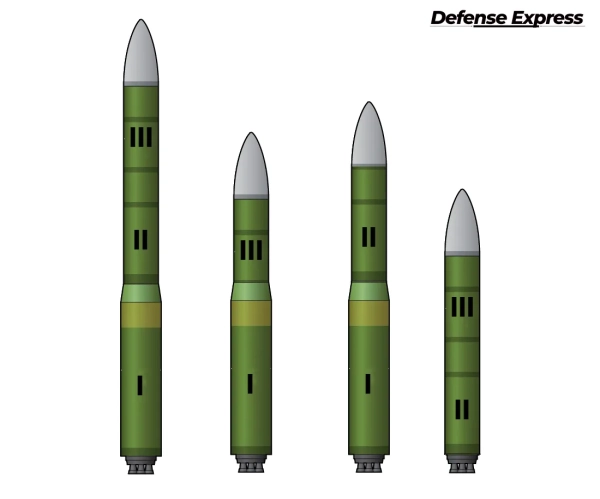
Possible concept of the “Kedr” system / Illustration by Defense Express
The consensus now is that the Oreshnik, which allegedly received the R-28 index, is a reworking of another secret Russian development, the R-26 Rubezh. Channel 24 wrote about it in detail as well.
At the same time, the Rubezh itself is a modified and scaled-down version of another Russian development – the Yars intercontinental ballistic missile. In turn, the Yars is a modernization of the Topol, and the Topol is a modification of previous missiles.
All this resembles a nesting doll and indicates a crisis of ideas among Russians, who do not invent anything new and groundbreaking, but only parasitize on Soviet developments, which are not actually Soviet, but adapted through third parties – German.
Ukrainian intelligence claims that the missile was developed by the Moscow Institute of Thermal Engineering. This institution is responsible for the development of all Russian solid-fuel medium-range and intercontinental missiles since the Soviet era: Temp-S, Temp-2S, Pioneer, Topol, Yars, Bulava, and Rubezh.
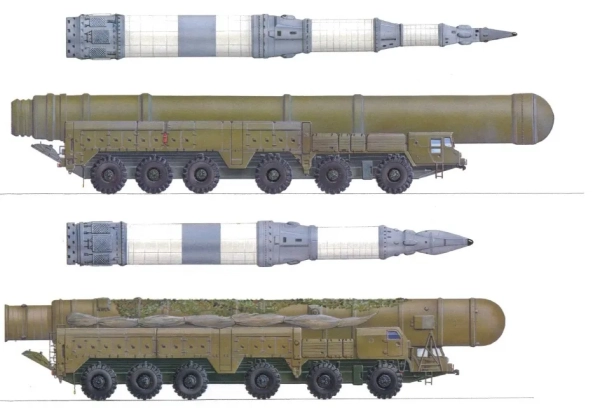
“Temp-2S” and “Pioneer” / Illustration by rosZMI
“Hazelnut” – possible characteristics
- developer – “Moscow Institute of Heat Engineering” (Russia),
- status – experimental sample,
- type – medium-range ballistic missile,
- range – up to 5,500 kilometers,
- the ability to carry a nuclear warhead is available,
- warhead weight – 1,500 kilograms,
- the number of combat monoblocks – 6 (each of them will be divided into 6 more),
- accuracy – 250 – 500 meters in radius,
- quantity as of the end of 2024 – 2 – 3 pieces.
Should we be afraid that Putin will make “Oreshnik” nuclear?
The peculiarity and difference of “Oreshnik” from its “predecessors” is the presence of 6 combat monoblocks at once . “Yars” has 3 of them, and “Rubezh” – supposedly 4.
It is the fall of these 6 blocks that we see in the available video of the impact on the Dnieper River – the same one where plasma clots seem to appear out of nowhere and at great speed.
Now these fragments have been examined by experts and even presented to journalists. You will laugh (no), but elements from countries that have imposed sanctions on Russia have also been found there.
It is now established that the missile has six monoblocks, each of which carries six submunitions, the approximate weight of one is 40-42 kilograms, that is, it is comparable to the strike force of the “Shahed”. The total weight of the warhead is 1.5 tons, that is, as in 3 “Iskanders” or 2 Kh-22 missiles.

The wreckage of the “Oreshnik” / screenshot from the AR video
Based on the analysis of the Oreshnik fragments from the Dnipro, it can be argued that the missile's monoblocks were simple blanks, i.e. they did not contain any warhead. That is why the real consequences and destruction were minimal (although Russian propagandists were quick to declare that the entire Yuzhmash was destroyed, and Putin blurted out about the terrible force comparable to a nuclear explosion).
This also explains the missile's inaccuracy, because it is not needed for nuclear strikes, so de facto it is just an attempt by the Russians to hammer in a nail using a microscope.
But as a hellish threat, all this does not work, because smaller, but quite comparable destruction can be caused by cruise missiles or pseudo-ballistic Iskanders or even Russian KABs, and a nuclear strike with the Oreshnik will not give Russia strategic advantages on the battlefield, only limited tactical ones. Instead, it will probably cause indignation of the “collective South”, including even China (it is currently silent about the Oreshnik, but it is not a fact that it will continue to do so).
Most importantly, the potential use of tactical nuclear weapons would disrupt the fragile balance and open Pandora's box, as a situation would arise where the West would be unable to resist.
Can air defense shoot down “Oreshnik”?
On November 21, 2024, it was not possible to shoot down a Russian experimental missile. This is a fact, but it is not a verdict. Ukrainian air defenses have already proven that they are capable of performing miracles. Recall that earlier Russia stated that it was impossible to shoot down “Dagger” or “Tsirkon”, and then the Ukrainians shot them down.
History may repeat itself with “Oreshnik”.
- But this is a very difficult target. Despite the fact that the missile is tens of meters long, it is difficult to intercept it, because it is ballistic, which means it has a very high speed .
- The situation is further complicated by the fact that the combat unit is divided into six blocks, and those are further divided into six more each.
In such a situation, PATRIOT systems or their analogues will be able to intercept only some of the monoblocks, and to neutralize the entire missile, it is necessary to intercept it at the flight stage outside the atmosphere.
For example, the American THAAD or Aegis systems are capable of this. THAAD complexes are deployed in Israel, and Aegis – in Romania and Poland. Unfortunately, neither of them still covers the Ukrainian sky.
At the moment, it seems much easier to shoot down the person who gives the orders to launch it and threatens the entire world with this missile, instead of the “Hazelnut”.