
Main points
- In the Oleksandrivka direction, Russian troops are trying to seize strategic heights for the complete occupation of the Zaporizhia region.
- The combat unit of the 110th Motorized Rifle Brigade spoke about the current situation in the direction, the threats to Zaporizhia, the readiness of the Dnipropetrovsk region for defense, and how the weather conditions this winter affected the course of hostilities.
- 1 The Russians' goal is to capture Zaporizhia: what is the situation in the Oleksandrivka direction?
- 2 Why did the Russians break into the Dnipropetrovsk region and how to prepare the defense further?
- 3 Why do infantry get stuck in positions and how long should the sorties last?
- 4 Not just mobilization: where do new recruits to the brigade come from?
- 5 Commanders need to work: what is the current situation with the SZCH?
- 6 “Whoever jumps first wins”: what technologies is the 110th Brigade currently implementing?
- 7 A completely different generation: how did the army change during the Great War?
- 8 The word “victory” has fallen out of use: what do the military think about the end of the war?
- 1 The Russians' goal is to capture Zaporizhia: what is the situation in the Oleksandrivka direction?
- 2 Why did the Russians break into the Dnipropetrovsk region and how to prepare the defense further?
- 3 Why do infantry get stuck in positions and how long should the sorties last?
- 4 Not just mobilization: where do new recruits to the brigade come from?
- 5 Commanders need to work: what is the current situation with the SZCH?
- 6 “Whoever jumps first wins”: what technologies is the 110th Brigade currently implementing?
- 7 A completely different generation: how did the army change during the Great War?
- 8 The word “victory” has fallen out of use: what do the military think about the end of the war?
The Oleksandrivka direction is one of the most difficult on the front. Last year it was one of the most unstable sections of the contact line, where the Russians had the fastest pace of advance. The enemy managed to reach the Dnipropetrovsk region and fighting is now ongoing there.
However, last fall the situation was stabilized and the contact line was leveled. Although the Russians are still trying to attack and take control of strategic heights and a new section of the Kurakhove-Zaporizhzhya highway.
24 Channel had the opportunity to visit the Oleksandrivka direction and talk to the commander of the 3rd mechanized battalion of the 110th separate mechanized brigade named after Lieutenant General Maksym Bezruchko . His unit is among those holding the borders in the Dnipropetrovsk region and Zaporizhia.
What is the current situation in the Oleksandrivka direction, what are the Russians' plans, can the issue of the shortage of people in the army be resolved, and can Ukraine win the war – read in an exclusive interview.
Interesting: There's no one left to put in the trenches anymore – Alina Mikhailova's candid interview about the front and the evacuation of the wounded
Watch the interview with the commander of the 110th Brigade Battalion: video
The Russians' goal is to capture Zaporizhia: what is the situation in the Oleksandrivka direction?
We are currently in the Oleksandrivka direction, so the first thing I want to ask is – what is the current situation in your battalion's area of responsibility? What is happening here and what goals does the enemy set for itself?
In the Oleksandrivka direction, the situation is currently difficult, but controlled, because the enemy is paying more attention to Hulyaipol.
Our task is to some extent to defend the Pokrovske-Gulyaipole road. But the enemy has partial successes, despite the fact that he suffers huge losses. According to the global tasks, they have access to the settlement of Ternuvat.
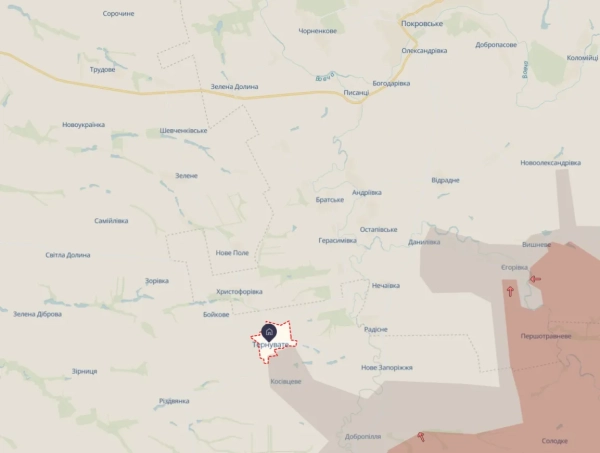
Ternuvat is one of the main goals of the Russians in the Oleksandrivka direction / DeepStateMAP
And what significance does this village have for them?
This is the central settlement, the height is further – and they want to take this line for further advancement in the Zaporizhia region.
If they manage to enter Ternuvat or capture it, what threat does that pose to us?
After this milestone, they will have another main task – the Zaporizhia-Donetsk highway.
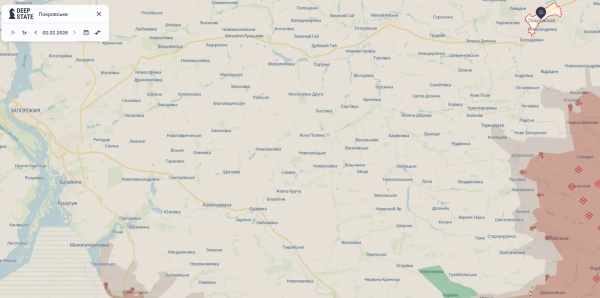
The route to Zaporizhia passes through Pokrovske and Oleksandrivka / DeepStateMAP
Given the actions of the Russians in the area of Hulyaipol and Orekhov, such a scenario poses significant threats to Zaporizhia, doesn't it?
Of course. The enemy's global objective is the entire Zaporizhia region, including Zaporizhia.
And advancing deep into the Dnipropetrovsk region is not a priority for them?
This is a buffer. They want to create a buffer zone, just like in the Sumy region.
What are the main tactics currently being used by the Russians in your area of responsibility? Is it an emphasis on small infantry groups, or do they combine this with mechanized assaults?
Mostly small infantry assault groups, but there are also mechanized ones. However, mostly mechanized ones are on motorcycles, ATVs, converted “Nivas”, cars, “Urals”, and so on.
There are also armored vehicles, but these are quite rare now. The ratio is somewhere around 90% to 10%.
January was marked by quite severe frosts and fogs. How do weather conditions affect combat operations – do they stop the enemy or, on the contrary, do the Russians take advantage of it?
They use bad weather conditions to promote themselves. As soon as the weather conditions worsen, drones are in trouble. Unfortunately, this is technology and it has its own limits.
So, unfortunately, drones often stop functioning the way we want them to and the way they do under good conditions. The enemy takes advantage of this.
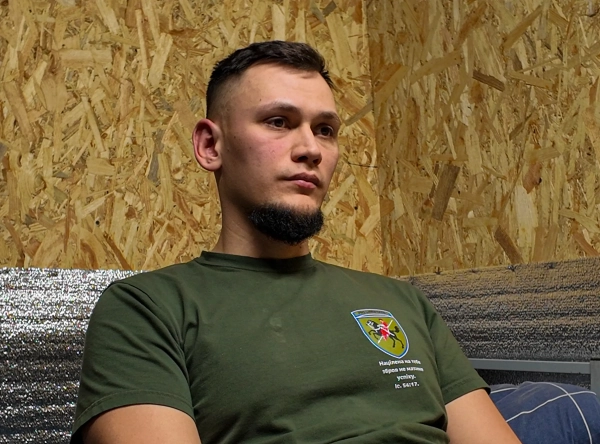
Commander of the 3rd Battalion of the 110th Motorized Rifle Brigade / Photo by Ivan Maguryak, 24 Channel
Over the past year, the Oleksandrivsky direction has undergone significant changes. A year ago, it was the Vremivsky and Kurakhivsky directions, then Novopavlivsky. The contact line was very dynamic, but if you look at open source data, the situation here has now more or less leveled off. Was this facilitated by the fact that the Russians are now paying more attention to Gulyaipol, or were there other factors that allowed the front line to stabilize?
Indeed, the enemy's main objective is Gulyaipole. But, in my opinion, our direction is still one of the top priorities, because the highway passes here. Whoever has logistics has quite a lot of opportunities to develop a further offensive, preparing a bridgehead.
Why did the Russians break into the Dnipropetrovsk region and how to prepare the defense further?
Last year, the fighting reached the Dnipropetrovsk region. And last spring, many media and military and not only military people called for the region to prepare for defense, because the front was approaching from the direction of Pokrovsk. For almost a year, we see that there has been no breakthrough from this area, but still the fighting in the Dnipropetrovsk region is going on in the Oleksandrivske direction. In your opinion, was the Dnipropetrovsk region ready for defense?
There are many factors why the Russians broke through. You can't be prepared for everything that's in their heads. Of course, many things can be predicted, intelligence works and knows some plans, but there's always an element of surprise and all these “surprises” that they arrange for us.
It just so happens that the front is here. We need to proceed from the current situation and plan defense according to what is available.
Doesn't the area where the front is now playing against us? It's a fairly flat area.
This is no longer Donbas. There were many more different fortifications in Donbas, and so on. Now we are doing a lot on our own – we are equipping dugouts, we had certain tasks to prepare defensive lines.
Actually, about the preparation of the frontiers, especially the one that is not in your area of responsibility. What about the pre-arranged positions now? There was just a case last year when one of the engineering brigades showed prepared positions in the form of trenches in an open field and this was immediately criticized. But this is not the only case. What about the preparation of the frontiers now?
I understand what you mean. I hope that positions are no longer prepared in the open field, where they are easily visible, because they are generally ineffective. First, they are visible. Second, we do not have the number of soldiers to conduct defense there.
Based on these two factors, it is necessary to create small positions for 3-4 servicemen somewhere in the plantations, where there are plantations, where there are trees and where you can take cover.
Why do infantry get stuck in positions and how long should the sorties last?
The situation at the front is quite complicated now, and unfortunately, there are often cases when infantrymen spend several dozen or even more than a hundred days in positions. Do you have such cases in your unit?
There are various cases and this happens, but mainly it is if there are, let's say, prerequisites for this. That is, when the infantrymen are “cut off” somewhere or they are surrounded due to enemy actions or certain actions of adjacent units.
Speaking of your battalion, what is the largest number of days that infantrymen spent in positions?
73 days.
Were they able to be evacuated?
Yes.
Different units have their own approaches to such cases, the most popular being that if an infantryman is stuck in a position, upon his return he is given a new position, rather than moving on to the next sortie. What is your approach?
Indeed, there is such a practice. People who have been through the infantry and return with a wound or, God forbid, without one, are treated, rehabilitated and return to the unit, but to a new position. They can move to fire support, UAVs or NRCs, which we are currently developing and sending fighters for training.
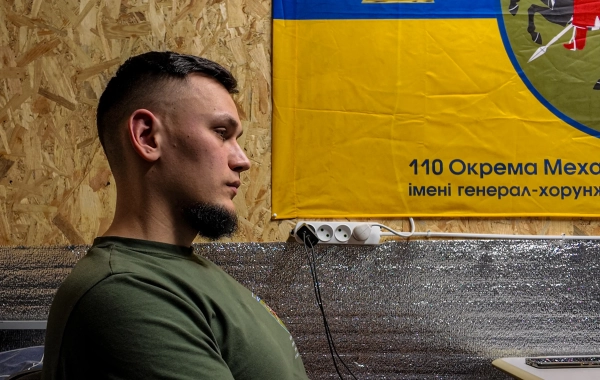
Commander of the 3rd Battalion of the 110th Motorized Rifle Brigade / Photo by Ivan Maguryak, 24 Channel
Ideally, what should be the duration of an infantryman's exit under current conditions?
Ideally, we would like up to 10 days. 10 days have passed – rest. But we are far from ideal, we have difficult logistics. All logistics are now carried out using drones and ground robotic complexes. That is, with the help of these means we transport provisions, food, ammunition, communication equipment, batteries. Especially in frosty conditions.
Not just mobilization: where do the recruits for the brigade come from?
Logistics in such cases is the No. 1 problem. What about the shortage of people? How much is it felt, especially when we are talking about infantry?
Indeed, the shortage is felt. But there is a significant difference between what is now and what was a year ago. Now we are paying more attention and effort to drones, the development of UAVs, IRCs, and so on. Their development will allow us to cover all this, so to speak, shortage of infantry.
But can, for example, NRCs replace infantrymen?
It's completely impossible, because, as I mentioned, weather conditions affect the equipment, for example. And, unfortunately, it often doesn't work as efficiently as we would like.
The main way to replenish the army now is mobilization. But are there still volunteers who come to you on their own, or perhaps under the “Contract 18-24”?
Under this contract, we only have those who are already serving with us and want to sign such a contract now. We have no new recruits under this contract.
Interesting! “Contract 18 – 24” is a special form of contract for citizens who have not reached mobilization age, which can be signed with any chosen unit. The contract can be signed for 1 or 2 years (the latter for those who want to work in the UAV direction). Anyone who signs such a contract can receive cash payments, the opportunity to study for a state order and other benefits, and after the contract is completed – 1 year of deferment from service.
At the pilot stage, this contract could only be signed in a certain list of brigades, but now there are no restrictions on units.
The main influx of people into the unit now comes from recruiting, which we have been actively developing since last year.
Are there more recruits than mobilized?
I think so, because the influx of mobilized people is not large. And the recruitment is going on in different directions and areas. People are going for different reasons – on a voluntary basis, through the SZCH or for some other reason.
Commanders need to work: what is the current situation with the SZCH?
By the way, about SZCH. The new Minister of Defense Mykhailo Fedorov stated that we have about 200 thousand cases of SZCH, and the Commander-in-Chief of the Armed Forces of Ukraine Oleksandr Syrsky says that this figure is growing. What is the trend in your unit now?
Growth is observed only when there are many military personnel. It is necessary to understand that a mechanized battalion is infantry, because currently little equipment is involved due to drones.
And when there is a replenishment, when we physically do not have time to work with people, they panic, because they come from civilian life and this happens. But when everything is stable, people know each other, then such cases are much less. But, unfortunately, there are.
But there are also cases of returning from the North-Eastern Front. How do you work with such fighters?
They return mainly for several reasons. Some are caught at checkpoints, some return because they have closed their health issues and have the status of limited fit, some are motivated and want to continue working. There are different options.
If they return, that's fine, we work and find positions for them. Sometimes specialists return who can be recruited to the NRC, UAVs, a mortar battery, and so on. Accordingly, we select a position.
There are cases when a fighter goes on vacation and doesn't return. And it happens that other fighters have their vacations canceled because of this. And it looks like they're punishing those who stayed. What do you think about this?
This is an individual issue. This happens less and less with us. Especially when we are already getting along as a team, our people are familiar with each other, and these factors reduce the risks of SZCH.
When a commander works with a person, knows about his problems, helps to solve them, even if it is, for example, some family circumstances. Such moments and nuances give an incentive to stay and not leave. Or even if you leave, then, let's say, with elements of decency.
In 2022, and even in 2023, we had lines at military registration and enlistment offices, many people volunteered. Now the situation is the opposite. In your opinion, is the situation we find ourselves in, given that we are in a war of attrition, a pattern or the result of a mistake being made somewhere?
Of course, the mobilization, to put it mildly, is not as we would like. And that is putting it very mildly. There are many people who made mistakes, but I think only time will tell. And only then will we perhaps find answers.
There is a popular saying among the military – “There are three ways out of the army – 200, 300, SZCH”. Many military personnel have been in the army for almost 4 years, although they were not career soldiers before the invasion. But on the other hand – in conditions when we have a shortage of people, it is also impossible to dismiss those who have been in the army since 2022. In your opinion, what can be the way out of this situation?
If there is a term of service, there will be no 100% replacement for soldiers. I am also mobilized – 4 years ago I did not see myself as a soldier, but now I am.
“Whoever jumps first wins”: what technologies is the 110th Brigade currently implementing?
You mentioned that in the conditions we are in now, the focus is on technology to help cover the shortage of people. What specific technology priorities do you have in your battalion now?
Directly – reconnaissance. Our strike component is also at the stage of active development, but there are many nuances. We also want to introduce ground robotic complexes, because they have proven themselves very well, especially in moments where it is not necessary to send military personnel and risk their lives, but to use them.
What about heavy bombers?
We have them developed, we have been working in this direction for over a year. Now we want to add people to FPV drones.
FPV drones, and especially fiber-optic drones, are a significant problem. And what is their range now? Because I know that they find coils in the wreckage for several tens of kilometers, but in practice, what is the range?
This could be a hit at 20 kilometers or more. Recently, a pickup truck belonging to a communications platoon was hit. Anyone who understands knows that they are relatively far from the front. But they hit at a distance of 26 kilometers from the contact line. The take-off point is unknown.
Important. Drones have become both an opportunity and a challenge, because the enemy also does not stand still. Drone detectors are now a necessity that can save more than one life of our soldiers. Now the 110th brigade is collecting for “Chuyka”, which will help detect enemy drones. The goal of the collection is 30,000 hryvnias.
Follow the link and join the gathering!
FPV drones are actually consumables. For example, for one crew, how many drones are used per day or per mission?
There are many factors, sometimes there are 10 to 20 drones per day. On calmer days, there are fewer.
FPV drones are an effective weapon, we have quite a few of them now and we use them daily.
And how do you use the NRC? This direction is relatively new for the battalion, as I understand it?
We already have cases of effective use. For example, we evacuated seriously wounded people who could not move, delivered ammunition to positions and provisions. We use the NRC to the maximum.
Once upon a time, FPVs were a novelty and something incomprehensible and unknown, and were treated with caution, now it's the same with NRK. But, I'm sure, whoever jumps on this train first can win in the future.
At what distance does the evacuation of the wounded take place?
It is important to understand that the route is not a straight line. There are crossings, the operator needs to plan the route in advance or adjust it during the operation.
From the last one – they evacuated a wounded person, the NRC drove 12 kilometers to him from the unloading point. It seems that this was in November of last year. This operation lasted all night – it started around 8 pm and ended at 6 am. They worked all night.
What is the future of this fighter?
After a successful evacuation, he was sent for treatment. He was in serious condition, but, thank God, he is doing well.
A completely different generation: how did the army change during the Great War?
You have been in the army for more than one year, and in fact since the very beginning of the full-scale war. It is obvious that during these years there have been many changes in various areas. What change do you consider the most important?
The army has changed a lot. Friends who were in the army before the full-scale war say that the changes are radical. There is a whole new generation of commanders, starting from battalion commanders and further up – commanders of brigades, army corps, operational commands. This is a completely different generation.
Young servicemen came to the department who really know what it's like to be a company commander during war, a battalion commander, or a brigade commander. And it's bearing fruit.
Among the young commanders, you can also be singled out. Did you have an officer's rank before the full-scale invasion?
Yes, I graduated from the military department in Kharkiv, but I am not a regular soldier – I am mobilized.
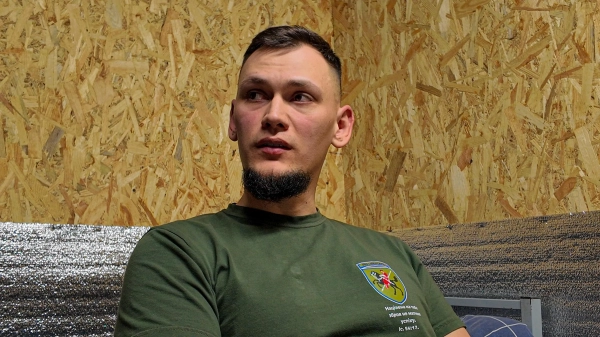
Commander of the 3rd Battalion of the 110th Motorized Rifle Brigade / Photo by Ivan Maguryak, 24 Channel
The word “victory” has fallen out of use: what do the military think about the end of the war?
When some high-profile corruption scandals arise, such as the deals around Energoatom, organized, in particular, by Timur Mindich, the civilian part of society reacts sharply and in some places it hits the morale, because on the one hand – war, on the other – someone is profiting. And how do the military, your subordinates, react to such scandals?
Mostly not. We are busy with our work here and basically don't have time to watch. Although we see the news, we discuss it, but not as actively as one might think. Sometimes we talk, laugh, think or curse at certain characters and then we continue our work.
In 2022, when we declared at the state level the goal of reaching the 1991 borders, given the counteroffensives in the Kherson and Kharkiv regions, society had a vision of how the war could end – for example, by consolidating our troops at the state borders. However, now this is practically impossible. So the question arises – can we win?
The word “victory” has already fallen out of use in our country. It is for society, for foreign partners. And for us, victory… Well, what can I say about victory to a person who has lost everything? To someone who has lost parts of their body, who has lost their loved ones – what is victory for them and what will it mean?
First of all, we have thoughts about what we would like to see a quicker end. When there were so-called truces last spring, there was an unusual silence in the Sumy region, where we were then. The infantry reported – 4.5.0. There was some hope inside. Although on the one hand you understand that it is unlikely, but on the other hand – “what if?”.
We have been talking about negotiations for a year now, and we all hope that the war will end somehow. However, a year has passed, the front is moving closer, and several more cities have turned into a wasteland. Against this background, according to my observations, and not only my own, people's involvement in gatherings and in supporting the army is somewhat decreasing, because there is indeed hope that everything will end soon. And does this affect the military?
It's one thing to watch the negotiations and listen to some slogans from politicians or foreign partners, but it's another to see reality. When you're here, on the front lines, you see everything and understand that there can be no talk of peace or an end to the war right now.
We have already talked about victory, but at the same time the threat of defeat remains. What should we as a society do to avoid losing?
Everyone is tired. It sounds terrible, but it is. But you have to understand that we, the military, are also not very happy to be here and it is not something we would like to continue. We also want it to end.
However, in order for the war to end, we need a lot of resources, and the state cannot provide them all. Therefore, we are opening a fundraiser, asking the public to help us, and indeed, donations have decreased now, and we are no longer collecting for pickup trucks or electronic warfare vehicles, but simply for equipment repairs, so that we can repair the pickup trucks that we have.
Therefore, a huge request to people to open their eyes, take off their rose-colored glasses, and help.
And, in my opinion, turning off the lights is another response and a reminder that the war continues.