
Main points
- The P1-SUN drone, developed by the Ukrainian company Skyfall, is an effective means of intercepting Iranian and Russian drones, such as the Shahed.
- The P1-SUN has a modular design and can be produced in the thousands per month, making it a cost-effective option for countering enemy drones.
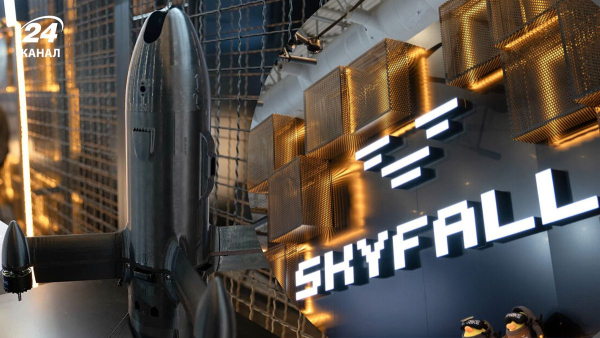
P1-SUN interceptor drone / Channel 24 Collage
After the start of the new war in Iran, it became clear that the US and its Arab allies are unable to protect their infrastructure from attacks by Iranian “Shaheeds” (with Russian modernization) and other drones. Since Ukraine today has the world's greatest expertise in countering drones of these types, the appeal of the victims to Kyiv to “close the sky” seems both logical and understandable.
- 1 Where did the P1-SUN drone come from and what is known about it?
- 2 Why was the P1-SUN drone named that and how did it spark a wave of memes?
- 3 What is P1-SUN and how does it work?
- 4 P1-SUN – main characteristics
On March 5, it became known that the Americans had sent a corresponding request to Ukraine. Donald Trump, who still says that “Ukraine has no cards,” actually confirmed this information. In the evening of the same day, President Zelenskyy said that Ukraine would come to the rescue and not only hold consultations, but also provide means to intercept the Iranian-Russian “Shaheeds”. Currently, Ukraine has several models of interceptor drones. These are Merops, the hero of the FOX News Sting story , and others. However, the most famous is the P1-SUN drone.
Thanks to its frivolous name, this drone has become a meme, but the naming is far from the only noteworthy feature of the P1-SUN. What kind of drone is this, why is it called that, and what characteristics does it have, 24 Channel tells us.
Where did the P1-SUN drone come from and what is known about it?
In 2024 and 2025, Russia scaled up attacks with Shahed drones (in the Russian version, Geran-2) in the Ukrainian rear. Both infrastructure facilities and residential buildings were hit. Indiscriminate terror with signs of genocide perpetrated by the Russians became a major problem.
In fact, with these strikes, Russia tried to put Ukraine in a hopeless situation, because the air defense forces had no right not to shoot down cheap “Shaheeds”, which cost about $50,000, and the price of “Gerber” decoy drones is even lower. Instead, much more expensive, and most importantly, rare missiles were used to intercept them.
The Arab monarchies of the Persian Gulf are doing roughly the same thing now, repelling Iranian attacks. They are spending very expensive missiles on Patriot systems, the price of which is many times higher than the price of the Iranian shells flying in their direction.
Several development teams worked to rectify the situation and find economically viable and effective options for countering Russian drones.
One of the first projects that entered service with the Defense Forces as a hunter for “Shaheeds” was the P1-SUN drone. Its author and creator is the Skyfall company, known as the developer of the legendary Shrike FPV drones and Vampire bombers, which the Russian occupiers call “Baba Yaga” with respectful horror.
In October 2025, Skyfall presented prototypes, and by the end of 2025, the interceptor drone codenamed P1-SUN had proven its effectiveness.
One of the first published photos of P1-SUN:
Later, the first videos of combat work of a Ukrainian drone successfully hunting Russian ones appeared.
P1-SUN shoots down a Shahed jet: watch the video
Over time, such videos became more and more numerous, as did downed Shaheds and their Gerber decoy versions. As of early March 2026, there were already over 1,500 Shaheds shot down by P1-SUN, which is an average of over 300 targets per month.
It is also necessary to add to this list about 1,000 intercepted Russian drones of other types.
In February 2026, P1-SUN drones were responsible for 70% of drones shot down in Kyiv and its surroundings.
In an interview with Bloomberg in November 2025, the drone's developers said that the creation of the P1-SUN was based on the combat experience of the Ukrainian military, which regularly intercepts and destroys Russian strike UAVs of the Geran-2 type.
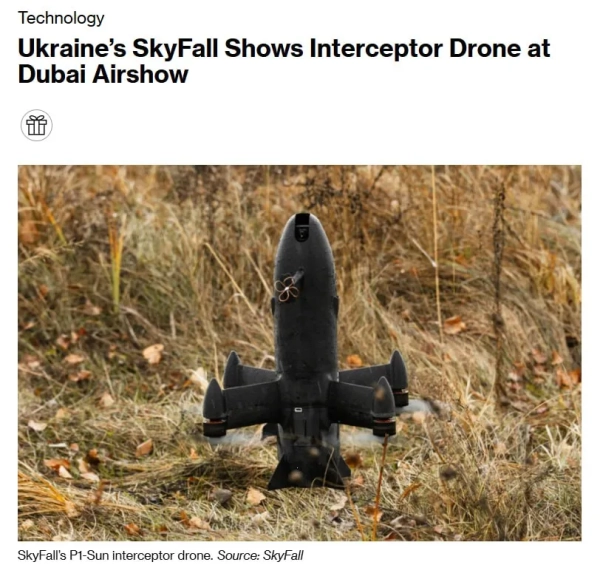
Screenshot of Bloomberg article about new Ukrainian development
That is, we are dealing with the most effective strategy when engineers make a product, taking into account the experience and wishes of customers. The manufacturer also trains pilots itself – SkyFall has its own academy, which conducts a three-week course for new drone operators.
At the same time, the network fame of the latest development grew. An additional factor in its popularity was undoubtedly the hooligan naming, which turned out to be surprisingly successful.
Why was the P1-SUN drone named that and how did it spark a wave of memes?
At the arms exhibition in the UAE, Dubai Airshow, in November 2025, a product called P1-SUN attracted a lot of attention. At the same time, for foreigners, the abbreviation P1 with the addition of the word SUN (in Ukrainian – sun) did not seem strange, but every Ukrainian, when he saw it, certainly smiled.
The thing is that behind the Latin letters and Arabic numerals lies a pun – a slang name for the male genitalia, known since childhood.
It seems that the developers or the military who tested the product decided to make a joke at an early stage of the project, because the drone is indeed a bit (no, actually a lot) similar, but the prank with elements of front-line humor got out of control, and the name stuck.
And now, the former First Lady of the United States, Hillary Clinton, is taking pictures with the P1-SUN drone and posting them in her X, and then, as they say in youth forums, “everything is like in a fog” and “we are now in this timeline.”
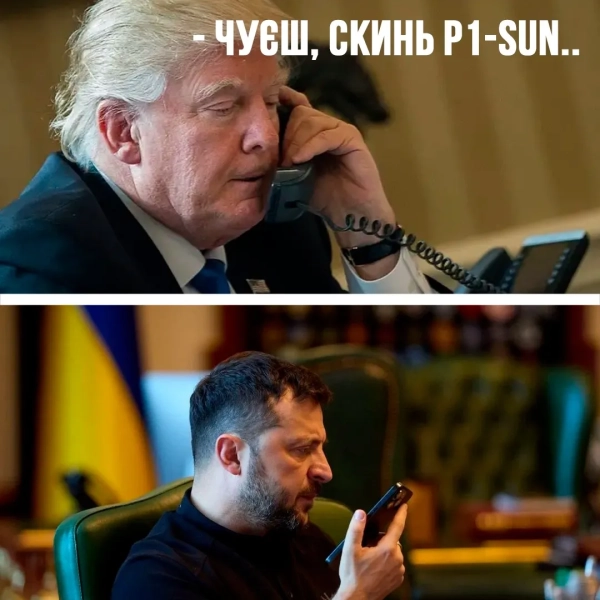
A joke about P1-SUN from a famous meme master / Photo from Dmytro Kovalenko's Facebook
What is P1-SUN and how does it work?
The P1-SUN drone is made using FPV technology from plastic and printed on a 3D printer. It has a modular design. This makes it cheap (about $1,000 apiece) and not too fussy to manufacture. And this is exactly what the Defense Forces needed to combat Russian drones.
According to SkyFall, by the winter of 2025/2026, these drones were being produced in the thousands per month. Thanks to this, the effectiveness of intercepting the Shahed and Gerbers significantly increased, and the P1-SUN became one of the factors that helped Ukraine survive the most terrible winter in its history.
The P1-SUN is an FPV quadcopter with pusher propellers. The drone launches from the surface and can deliver kinetic strikes or strike with the explosion of a warhead.
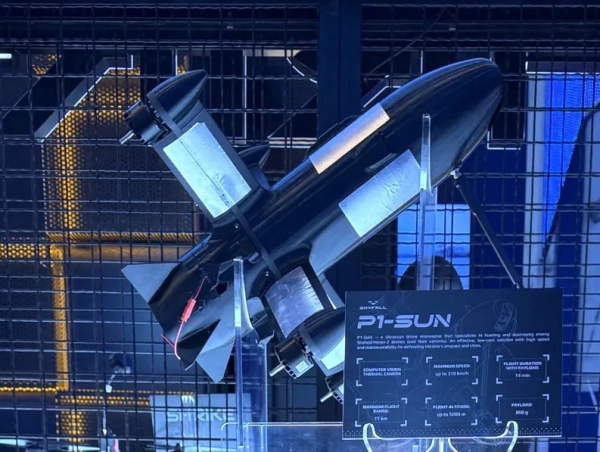
P1-SUN – the star of the arms exhibition in Saudi Arabia / Photo SkyFall
The engineering solution and focus on the module allow the P1-SUN to be adapted and quickly modified, improving aerodynamics and characteristics.
All this is happening so quickly that even Wikipedia can't keep up with the feature updates. For example, the latest software “patches” allow the P1-SUN to operate remotely, meaning drones can now be deployed across the country and launched when radar detects a swarm of attacking Russian drones.
The drone can reach speeds of over 300 kilometers per hour. This means that it is faster than the “classic” Russian “Shahed”, which has a speed of 150-180 kilometers per hour. This speed also makes it possible to “catch” jet modifications of the “Shahed”, whose maximum speed can be even up to 600-700 kilometers per hour, but all the way.
P1-SUN – main characteristics
- type – interceptor drone;
- manufacturer – SkyFall (Ukraine);
- maximum speed – 310 kilometers per hour;
- maximum altitude – 9000 meters;
- range – up to 33 kilometers;
- warhead weight – 800 grams;
- price – $1000.
The success of the P1-SUN drones in real combat conditions has attracted the attention of the world, and recent news from the Middle East and other hot spots suggests that the demand for such products will only grow. Currently, there are reports that Denmark wants to locate SkyFall production on its territory, and dozens of countries are interested in the products of the Ukrainian defense company.
In a recent interview with Reuters, SkyFall representatives said that they can produce up to 50,000 interceptor drones per month and export from 5,000 to 10,000 without harming Ukraine's needs. SkyFall also said that it is ready to send instructors abroad if the Ukrainian government allows it to sell drones to other countries. In particular, to the United States. Yes, to the same country whose president says that “Ukraine has no cards.”