
Main points
- Using a two-prong cable to power an entire apartment through a charging station can lead to fatal consequences, including ignition and fire.
- Safe backup power at home requires specialized equipment, such as an automatic backup input system or a transfer switch, and professional assistance from electricians.
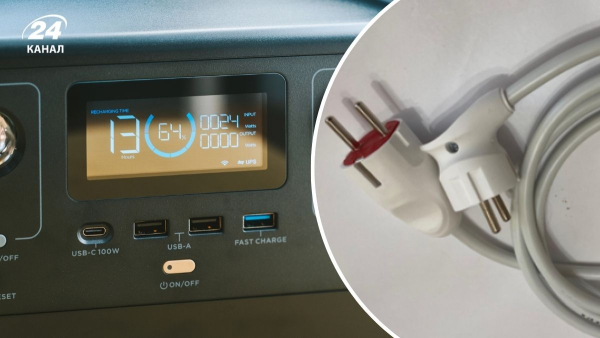
The danger of the “killer cable” / Collage of Channel 24 / Photo Depositphotos
Using a portable charging station to power your entire apartment via a two-prong cable is a popular but extremely risky solution. This connection method can lead to fatal consequences for property and the equipment itself.
Experts emphasize that without specialized equipment and the help of electricians, such experiments with the power grid pose a threat to residents, reports 24 Channel .
What are the dangers of using a cable with two plugs?
Typically, charging station owners follow a certain pattern: they turn off the input circuit breaker in the panel, connect the station to the nearest outlet with a “plug-to-plug” cable, and turn on the device.
When the external power supply is restored, the procedure is repeated in reverse order. However, this method hides a huge danger: if you accidentally forget to turn off the circuit breaker or disconnect the cable before the voltage appears in the general network, the two current flows will collide . explains Electrical Technology.
Why is this dangerous?
The current from the mains is much more powerful than that produced by the charging station. If they move in opposite directions, the charging station board can instantly fail, which often provokes ignition and a fire in the entire apartment.
Even ready-made cables with two plugs that can be found on the market do not make this method safe. You should understand the limitations of your devices and the number of consumers you plan to power.
In addition to the breakdown of the station itself, there are other serious dangers:
- Danger to life: Live plugs can cause fatal injuries if touched. At currents above 30 mA, a “hold-to-let” effect occurs, when a person cannot independently detach themselves from an electrically conductive object.
- Fire risk: poor contact in a socket under heavy load causes severe heating, melting of insulation and igniting of wall decoration or furniture.
- Failure of household appliances: the conflict of two phases negatively affects the sensitive electronics of boilers, refrigerators and computers.
- Overloading of wiring: household sockets and wires are often not designed to power the entire home, leading to insulation breakdown and current leakage.
Experts call such a wire a “killer cable.” For safe power supply, specialized equipment must be used.
How to organize reliable backup power at home?
The most correct and safest method of using a charging station is to connect the necessary devices directly to the station ports using conventional cables. Typically, modern charging stations are equipped with several full-size 220 V sockets, a special 12 V car connector and USB ports of various standards.
In most cases, this is enough to charge a smartphone, laptop, or some household appliances. But even then, you should take into account the characteristics of the equipment, because the consumption should not exceed the capabilities of the charging station.
If you want to power the entire apartment without moving the device from room to room (and your station allows this), you need to modernize the distribution board and you should definitely seek the services of specialists. In this case, the station is connected through specialized devices, such as an automatic reserve input system (ATS) or a three-position rocker switch.
The rocker switch provides three operating modes:
- power supply only from the mains,
- complete lack of current,
- power supply only from an alternative source.
This mechanically prevents phase overlap and reverse voltage, which is the main cause of breakdowns. The use of separate circuit breakers, RCDs, neutral and grounding buses is also mandatory, explains Electric Shop.
Important! In most cases, manufacturers, in particular EcoFlow, emphasize that their equipment is not designed for power distribution through homemade “plug-plug” cables and does not have built-in protection against reverse phase. Therefore, professional electricians should be called to install switches and set up automatic mode. They will help you correctly calculate the number of consumers, check the cable cross-section (usually 1.5 – 2.5 mm) and provide a guarantee of safe operation of the entire system.