
Main points
- Former Harvard physicist Michael Guien hypothesized that God could reside on the “cosmic horizon” 439 billion trillion kilometers from Earth, which sparked skepticism in the scientific community.
- Guillén's idea contradicts modern cosmology, since the cosmic horizon is not a physical boundary, and time does not stop there, which refutes his philosophical and religious interpretation.
Physicist claims to have “found” God at the edge of the Universe / Unsplash
A former Harvard physicist has attempted to combine modern cosmology with biblical ideas about God. The result is a hypothesis about a specific place in the universe where a “divine entity” might reside. The idea sounds impressive, but it raises serious questions from the scientific community.
Can God be linked to the cosmic horizon?
Former Harvard physicist Michael Guien has proposed that God may have a physical “place” in the universe. According to him, this point is located approximately 439 billion trillion kilometers from Earth. Obviously, this is not a scientific discovery or a hypothesis recognized by the academic community. It is rather a philosophical-religious interpretation using certain terms from physics, writes IFLScience.
At the heart of Guillén's reasoning is the concept of the cosmic or event horizon. This is the boundary of the observable Universe beyond which light from objects can never reach Earth. The reason is simple: the Universe is expanding, and the space between us and distant galaxies is growing faster than light can overcome it.
In a static universe, the situation would be different. Over time, we would gradually see more and more distant objects, because light simply takes time to reach us. But the real universe is not static. According to Hubble's law, the further an object is, the faster it moves away from us. At some point, the speed of this movement reaches the speed of light.
It is this distance that Guillén calls the “cosmic horizon,” adding a divine meaning to it. He claims that at this boundary time seems to stop, and therefore there is no past, present, or future. He then draws a parallel with the Bible, which says that heaven is inaccessible to living people and is the abode of immaterial, immortal beings.
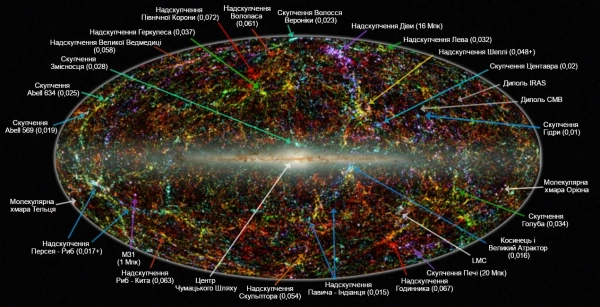
This diagram shows the boundaries of the observable Universe in a very conditional way, but it doesn’t end there. Then there is the same cosmos, space, stars, galaxies and planets. We just don’t see them because their light hasn’t reached us yet / Photo California Institute of Technology / Thomas Jarrett
Why is all this not true?
The problem is that this interpretation contradicts modern cosmology. In scientific models, time does not “freeze” at the cosmic horizon. Events there occur in the usual way, they just appear to an observer on Earth to be slower and slower due to the strong redshift of light. This is an observational effect, not a real stoppage of time.
The cosmic horizon is also not a physical wall or a specific place in space. It depends on the point of observation. For hypothetical observers in distant galaxies, the Earth itself is beyond their cosmic horizon. This does not make our planet sacred or divine.
In short, Guillén’s claims, which he happily made to Fox News, amount to poetic metaphor rather than scientific conclusion. He treats the observable edge of the universe as a physical location and attributes to it properties it does not have.