
Main points
- An international group of climate scientists predicts that in 250 million years, the formation of a new supercontinent could make Earth too hot for mammals due to a combination of factors such as increased solar activity and rising CO2 levels.
- Models show that only 8-16% of the new supercontinent's area will remain habitable, and CO2 levels could rise from the current 400 ppm to over 600 ppm if humanity does not stop burning fossil fuels.
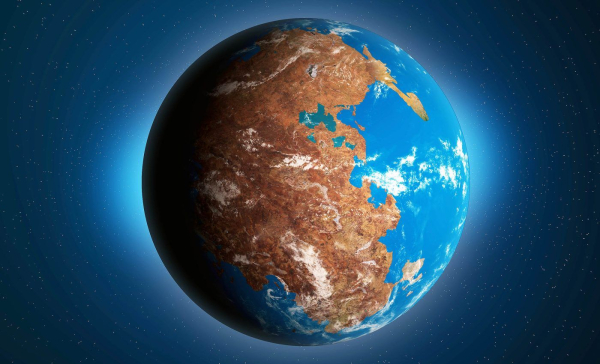
Earth could become uninhabitable due to supercontinent / Earth.com
An international team of climate scientists has modeled Earth's future 250 million years from now and concluded that the formation of a new supercontinent could make the planet too hot for most mammals. The cause will be a combination of factors, from increased solar activity to rising CO2 levels.
The idea that extreme heat could lead to the complete extinction of humans and other mammals may seem like a fantasy, but a study suggests that such a scenario is quite possible in the distant future, writes Earth .
Why could a supercontinent wipe out mammals?
The work was led by Dr Alexander Farnsworth from the University of Bristol . The team used climate models that took into account the movement of tectonic plates, changes in solar radiation and greenhouse gas concentrations.
What is Pangaea Ultima?
Geologists have long proven that the continents are gradually moving. In hundreds of millions of years, they may reunite into a single landmass called Pangaea Ultima.
If such a merger were to occur, much of the land would be far from the oceans that currently cool the climate. This phenomenon is called the continentality effect. According to Farnsworth, the new supercontinent would create a triple whammy – greater distance from the oceans, a brighter Sun and increased CO2 levels.
The three factors of critical warming are:
- The first factor is the huge land area with hot interior regions.
- The second is a gradual increase in solar radiation. The Sun is expected to become about 2.5% brighter.
- The third is active volcanic activity, which will increase the concentration of carbon dioxide.
According to WWF, average temperatures are predicted to reach 40-50°C, and in some places even 70°C. High humidity will only exacerbate the effect. Farnsworth noted that humans and many other species will die due to the inability to effectively dissipate heat through sweat.
Will other mammals be able to survive?
Mammals have adapted to the cold in the past, growing thicker fur or going into hibernation. However, prolonged heat is more difficult to tolerate. Without access to cool areas and sufficient water supplies, the body will not be able to maintain a normal temperature for long.
Models show that only 8-16% of the supercontinent will remain habitable. A drier climate will reduce vegetation and water resources, making it difficult to find food and water.
CO2 levels could change in the future. Scientists have modelled changes in ocean chemistry and tectonic processes to estimate future CO2 concentrations. Professor Benjamin Mills of the University of Leeds said the figure could rise from around 400 ppm today to over 600 ppm in millions of years. If humanity does not stop burning fossil fuels, these levels could be reached much sooner.
Greenhouse gases will trap more heat in the atmosphere, amplifying the warming effect on the planet with minimal oceanic influence.
The modern climate crisis
Study co-author Dr. Eunice Law from the University of Bristol said that while the forecast was far off, humanity was already facing dangerous heatwaves. She stressed the importance of achieving net-zero emissions.
Recent decades have shown rising temperatures, damaging agriculture, energy systems and human health. Experts are convinced that proactive actions and environmental policies can mitigate the immediate consequences.
Lessons from past disasters
Earth's history contains at least five major mass extinctions .
- About 443 million years ago, the Ordovician-Silurian event wiped out approximately 85% of marine species.
- The Late Devonian led to the loss of up to 75% of species.
- The Permian-Triassic extinction event 252 million years ago wiped out over 90% of marine organisms and 70% of terrestrial organisms.
- The Triassic-Jurassic reduced biodiversity by about half.
- And 66 million years ago, an asteroid impact caused the Cretaceous-Paleogene extinction event, during which dinosaurs and about 75% of species disappeared.
The new scenario could be the first time that excessive land heating is the decisive factor.
What does this mean for the search for life in space?
The study also has implications for the assessment of exoplanets. Even if a planet is in the habitable zone, the combination of continents and the composition of the atmosphere could make it unsuitable for humans. Scientists also take into account the planet's rotation speed and the chemical composition of the air.
Thus, the distant future of the Earth demonstrates how important the balance between geological processes, the atmosphere and solar activity is. And although the events described may occur in 250 million years, climate change is already affecting people's lives today.