
Main points
- Astronomers have simulated how a star collapses near a black hole, producing powerful bursts of energy that exceed the luminosity of the galaxy.
- The study showed that the mass, rotation speed, and orientation of a black hole affect the behavior of the flow of matter, which allows for the detection of hidden black holes.
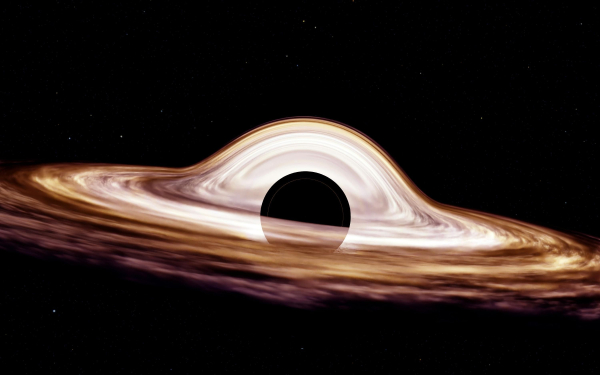
Scientists have shown how a black hole rips apart a star and reveals itself / Unsplash / BoliviaInteligente
Astronomers have modeled in detail what happens when a star approaches a supermassive black hole, explaining how such events help detect objects that are themselves invisible.
Supermassive black holes , which are located at the centers of most galaxies, remain some of the most mysterious objects in the universe. They can have masses millions or even billions of times greater than the Sun. At the center of the Milky Way is Sagittarius A* , a black hole with a mass of about four million solar masses. This is what Futurity writes.
How does a black hole destroy a star and why is it important?
The problem is that such objects do not emit light, so they can only be studied indirectly – by their effects on surrounding stars and gas. One key way is to observe so-called tidal disruption events.
A new study published in The Astrophysical Journal Letters , led by Eric Coughlin of Syracuse University, explains what happens when a star gets too close to a black hole.
The star does not disappear instantly. Powerful gravity stretches it into a long stream of matter. Over time, this stream begins to rotate around the black hole. Importantly, this process is explained not by classical physics, but by the effects of the General Theory of Relativity.
When parts of this stream collide, powerful bursts of energy occur. After that, the matter gradually “falls” into the black hole . Both processes – the collision and the subsequent absorption – create radiation so bright that it can temporarily exceed the luminosity of the entire galaxy.
Such phenomena are called tidal disruption events , or TDEs, and they are one of the few ways to probe hidden black holes in other galaxies.
To better understand these processes, scientists used modern computer models . The team, led by Lucio Mayer from the University of Zurich, used the method of particle hydrodynamics. In the model, the star is broken up into billions of conditional particles that interact with each other according to the laws of fluid motion described by the Navier–Stokes equations.
Thanks to the use of powerful supercomputers and graphics processors, it was possible to obtain a much more accurate picture. It turned out that the matter does not scatter chaotically, as previously assumed, but forms a narrow and ordered stream that moves along a predictable trajectory.
The study also showed that three factors influence the course of events – the mass of the black hole, the speed of its rotation and the orientation of this rotation. If the black hole rotates, the effect of the so-called nodal precession occurs, when the trajectory of the flow is shifted. Because of this, parts of the flow may not collide immediately, but make several revolutions before that.
This helps explain why tidal disruption events look different . Some flares appear quickly and fade quickly, while others last longer. The difference in behavior may be related not only to the mass of the black hole, but also to its rotation.
So when a star collapses, it creates a kind of signal that allows us to detect an invisible black hole. Thanks to new models and more powerful telescopes, astronomers are gradually learning to “read” these signals more accurately.