
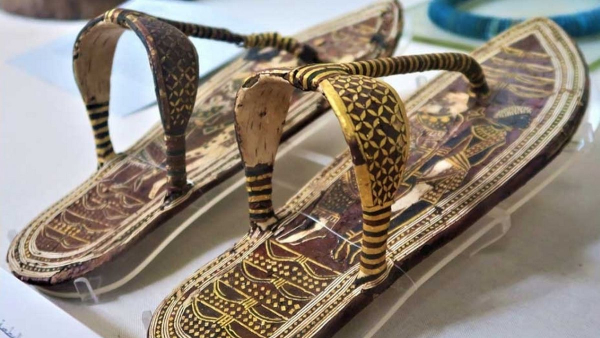
Tutankhamun's sandals / Merja Attia/Cecilia Bogaard
Archaeologists have unearthed dozens of pairs of shoes during the excavation of the tomb of a young pharaoh. Among them, one stands out in particular – its soles are decorated with images of bound enemies. This artifact offers an unexpected look at the symbolism of power in ancient Egypt.
Why did Tutankhamun's sandals become a symbol of dominance?
When British archaeologist Howard Carter and Egyptian workers opened Tutankhamun's tomb in 1922, the world was presented with thousands of items buried with the ruler who had died too soon. Among them were dozens of pairs of sandals intended for his afterlife. One pair in particular caught the researchers' attention, Live Science reports.
According to the original find card, these sandals were 28.4 centimeters long and 9.2 centimeters wide. By modern standards, this is approximately a 45 shoe size in the European system. Carter recorded that the artifact was lying under a basket, but the exact original location remains unknown.
The sandals are made of wood. They were covered with a layer of bark, greenish leather and decorated with fragments of gold foil on top of a white ground. The decor had not only aesthetic but also ideological significance. In the arch of the foot, two bound people are depicted, intertwined with lotus and papyrus – plants that symbolized Upper and Lower Egypt.
In addition, each sandal has eight bows – four near the toes and four near the heel. The straps are also made in the shape of a bow. Together, these elements form the so-called “Nine Bows” – a traditional symbol of all the enemies of Egypt. In the art of that time, this image personified the conquered peoples and threats that were under the rule of the pharaoh.
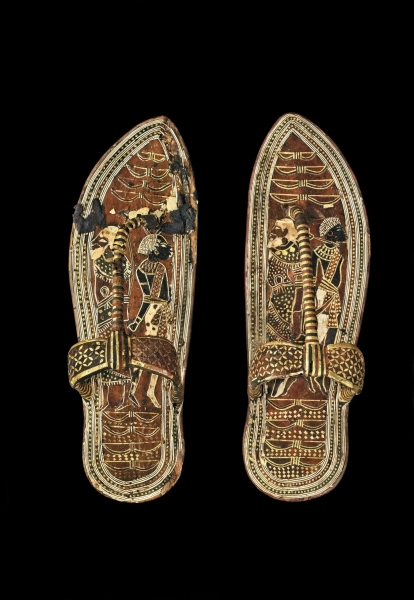
Tutankhamun's sandals / Photo Egypt Museum
The symbolism was literally under the ruler's feet. As the description of the exhibition notes, the enemies are placed so that the king steps on them, confirming his own dominance over them. This is not a random artistic technique, but a clear political message – even in an everyday object, the absolute power of the monarch was emphasized.
Today, these sandals are on display at the Egyptian Museum in Cairo. They are an example of how ancient Egypt combined utilitarianism and propaganda.
Interestingly, when Tutankhamun's mummy was discovered, he was wearing gold sandals and separate gold toe rings, writes the Egypt Museum. It is not known whether he wore wooden sandals with images of enemies during his lifetime. Perhaps they were created specifically for the funeral ritual, where even the details of the outfit had magical and political significance.
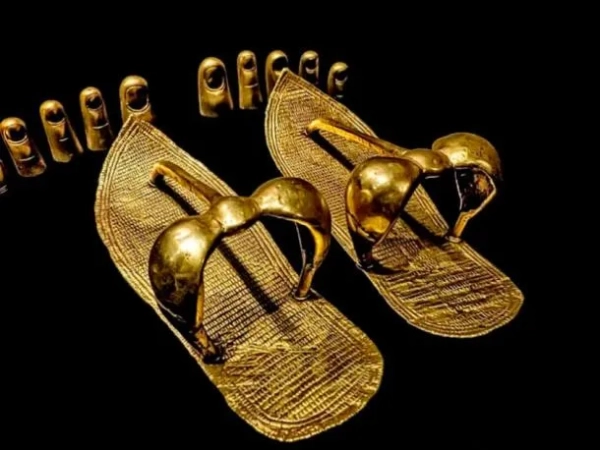
Gold sandals and toe caps found in Tutankhamun's tomb / Photo by Mary Harrsh