
Main points
- US President Donald Trump held a meeting with the Artemis 2 mission crew at the White House, where the astronauts remained in the background, and the media's attention was drawn to Trump's comments.
- Trump joked about his chances of flying into space and discussed the possible relocation of NASA headquarters, while the importance of the Artemis 2 mission and the agency's budget issues went unnoticed.
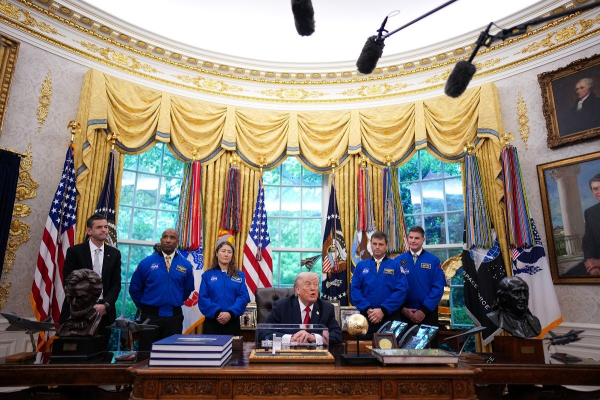
Artemis 2 crew at the White House / Andrew Harnik/Getty Images
US President Donald Trump held a meeting with the Artemis 2 mission crew at the White House. Despite the historic flight around the moon, the astronauts did not speak during the event, and the media's attention shifted to political topics and statements by the president.
Trump welcomed the four Artemis 2 astronauts to the Oval Office along with NASA Administrator Jared Isaacman. The event, which was broadcast live, was officially called a “welcome meeting,” but it went a bit strangely, Space.com reports.
How did the Artemis 2 astronauts stay in the shadows?
The spotlight was not so much on the astronauts themselves, but on the comments of the US president. Trump publicly praised the crew members – Reed Weissman, Victor Glover, Christina Koch and Jeremy Hansen – emphasizing their courage and importance to the country. At the same time, the astronauts themselves did not say a single word during the entire 22-minute event, remaining behind the president.
During the meeting, Trump also joked about his own chances of flying into space. He said he was in good physical shape and could handle such a challenge, and then asked Isaacman if the president could participate in the mission. The NASA chief replied diplomatically that it could be worked on.
In general, Isaacman received special attention during this event. Trump congratulated him on his appointment, calling it a “good choice,” and even joked about his “excellent hearing,” drawing attention to his ears, to which Isaacman responded with self-irony.
At that time, the head of NASA was answering a question about the possible relocation of the agency's headquarters, emphasizing that a presence in Washington helps to effectively interact with key partners.
What's up with the headquarters?
The question of the possible relocation of NASA headquarters from Washington was raised by journalists, but they addressed it not directly to the head of the agency, but to Trump, who actually passed it on to Jared Isaacman in his own style.
Isaacman emphasized that having its headquarters in Washington allows NASA to remain at the center of decision-making and maintain constant contact with key parties – from government agencies to partners and contractors.
According to him, such closeness helps to coordinate decisions more quickly and work in the interests of the country.
In fact, it was a cautious, diplomatic response without specifics: Isaacman did not confirm any plans to move, but he also did not directly deny the possibility of future changes.
The importance of Artemis 2 was ignored
The Artemis 2 mission, which lasted from April 1 to 10, was a landmark one: the crew flew around the Moon and returned to Earth. It was the first time humans had left Earth orbit since Apollo 17. In addition, the astronauts broke the record for the distance from Earth, surpassing the record set by Apollo 13.
Despite this, during the press event , journalists almost did not ask questions about the flight itself . The main part of the conversation concerned foreign policy, war and domestic American issues. Space was mentioned only sporadically – in particular, in the context of the possible declassification of materials about UFOs and plans to land people on the Moon as part of the upcoming Artemis 4 mission, which is planned for the end of 2028.
What other UFO materials?
At one point during the meeting, the topic of space unexpectedly shifted to UFOs. One of the reporters asked Trump about his promised declassification of government materials on unidentified objects.
Trump responded cautiously, but intriguingly: according to him, the authorities plan to release “as much as possible” in the near future. He also added that he had personally spoken to pilots – mostly during his first term – and they told him things that were “hard to believe.”
Trump did not provide any specific details or dates. There was also no clarification as to what exactly the materials in question were – whether they were new data or already known reports that could simply be made more widely available.
The US President also touched on the topic of the “Space Force”, created during his first term, and stated that this structure will become one of the most important for the country.
In addition, he again emphasized his role in rebuilding NASA, describing the state of the agency before his presidency as neglected, mentioning grass that “grew between the cracks on the runways.”
At the same time, the budget issue was ignored: the White House's proposed reduction of NASA funding by 23% and science programs by almost half was not discussed during the meeting.