
Main points
- Scientists have studied temnospondyls that survived a mass extinction 250 million years ago, adapting to life in salt water and populating the entire planet.
- The study showed that the fossils belong to two different species from the Trematosauria family, which successfully developed new ecological niches after the “Great Extinction”.
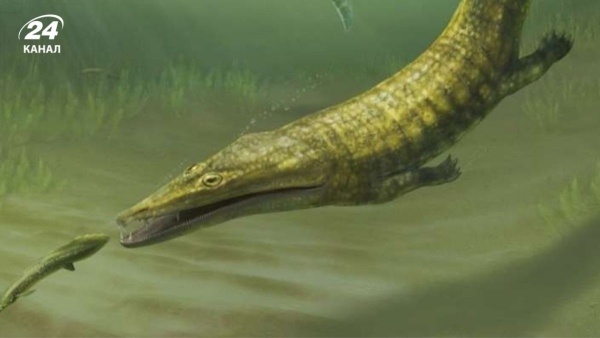
Fossils lost 50 years ago reveal secret of species survival / Swedish Museum of Natural History
250-million-year-old fossils found in Australia have revealed the secrets of the global distribution of temnospondyls – creatures that resembled a cross between a salamander and a crocodile.
A new study of skull fragments lost for half a century has proven that these amphibians not only survived the largest extinction in Earth's history, but were also able to adapt to life in salt water and populate the entire planet, writes Phys.org.
How were ancient amphibians able to conquer the world after a global catastrophe?
Today, the Kimberley region of northwestern Australia is a land of rocky ridges, red soil, and harsh droughts. But in the early Triassic period, about 250 million years ago, the landscape was very different: the area was covered by the brackish water of a shallow bay, and the shores resembled vast mudflats.
Instead of modern dingoes or kangaroos, temnospondyls ruled the roost, a bizarre group of vertebrates that looked like giant salamanders with crocodile-like features. These creatures turned out to be some of the hardiest creatures on Earth.
Their lineage lasted for over 210 million years , successfully surviving two mass extinctions at the end of the Permian and Triassic periods.
A new study published in the Journal of Vertebrate Paleontology sheds new light on these animals, showing for the first time how they were able to become an evolutionary success story.
How did it all start?
The story of this particular find, known as Erythrobatrachus noonkanbahensis , began in the 1960s during expeditions to the Nunkanbah Station, 250 kilometers from Broome. Then, paleontologists extracted three skull fragments from the rock, which were later sent to museums in Australia and the United States.
However, for the next fifty years these valuable specimens were considered lost. Scientists were lucky twice: first, a high-quality plaster cast of one of the fragments was found in the Western Australian Museum, and later, one of the originals was unexpectedly discovered in the collection of the University of California, Berkeley.
A careful analysis of these two fragments brought a scientific sensation: it turned out that they did not belong to the same species, as previously thought, but to two completely different creatures. Although both animals had skulls about 40 centimeters long, they occupied different ecological niches.
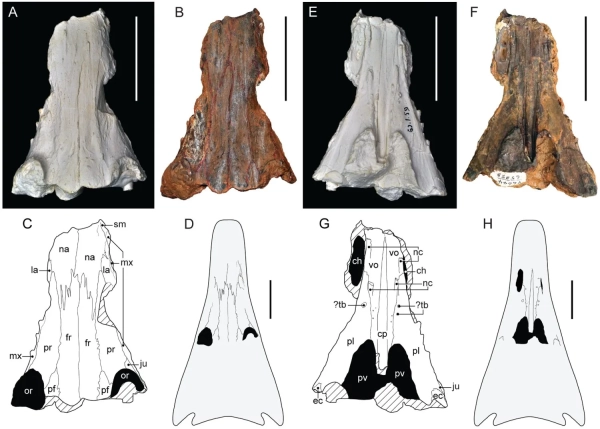
High-quality plaster cast and holotype specimen of Erythrobatrachus noonkanbahensis / Photo Journal of Vertebrate Paleontology
Erythrobatrachus itself had a massive, broad head that made it an apex predator in its environment. In contrast, the second species, identified as Aphaneramma , had a long, thin snout, ideally suited for hunting small fish.
What most impressed the researchers was their ability to ignore high salt levels in the water. Modern amphibians are usually very sensitive to salinity, but the Trematosauria family, to which both species belong, felt quite comfortable in marine sediments. It was this feature that allowed them to settle all over the world.
Confirmation that Aphaneramma's range included Australia is extremely important, as fossils of the same genus have previously been found in Svalbard, Pakistan, and Madagascar.
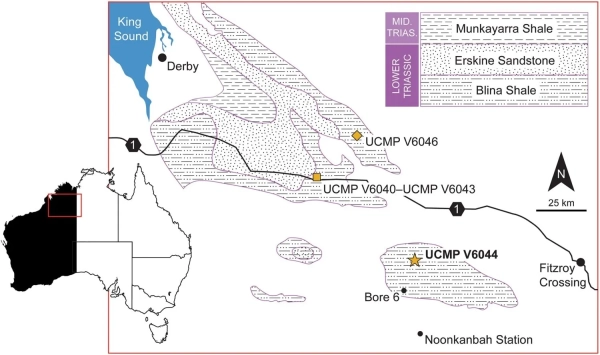
Locations of Erythrobatrachus noonkanbahensis detection / Photo by DEMIRS Data & Software Centre
What makes the discovery particularly significant is that these animals appeared in the geological record less than a million years after the “Great Extinction” – the most catastrophic event in the history of the planet .
This highlights the incredible evolutionary flexibility of temnospondyls. Their ability to rapidly adapt to new ecological niches, even during extreme global changes, makes them one of the most successful groups in the history of life on Earth.