
Main points
- In Sudan, 260 previously unknown monumental tombs older than the Egyptian pyramids have been discovered in the Atbai Desert.
- These architectural monuments date back to the fourth and third millennia BC and testify to the complex social structures of nomadic pastoral communities.
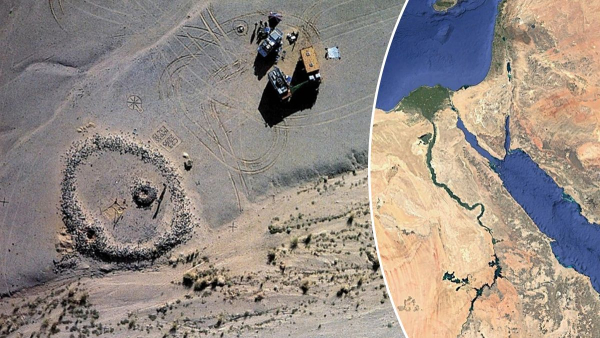
Treasures of the Atbai Desert: Satellites Discover Hundreds of Monumental Structures Older than the Egyptian Pyramids / Channel 24 Collage/Castiglione Museum/Google Earth
In the sands of the Atbai Desert, which stretches between the Nile and the Red Sea, researchers have discovered unique architectural monuments. These stone structures have long gone unnoticed, hiding evidence of the life of the communities that ruled there before the founding of the first dynasty of pharaohs.
How did the ancient inhabitants of the desert live long before the era of the pharaohs?
Archaeological science has received new data thanks to the Atbai Survey Project, which applied remote sensing methods of the Earth. Using satellite images from Google Earth and Bing, scientists were able to identify 260 previously unknown monumental objects in the Atbai Desert, located in the territory of modern Sudan and Eastern Egypt. The total number of documented structures now stands at 280, of which only 20 were previously known. They were discovered thanks to ground expeditions, writes Arkeonews.
These monuments are called the “Atbay Walled Burial Grounds.” They are large stone walls of a round or oval shape, inside which graves are located. The sizes of the structures are impressive: from small objects with a diameter of a few meters to gigantic complexes reaching more than 82 meters, notes a team of authors led by Julien Cooper, whose article appeared in the journal African Archaeological Review.
These features are a unique manifestation of the local pastoral culture, which we generally date to the fourth and third millennia BC,
– commented the head of the study, Julien Cooper from Macquarie University.

Thus, the earliest phases of this tradition are older than the first Egyptian pyramids.
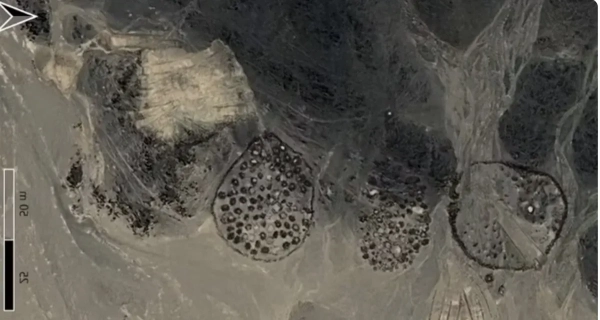
Satellites have discovered 260 previously unknown stone burial monuments in the Atbai Desert / Photo by Julien Cooper and other authors of the study
The discovered monuments belong to the era of the end of the African wet period. Once the Sahara was much greener and more favorable for life, but as the monsoons gradually retreated south, the lakes and rivers began to dry up. During this transitional period, between 4500 and 2500 BC, the region was dominated by mobile communities of pastoralists. Their main resource and symbol of wealth was cattle. In scientific circles, this phenomenon is called “cattle-focused behavior.”
During excavations at sites such as Wadi Khashab and Wadi el-Ku, archaeologists have found human remains alongside the bones of cows, sheep, and goats. Often, the main human burial is located in the center of the structure, with the animals placed around it.
The Atbay tombs demonstrate that mobile desert societies could also create enduring monuments and complex ritual landscapes,
– says the conclusions of the Atbai Survey Project.
This refutes the notion that complex social structures in ancient times could only arise in river valleys or cities.
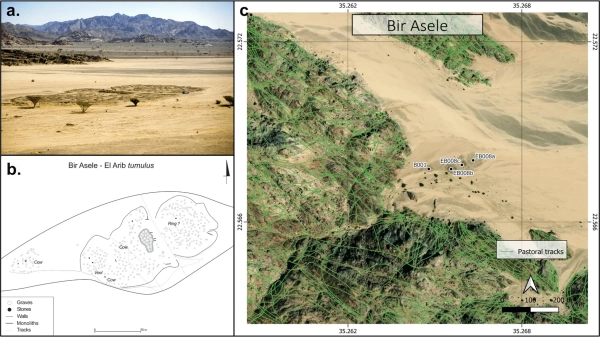
Bir Asele location with green trails marked / Image by James Harrell/ Marie Bourgeois
Researchers distinguish several types of structures. The most common are circles without visible entrances, but there are also structures with passages oriented mainly to the east or southeast. The construction of such monuments required considerable effort.
Scientists estimate that building an average-sized wall took about 161 working days for one person, or just over 3 days for a group of 50. This suggests that the construction was an act of strengthening social bonds within the community.
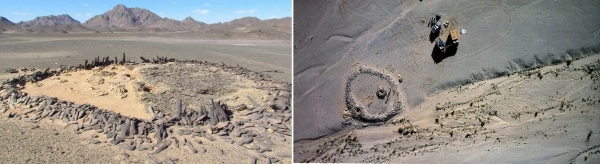
Tombs in Atbai / Photo by Piotr Osypinski/Castiglione Museum
Most of the tombs are located near dry riverbeds (wadis), at the foot of mountain ranges and plateaus. The average distance to the nearest water source or pasture in the past was about 196 meters. This confirms that the monuments were built near the places of residence of nomads.
Interestingly, thousands of years later, other cultures, including the ancient Blemmyes in the first millennium AD, continued to use these same locations for their burials, indicating the special sacred significance of these places in the desert landscape.
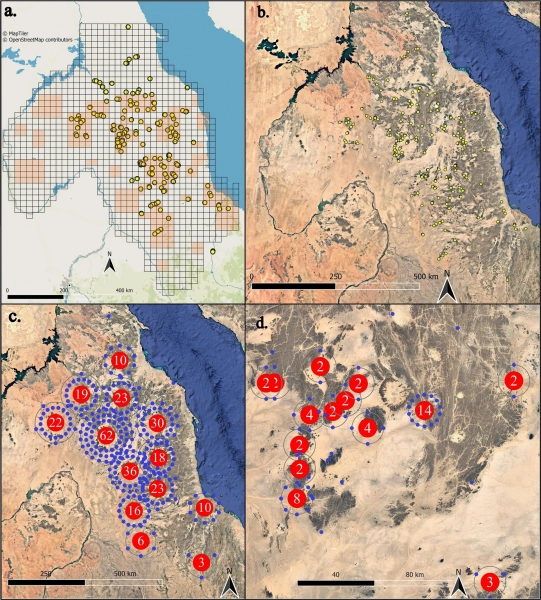
Tomb locations / Image QGIS/MapTiler Planet/OpenStreetMap/Google Earth
Monuments in danger of disappearing
Today, this unique heritage is under serious threat. The main threat is unregulated gold mining in Sudan. Heavy machinery and looting are destroying archaeological landscapes that have remained untouched for millennia.
In addition, the condition of the monuments is influenced by climatic factors: although rains in the region are rare, flash floods sometimes erode stone structures.
You will also be interested to know: what cultures lived in North Africa before the era of the pharaohs
Before the emergence of the first pharaohs and the formation of a unified state of Ancient Egypt, the Nile Valley and the adjacent areas of modern Egypt and Sudan were inhabited by many Neolithic and predynastic cultures, writes 24 Kanal . They laid the foundation for the future Egyptian civilization: they developed agriculture, cattle breeding, crafts, religious cults and even early forms of social organization.
Nabta Playa culture
One of the earliest known cultures in the region was the Nabta-Playa culture, which existed in southern modern-day Egypt from about the 7th to 5th millennium BC. Its settlements were located in what was then the Sahara savannah, which was much wetter and more habitable at the time.
The Nabta Play people were pastoralists, hunters, and gatherers. Archaeologists have found well-organized settlements with wells, stone structures, and even megaliths, which some researchers believe were early astronomical observatories. This culture already has traces of religious cults associated with cattle, which later became an important part of Egyptian symbolism.
Badari culture
The Badarian culture arose in Upper Egypt around the 5th millennium BC. It is known as one of the first cultures in the region to develop advanced agriculture and permanent settlements. The Badarians grew cereals, raised livestock, fished the Nile, and produced high-quality pottery with a distinctive black top.
Their burials indicate a belief in an afterlife – food, jewelry, and tools were placed in the graves. This was no longer just a hunter-gatherer community, but a society with artisans and a certain social structure, notes Encyclopedia Britannica.
Nagada or Nakada culture
After the Badarian culture, the Naqada culture, or Naqada, emerged in Upper Egypt, which existed approximately between 4000 and 3000 BC. It is considered the direct predecessor of Pharaonic Egypt.
The Naqada culture went through several stages of development, from small agricultural settlements to large centers of power with elites, artisans, and active trade. The Naqada people traded with Nubia, the Levant, and probably Mesopotamia.
They were already using copper, building large tombs for the nobility, and creating complex art with religious symbolism. It was during this period that proto-states began to emerge, which later united under the rule of the first pharaohs.
Kerma Culture
In the territory of modern Sudan and Nubia, there were also developed cultures that were not peripheral to Egypt, but developed in parallel. One of the most important was the Kerma culture, which formed in the 3rd millennium BC in the middle Nile region. It is considered one of the first great civilizations of Africa south of Egypt.
Kerma had cities, fortifications, monumental buildings, and a developed metallurgy. Its inhabitants controlled the trade routes between Central Africa and Egypt. At one point, Kerma even became a rival to Egypt, writes Discover Sudan.
What was Africa like during the African Humid Period?
A significant role in the formation of these cultures was played by the so-called African Humid Period, or “Green Sahara.” This was a climatic stage between approximately 14,500 and 5,000 BC, when the present-day Sahara Desert looked very different.
Due to the shifting monsoons and significantly greater rainfall, vast areas of North Africa were covered in savannas, grasslands, lakes, and rivers. Elephants, giraffes, hippos, crocodiles, antelopes, and a wide variety of other animals lived there.
In many places in the modern Sahara, archaeologists find rock paintings depicting herds of cattle, hunting, and boats, which seems almost impossible for the desert today, writes ScienceDirect.
During this humid period, people actively populated the Sahara. They created seasonal or permanent settlements near lakes and rivers, engaged in fishing, hunting, and gradually switched to pastoralism.
When did everything change?
Some regions of modern-day Sudan and Egypt were even more habitable than the Nile Valley at the time. However, after about 6000–5000 BC, the climate began to rapidly become drier. Lakes dried up, savannas turned into deserts, and populations gradually concentrated along the Nile.
This process is considered one of the key factors in the formation of early Egyptian civilization. People displaced from the degrading Sahara migrated to the Nile Valley, where resources, agriculture, and power were concentrated.
Read also: what similar discoveries were previously made in the deserts of Africa
- Archaeologists have found a papyrus containing Homer's “Iliad” inside an Egyptian tomb.
- Egypt has completed the excavation of an ancient Christian monastery, the second largest in history.
- Archaeologists have found evidence of the oldest cremation in Africa, carried out almost 10,000 years ago.
- Three late-period mummies were discovered in the Step Pyramid of Djoser.
- Previously unknown passages were found in one of the pyramids of Giza.