
Main points
- An experiment begun in 1927 at the University of Queensland demonstrates the extraordinary viscosity of a resin that is considered a liquid.
- The experiment is listed in the Guinness Book of Records as the longest continuous laboratory experiment, and could continue for about another hundred years.
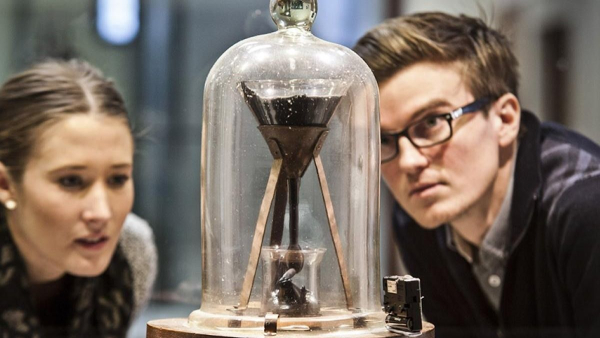
World endurance record: a laboratory experiment that lasts almost a century / University of Queensland
In the world of science, there is an experiment that goes against everything we usually associate with research. There are no complicated instruments, quick results, or instant discoveries. Instead, there are decades of waiting, stability, and a process that remains almost unchanged from generation to generation. This experiment has already become a symbol of patience and scientific stubbornness.
Why did this experiment become a scientific legend?
One of the longest continuous laboratory experiments in the world began back in 1927 at the University of Queensland. Its author was Professor Thomas Parnell, who set himself a simple but revealing goal – to demonstrate that resin, which many consider to be a solid substance, is actually an extremely viscous liquid, writes SupercarBlondie.
To do this, heated resin, derived from tar, was poured into a glass funnel and left for three years to fully stabilize the material. It was not until 1930 that the stem of the funnel was cut off, allowing the resin to slowly drain down under the influence of gravity. Waiting for the result immediately became part of the experiment.
- The first drop fell only after 98 months, that is, after more than eight years.
- The second one appeared even later – 99 months later.
- The third one seemed almost quick, as it took “only” 86 months.
- Over time, the pace slowed again – the seventh drop fell in July 1988 after 111 months of waiting.
- The eighth – in November 2000, 148 months later.
- The ninth, and so far the last, was in April 2014 after 161 months.
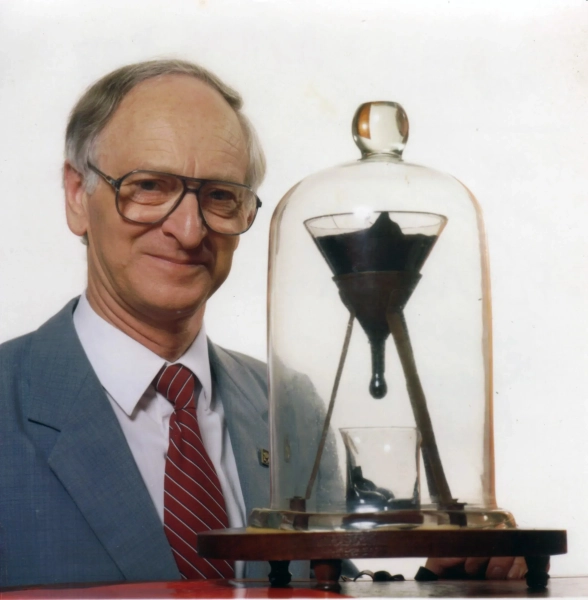
John Mainstone, who supervised the experiment / Photo by the University of Queensland
Adding to the irony is that none of the drops were ever captured live, according to the University of Queensland. The experiment's curator, John Mainstone, left the lab just minutes before the seventh drop fell. Later attempts at video surveillance were thwarted by technical glitches – the 2000 and 2014 drops were not recorded.
Nevertheless, the experiment yielded important scientific data. Analysis of the eighth drop showed that the viscosity of the resin is approximately 280 billion times greater than the viscosity of water. This result clearly demonstrated how misleading our ideas about the state of matter can be.
The experiment is officially listed in the Guinness Book of Records as the “world's longest continuous laboratory experiment.” Researchers estimate that it could last for another hundred years. The next drop is expected sometime in the 2020s. One can only hope that this time someone will actually see it fall with their own eyes.