
Main points
- The world's largest and most diverse dinosaur footprint complex, containing tracks from 21 morphotypes, including stegosaurs, has been found on the coast of Western Australia.
- These tracks, including those of sauropods, up to 1.75 meters long, were found on the Dampier Peninsula in the Broome Sandstone Formation, where they were preserved in sandstone that is 130 million years old.
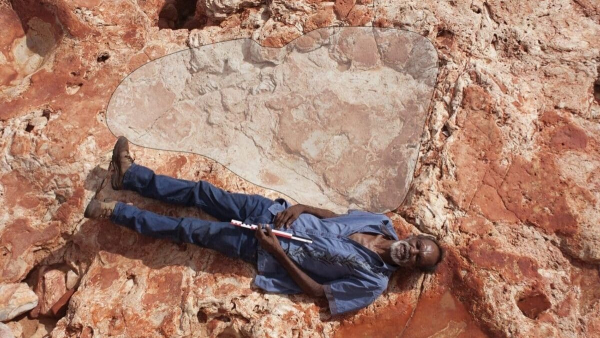
The Australian coast has preserved traces of dinosaurs of incredible size / Damian Kelly/University of Queensland/EPA
Scientists are investigating a unique complex of dinosaur footprints on the remote coast of Western Australia, already described as the largest and most diverse in the world. The imprints, preserved in coastal rocks, are providing new insights into the life of animals during the Cretaceous period and Australia's role in the planet's prehistoric history.
Which dinosaurs left the biggest footprints on the planet?
The discovery was made on the Dampier Peninsula, where the Broome Sandstone formation preserved traces that are approximately 130 million years old. The research lasted from 2011 to 2016 and covered about 25 kilometers of coastline. During this time, scientists spent more than 400 hours of fieldwork and discovered 48 separate sites with dinosaur tracks, writes Indian Defence Review.
These prints were formed in the conditions of deltaic plains and floodplains, which were periodically flooded. It was during such floods that soft sedimentary rocks recorded the traces of animals, and later they hardened and were preserved, thus “surviving” to the present day. Today, these areas surface in the form of intertidal reefs.
In total, the researchers identified at least 150 distinct tracks, which belong to 21 morphotypes. Among them are tracks of predatory theropods, massive sauropods, herbivorous ornithopods and armored thyreophores. Of particular interest are the sauropod prints up to 1.75 meters long – in size they are truly capable of “swallowing” an adult human in one step.
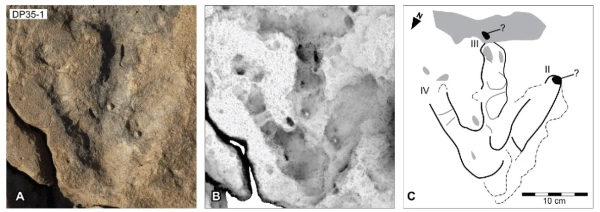
Dinosaur footprint Megalosauropus broomensis Colbert or Merriless / Photo Damian Kelly/University of Queensland/EPA
Of particular importance is the fact that this is the first time that reliable stegosaur footprints have been recorded in Australia. Until now, only indirect evidence of their presence on the continent has been available. Several new ichnotaxa, i.e. forms of footprints that have no direct counterparts among the found skeletal remains, have also been described.
The trackway complex shows that in the Early Cretaceous period, Australia retained a high diversity of dinosaurs, including lineages that had already disappeared in the northern regions of the planet. Comparison with similar formations in South America and Africa suggests slower extinction processes in Gondwana, in contrast to Laurasia.
Threats and rescue
The cultural aspect of the discovery is equally important. Local Aboriginal communities knew about these tracks long before the arrival of scientists and included them in their song routes and mythology. It was thanks to the insistence of the traditional custodians of the territory that a large-scale industrial project was stopped and the area was given national protected status.
Today, this stretch of coast is considered a key source of information about Australia's early Cretaceous dinosaurs, but scientists and local communities face a daunting task of preserving the unique remains from destruction by natural processes and uncontrolled tourism.