
Main points
- The Kings Trough in the Atlantic Ocean was formed by the movement of tectonic plates and powerful heat flows, not erosion.
- Studies have confirmed that the mantle plume made the Earth's crust in this area thicker but weaker, which contributed to the formation of the trench.
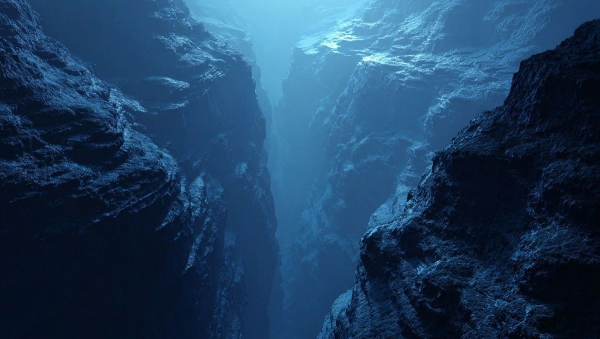
Researchers uncover secret of formation of deep-sea Kings Trough Canyon / SciTechDaily
Deep beneath the Atlantic Ocean lies a system of trenches larger than the Grand Canyon. The formation of this impressive structure has always been a mystery to scientists, but it has finally been solved.
A new study by an international group of scientists explains that this object arose not through erosion, but as a result of the movement of tectonic plates and powerful heat flows from the depths of our planet, SciTechDaily reports.
How did tectonic plates and magma create a giant rift in the ocean?
The Kings Trough complex, located about 1,000 kilometers west of Portugal, is not just a fault, but a massive system of parallel trenches and depressions about 500 kilometers long. The eastern part of the system, known as Peak Deep, is one of the deepest points in the Atlantic Ocean.
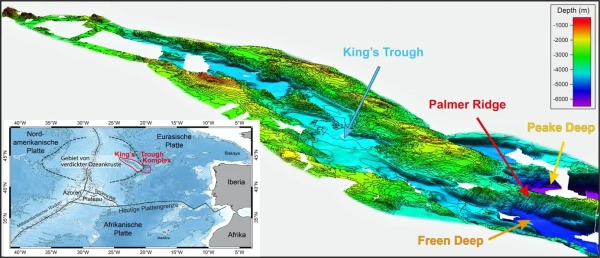
Location Kings Trough / Photo GEBCO
Unlike terrestrial canyons formed by rivers, this underwater giant appeared thanks to forces inside the Earth.
An international team of researchers from the GEOMAR Center has determined that approximately 37 to 24 million years ago, this area of the North Atlantic became the boundary between the European and African plates.
According to the study's lead author, Antje Dürkefelden, the Earth's crust here wasn't just sliding, it was literally tearing from west to east, like a zipper. But another factor played a key role: the previous state of the Earth's crust .
What did scientists discover during their research?
Scientists have found that this area was previously heated by a mantle plume – a stream of hot material from deep within the planet, which is an early branch of the modern Azores plume.
As co-author Jörg Geldmacher explains, this heating made the crust thicker but mechanically weaker. This caused the plate boundary to shift to this exact location. When the plate boundary later moved further south, the formation of the Kings Trough stopped.
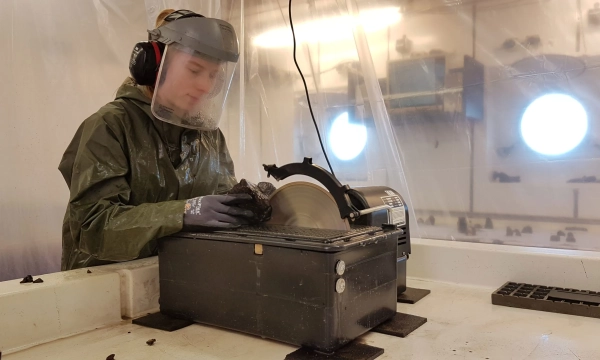
Scientists examined samples from the Kings Trough Trough / Photo GEOMAR
The findings are based on data from a 2020 expedition on the METEOR vessel, which used sonar to create a detailed map of the seabed and lift samples of volcanic rocks. The scientific work can be read in detail in the journal Geochemistry, Geophysics, Geosystems.
Laboratory analysis of the chemical composition and dating of the samples confirmed the close connection between processes in the mantle and the movements of lithospheric plates.
A similar process can be observed today in the Azores region, where the Terceira Rift system of trenches is forming in a similar way.