
Main points
- In 1899, an ancient coffin was found near the Polish village of Bagicz containing the remains of a woman who was centuries older than the coffin in which she was buried.
- New research has found that the woman lived in the early second century, and the dating errors were caused by her fish diet.
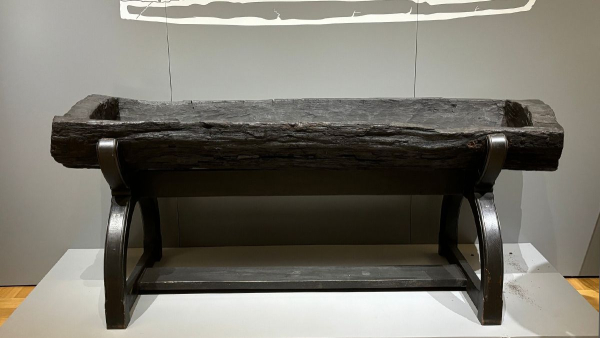
The secret of the sarcophagus from Bagić: new research reveals the true story of the 1899 find / Photo Chmiel-Chhrzanowska / Archaeometry
In 1899, storm erosion of the shore near the Polish village of Bagicz revealed an unusual find to the world. An ancient wooden coffin containing the remains of a woman fell from a cliff onto the beach. For over a century, this story was shrouded in myths that have only recently been unraveled.
Why couldn't archaeologists find out the truth for almost 130 years?
The story of the find began over a century ago, when residents of the Baltic Sea coast discovered a storm-washed oak trunk in the sand. Inside the hollow log lay a woman adorned with bronze bracelets and a necklace of glass and amber.
Locals, struck by the richness of the decoration and the isolation of the burial, immediately dubbed the deceased the “Princess of Bagić.” For decades, this narrative was considered the official version while the remains waited their time in museum vaults.
The problem arose in 2018, when scientists decided to radiocarbon date the woman's teeth. The results shocked the researchers: the analysis showed that she died about a hundred years before the coffin itself and the jewelry were made.
This created a real chronological gap: the artifacts pointed to the second century AD, but the biological data pointed to the first. Scientists were faced with a dilemma: either the woman had been reburied, or the entire chronology and understanding of the culture to which the woman belonged were wrong. A new study published in Archaeometry provides more clarity.
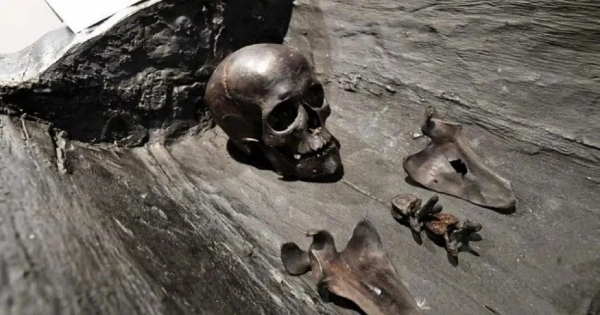
Princess of Bagic / Photo by AncientOrigins
The answer was found thanks to the latest methods of dendrochronological analysis. A team of archaeologists led by Marta Chmiel-Chrzanowska from the University of Szczecin received permission to take microscopic samples from the oak coffin.
By studying the annual rings of the wood, the researchers established the exact date of the tree's felling – between 112 and 128 AD. Since coffins were made from freshly cut trunks at that time, this confirmed that the burial took place precisely at the beginning of the second century.
Old bones
But how to explain the “obsolete” bones? The answer lay in the deceased's diet. Analysis of stable isotopes showed a high nitrogen content, which is typical of a diet with a lot of animal protein, in particular fish. The so-called marine reservoir effect worked here.
The deep ocean contains carbon that is hundreds of years old. When people eat seafood, their tissues accumulate this “old” carbon, which artificially ages the samples when tested in the laboratory.
Since the woman lived in the Baltic Sea basin, her diet was based entirely on local resources, which led to an error in dating.
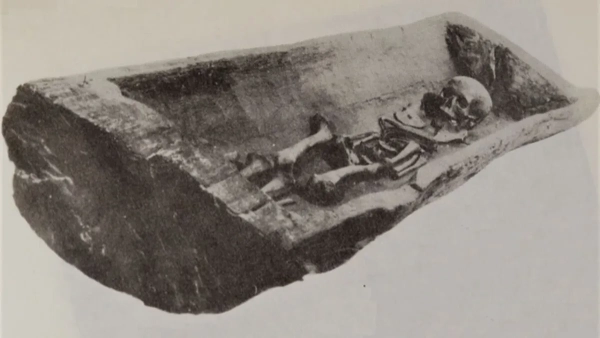
Old photo of coffin and body / Photo National Museum in Szczecin
Who was she?
The study also dispelled the myth of the woman's aristocratic origin. Examination of the skeleton revealed signs of osteoarthritis, which are not at all typical for a young woman aged 25-35, leading a leisurely life. On the contrary, the condition of her bones indicated heavy physical labor.
Furthermore, scholars have suggested that her grave was not isolated – it was most likely part of a larger Velbar culture cemetery that had long since been washed away by the sea due to erosion. Her grave was likely the last or one of the last at the site.
The sarcophagus is unique, as it is the only wooden structure of its type from the Roman Iron Age to survive to this day. It was saved by special conditions: after burial, the water level rose, creating an oxygen-free environment that stopped the decay of organic matter.
Scientists are currently continuing their work, trying to extract DNA from the temporal bone of the skull to learn more about the origins and health of this woman who lived on the Amber Road over a thousand years ago.