
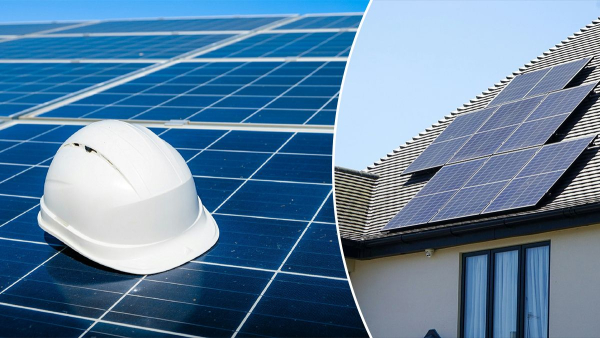
Five mistakes that will destroy your solar panels / Collage 24 Channel/Unsplash
Installing a solar power plant requires precision, as any deviation from the installation technology threatens to stop generation. Sometimes details that are invisible at first glance, such as the choice of metal for fastening or the wrong type of insulation, become the cause of destructive processes that manifest themselves only after a few years, turning an expensive investment into a pile of scrap.
How do technical blunders turn energy independence into a financial burden?
One of the most insidious problems that can destroy supporting structures and module frames is galvanic corrosion – when dissimilar metals with large differences in electrochemical potentials are used for installation, writes 24 Kanal .
For example, the contact of the aluminum frame of the panel with steel fasteners in the presence of moisture creates a galvanic circuit, writes Avenston Group. In this process, aluminum acts as an anode and gradually collapses, leading to a loss of system integrity. To prevent this, it is necessary to use insulating gaskets or select galvanically compatible materials.
Choose the right cables
Equally dangerous is the wrong choice of cables, notes Svitlobud. Using ordinary household wires instead of specialized solar cable with ultraviolet resistance is a direct path to fire.
Solar cables of type H1Z2Z2-K are designed for high voltage direct current and aggressive external environment. If the cable cross-section is smaller than required, for example less than 6 square millimeters for systems with a capacity of more than 5 kilowatts, this causes significant resistance and overheating.
Over time, the insulation cracks due to exposure to the sun and moisture, causing breakdowns in the housing or the occurrence of an electric arc, the temperature of which is capable of melting copper and aluminum.
No shadows
The third critical mistake is ignoring constant shading. Regular shadow from chimneys, trees, or neighboring buildings not only reduces output, but also physically destroys the photovoltaic cells. When part of the panel is shaded, it begins to consume current from neighboring cells, which causes overheating and the appearance of so-called “hot spots,” warns e-energy.
Bypass diodes are used for protection, but under conditions of daily heavy shading they work at the limit of their capabilities. Failure of a diode in an open state can lead to an internal arc, burning through the back layer of the panel and even a roof fire.
Take care of grounding
The fourth risk factor is the absence or incorrect grounding. Many owners mistakenly consider this a technical trifle, but without a grounding circuit, static charge accumulates on the equipment housings. As Dolya Solar Energy writes, this is not only dangerous for people, but is also the main reason for inverter failure during thunderstorms or power surges in the network.
Also, the lack of grounding contributes to the development of the so-called PID degradation, when the potential difference between the photocell and the frame causes a leakage of sodium ions, which can reduce the power of the station by 50-80 percent of the nominal in a short period of time.
Control the load
Finally, underestimation of mechanical load and design errors can lead to physical destruction of the roof or the panels themselves. One panel weighs about 20 kilograms, notes the Svoya Energia website, and a 10-kilowatt system, including fasteners, can weigh over 1 ton.
If the strength of the rafters or wind load is not taken into account during installation, the structure may deform or be torn out of place during a strong storm or snowfall.
Thus, only a comprehensive approach to design, the use of UV-resistant materials, proper grounding, and avoidance of shading guarantee the operation of the system for the claimed 25 years.