
Main points
- Apple's iPhone 17 became the most popular smartphone in the world, surpassing even more expensive models, and accounting for about 6% of global sales in the first quarter of 2026.
- The success of the base model is attributed to improvements such as more memory and a camera, which blurred the line between the standard and premium versions, making it an attractive choice for many users.
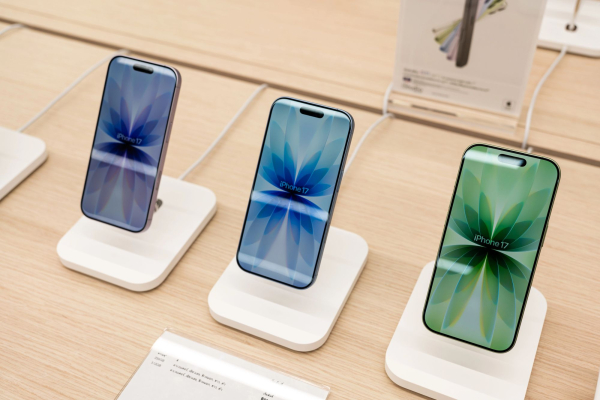
The “budget” favorite unexpectedly overtook the Pro version of the iPhone / Depositphotos
The global smartphone market has once again shifted the balance of power, with new data showing an unexpected leader among Apple devices, beating out even more expensive models.
According to Counterpoint Research, in the first quarter of 2026, Apple's iPhone 17 became the most popular smartphone in the world, accounting for about 6% of global unit sales. What's more, the top three are all from Apple's new lineup, followed by the iPhone 17 Pro Max and iPhone 17 Pro.
Such concentration in the top has become unprecedented: in total, the ten most popular models accounted for 25% of all global sales – a record for the first quarter in the entire history of observations.
By the way, Apple recently published its own financial results for the second quarter of 2026. The company reported significant revenue growth, the main driver of which was the iPhone 17.
Why did the basic iPhone become the best-selling model?
Analysts explain the success of the base model simply – it has become much closer to the Pro versions . Senior analyst Harshit Rastogi noted that the smartphone received more memory, an improved camera and a higher display refresh rate. This actually blurred the line between the standard and premium versions.
In China, the US and South Korea, the smartphone showed double-digit year-on-year sales growth, and in South Korea they tripled in the quarter,
– Rastogi emphasized.
According to him, the Pro models hold their positions thanks to even better cameras, batteries, and new design solutions.
What about Android smartphones?
While Apple dominates the top of the rankings, the Android segment looks more fragmented. The most successful among them was the Samsung Galaxy A07 4G , which led sales among Android devices.
Its popularity was ensured by the markets of the Middle East, Africa and Latin America, where users especially appreciate long-term support – the model received six years of system and security updates.
In total, five positions in the top 10 were occupied by Galaxy A series smartphones, which indicates stable demand in the budget segment.
Meanwhile, the flagship Samsung Galaxy S26 Ultra barely made it into the top ten, although it had a stronger start to sales than its predecessor. The device features new AI features and a screen with a privacy mode.
The only Xiaomi representative in the ranking was the Xiaomi Redmi A5 – the most affordable smartphone in the top ten, which is steadily selling in emerging markets.
Analyst Karn Chauhan predicts that the trend will only intensify:
The share of the top ten models will increase in 2026. The expected market contraction will hit the mass segment harder, while premium smartphones will continue to strengthen their position.
This could mean a shift in manufacturers' strategy: instead of chasing volume, they are increasingly focusing on more expensive devices with higher margins. Amid memory shortages and rising component costs, buyers are increasingly choosing trusted brands – and this is exactly what is playing into Apple's favor right now.
Why is everyone suddenly choosing a “simple” iPhone?
A few years ago, the basic iPhone was seen as a compromise. It was a suitable option for those who wanted to try the Apple ecosystem but were not ready to pay more. With the release of the iPhone 17, this logic has virtually disappeared.
Today, people buy it not because it is cheaper, but because its functions are more than enough. And this is probably the main change. For most smartphone users, not much is needed: a camera for social networks, instant messengers, more or less high-quality video, functions for work. And the basic model covers all these tasks with almost no compromises.
It's also interesting that more and more Apple smartphone buyers are switching from Android. For them, the starter model was a convenient entry point into the ecosystem, but now it's a smartphone that can do everything.
At the same time, a significant portion of buyers are people who simply upgrade their old iPhones and get a noticeable jump in speed and photo quality.
Against this background, the iPhone 17 Pro and iPhone 17 Pro Max no longer look like such attractive purchases. Yes, they are better, but not so much that everyone will feel it. The difference in the camera or materials is important for enthusiasts and those who work with content professionally, but for everyday use it is often simply not critical. And the difference in price is more than noticeable.
Apple's new strategy?
Apple seems to understand this perfectly well. The company is gradually “pushing up” the base models to a level that was only available in the Pro until recently. Given that smartphone sales are no longer growing so quickly, this is a logical move.
There is another less obvious factor – the rise in the price of components. Memory and other key parts are becoming more expensive, and this is hitting the entire market, affecting more computers, but also smartphones. Smaller brands have a harder time keeping prices down, while larger ones are more profitable to sell more expensive models with better margins.
That is why recently more and more analysts are inclined to believe that the budget smartphone market may disappear or undergo serious changes.