
Main points
- Archaeologists discovered the toxic mineral cinnabar, which is a form of mercury sulfide, in a Scythian burial on the right bank of the Dnieper River.
- Cinnabar was probably used by the Scythians as a cosmetic or for ritual purposes, but could cause poisoning due to its toxicity.
/ Collage of Channel 24/A. Kurzavska
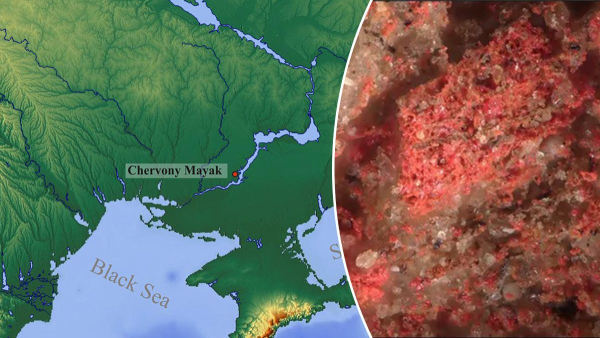
Archaeological excavations on the right bank of the Dnieper River have brought an unexpected discovery that forces us to reconsider our ideas about the daily life and rituals of ancient nomads. In a female burial of the Late Scythian culture, researchers discovered a substance of a rich red color.
Thanks to modern laboratory analysis, it was possible to establish the true nature of this mineral. It turned out to be deadly dangerous to humans, writes Live Science.
What was found in the Scythian grave?
The Chervonyi Mayak Necropolis, located in the Kherson region, is part of a large archaeological complex belonging to the Late Scythians. This culture developed in the southern territories of Ukraine from the second century BC to the mid-third century AD.
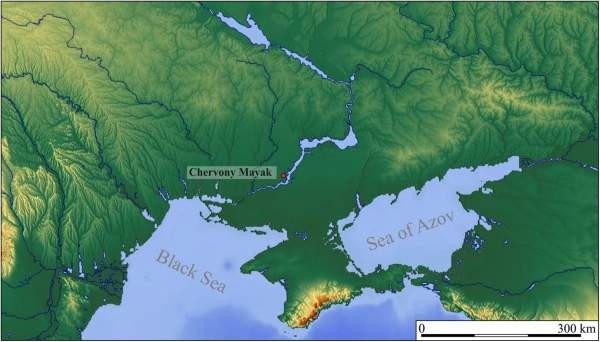
Graves were found here / Images by Olena Dzneladze and other authors
The site has been under investigation for many decades, starting with the first excavations by Oleksandr Bodiansky in 1975. Over the entire time, archaeologists have discovered 177 graves, but burial number 155 has attracted particular attention.
This structure is in the form of a catacomb with an entrance pit measuring 1.45 by 1.1 meters, which leads to a rectangular chamber with rounded corners. The layout of the entire structure resembles the letter “L”. Inside were found the remains of two women, who were buried at different times.
The first to be buried in the crypt was a woman aged 35 to 45. Later, the entrance to the chamber, which had been closed with a small stone, was reopened to place the body of a younger woman, aged 18 to 20.
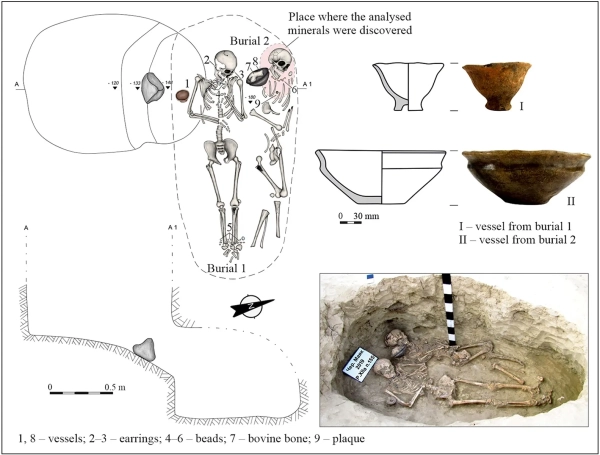
Grave plan, photos of bodies and finds / Images by Olena Dzneladze and other authors
It was near the skull and rib cage of the older woman that archaeologists noticed three clumps of intense red pigment. Although similar finds have occurred in this necropolis since 2011, they were previously usually identified visually as ochre or realgar.
However, a team of Ukrainian and Polish scientists decided to conduct a thorough analysis of the substance using a digital microscope, scanning electron microscopy (SEM-EDS), and X-ray diffraction.
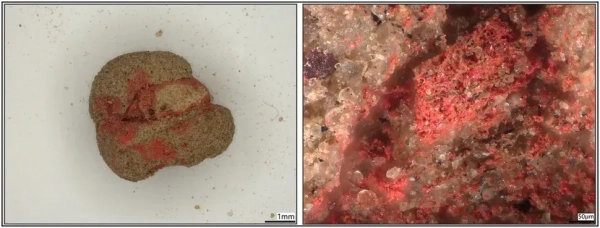
Mysterious substance found in the grave / Photo by A. Kurzavska
The results were sensational: the pigment turned out to be cinnabar, a mineral form of mercury sulfide. This is the first scientific confirmation of the use of this mineral by the late Scythians. Analysis showed that the substance consists of small, sharp-edged particles up to 20 micrometers in diameter, which cover a thin layer of sediment of quartz, microcline and calcite.
Cinnabar is an extremely toxic substance. In ancient times, constant contact with it caused mercury poisoning, leading to tremors, breathing problems, and even death, especially if the mineral was heated.
However, the Scythians were probably unaware of this threat. Scientists suggest that the pigment may have had several functions:
- Firstly, it could be used as a cosmetic product – a kind of blush that emphasized a woman's status.
- Secondly, cinnabar could have played a ritual role, symbolizing life or providing magical protection for the dead.
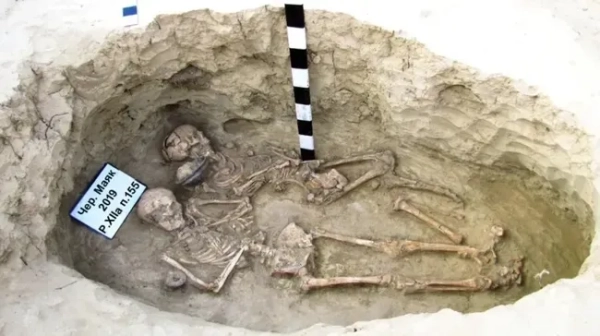
Grave of two women buried at different times / Photo B. Polit
Another interesting hypothesis concerns the bactericidal properties of mercury sulfide. Since Scythian crypts could be used for 50 years, periodically opening for new burials, the toxic mineral could have served as a means to slow the decomposition of bodies and cleanse the space of bacteria.
The fact that cinnabar is found exclusively in women's graves supports the version that it belonged to a specific set of women's items, which also included necklaces, copper alloy earrings, and special boxes for storing paints.
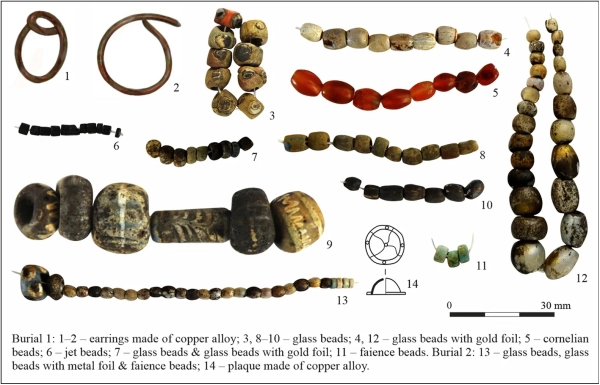
Finds made in graves / Images by Olena Dzneladze and other authors
The origin of this mineral remains a subject of further research. Although cinnabar deposits exist in southern and eastern Ukraine, scientists have yet to determine whether they were a source of raw material for the inhabitants of Chervony Mayak.
This discovery, the results of which were published in the journal Antiquity, which belongs to Cambridge University Press, emphasizes the importance of laboratory methods in archaeology, because without them, many unique facts about the lives of ancient peoples would remain only assumptions.