
Main points
- A new study shows that bees are able to distinguish between numbers of objects, not just respond to visual cues.
- Scientists used a mathematical model taking into account the vision of bees and found that they likely respond to numerical values, rather than visual complexity.
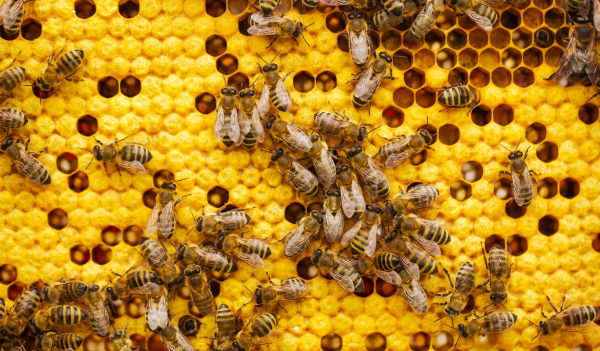
Scientists have proven that bees can distinguish numbers / Unsplash / Simon Kadula
A new study adds to the debate about bees' intelligence, finding that the insects are capable of distinguishing between numbers of objects, not just responding to visual cues.
The question of whether bees can count has long been a topic of debate among scientists. These insects are known for their ability to recognize patterns, so some researchers have suggested that in number tests they simply respond to visual differences, not to the number itself. This is reported by Science Alert .
Do bees really count, and not just see the difference?
The new study takes a key point into account: how bees see the world. According to neuroscientist Mirko Zanon of the University of Trento, if you analyze the stimuli in terms of the biology of these insects, the critics' arguments lose their force. The results show that bees do indeed respond to numerical values.
In previous experiments, bees were shown cards with varying numbers of items. In one 2019 study, they were taught to associate symbols with numbers. During training, the accuracy of the answers reached 75–80 percent, and during tests, it was about 60–65 percent , which is better than chance.
However, in 2020, these findings were criticized . It was suggested that the bees may simply have chosen more “saturated” images, ignoring the objects. In addition, their vision may not be sharp enough to distinguish small details.
The study authors agreed with these observations and decided to review the data. As zoologist Scarlett Howard from Monash University explains, when studying animal cognition, it is important to consider their perception, not human perception.
Bees have complex eyes that give them a completely different view of the world —less detailed and more generalized. So the researchers applied a mathematical model that reproduces their spatial resolution and reanalyzed the images.
It turns out that the ” visual complexity ” assumption doesn't always work. It was previously thought that more objects meant more detail that bees could see. But after adjusting for their vision, this relationship became much weaker.
According to SAN , this means that bees cannot rely on simple visual cues alone . Instead, they are likely responding specifically to the number of objects.
The results support the idea that bees have a basic sense of numbers . The researchers emphasize that studying animal intelligence requires taking into account the way they perceive the world.
As Howard points out, trying to see the world through the eyes of a bee is key to understanding their abilities. And each time, these insects demonstrate more complex behavioral mechanisms than expected.