
Main points
- Demand for robotic “monster wolves” to scare away bears is growing in Japan, due to their increasing presence near residential areas.
- The “Monster Wolf” robot uses infrared sensors to detect motion, activates light and sound effects to scare away wild animals, which has increased its popularity amid climate change and a reduction in natural food supplies.
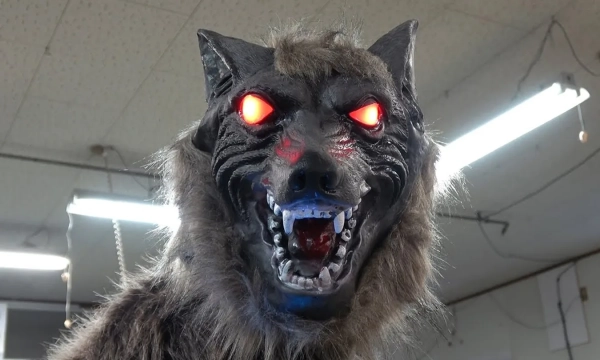
Glowing eyes and eerie howls: how Japanese robots scare away bears / wolfkamuy
Demand for a strange robotic device that resembles a science fiction character is surging in Japan, and the unusual development has already become an unexpected response to a problem that is increasingly plaguing the country.
Japan has found an unconventional way to combat the growing number of wild animal attacks. The country has seen a surge in demand for robotic “monster wolves” designed to scare away bears and other dangerous animals. Orders for these devices have tripled in recent days amid an increase in bear sightings near residential areas, Digitaltrends reports.
Why did the Japanese start buying wolf robots en masse?
This is a device called ” Monster Wolf “, developed by the Japanese company Ohta Seiki from the island of Hokkaido. Initially, the robot was created as a means of protecting agricultural land from deer and wild boars that damaged crops. However, now the scope of its use has expanded significantly.
Robots have begun to be installed near residential areas, mountain resorts, golf courses, construction sites, and other areas where the appearance of wild animals is recorded.

How does “Monster Wolf” work?
Externally, the device truly resembles a character from a horror movie. The robot has a massive head, thick artificial fur, glowing red eyes, and a moving mechanism that mimics the behavior of a predator.
The principle of operation is quite simple. The system uses infrared sensors to detect nearby movement. As soon as an animal approaches the control zone, a scare scenario is activated.
At this moment the robot :
- begins to move his head chaotically;
- turns on the bright red eye illumination;
- plays a set of loud sounds.
Audio signals include a wolf howl, a metallic clank, harsh industrial noises, and other sounds designed to scare the animal.
According to the manufacturer , surveillance camera footage has repeatedly recorded bears and wild boars instantly leaving the area after the device was activated.
Why has the problem become so acute?
According to AFP , the popularity of ” Monster Wolf ” is directly related to the increasing number of encounters between people and wild bears in Japan.
According to official data, more than 50,000 cases of bears appearing near settlements have been registered in the country recently. Experts attribute this to several factors.
Among the main reasons :
- climate change;
- reduction of the natural food base;
- shifting seasonal cycles;
- animals searching for food closer to cities.
Due to the scarcity of natural resources, bears are increasingly leaving forests and approaching human settlements, which increases the risk of dangerous incidents.
This is why demand for robots has increased so much that some buyers have to wait up to three months for delivery.
A strange idea that turned into a practical solution
When the “Monster Wolf” was first introduced, many perceived the development as another eccentric Japanese experiment in the field of robotics.
However, the reality turned out to be different. The device became an example of how highly specialized robotics can solve specific practical problems more effectively than complex universal systems.
The story of this robot also demonstrates Japan's unique approach to technology. The country has long experimented with unusual robotic solutions that seem bizarre at first glance but later find practical applications.
In the case of “Monster Wolf,” the focus on a simple but psychologically effective model of intimidation proved to be apt. And while the robot looks more like a prop for a fantasy thriller, in practice it has become one of the most sought-after tools for combating wildlife in modern Japan.