
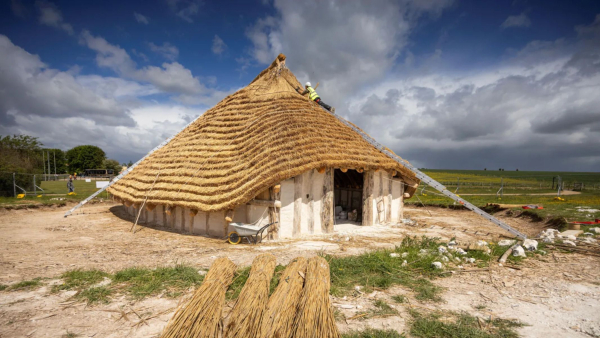
Archaeologists reconstruct 4,500-year-old Neolithic hall near Stonehenge / English Heritage
A major reconstruction of a Neolithic structure dating back some 4,500 years is nearing completion near Stonehenge, and archaeologists are still debating what it was used for by Stone Age Britons.
English Heritage has unveiled a reconstruction of a giant Neolithic building near Stonehenge. The structure, called the Kusuma Neolithic Hall , is one of the most ambitious archaeological reconstructions in the UK in recent years, The Guardian reports.
What was the mysterious hall of the Neolithic era like?
The seven-meter-high building was created based on archaeological data about the mysterious Durrington 68 structure, which was discovered about three kilometers from Stonehenge next to the Neolithic monument of Woodhenge.
The original structure was first excavated by archaeologist Maud Cunnington in 1928, and re-excavated in 2007 as part of the Stonehenge Riverside Project. Archaeologists found a ring-shaped arrangement of wooden post holes and four massive pillars inside, which probably supported the roof.

However, the actual purpose of the structure remains a mystery . Due to centuries of plowing, archaeologists have lost most of the traces of the floor and hearths. Among the possible versions are a ritual space, a place for winter feasts, a warehouse, or even a shelter for people or animals.
The building was built by hand using Stone Age technology.
The £1 million project took nine months to complete, with more than 100 volunteers involved. All the work was done by hand without the use of modern machinery. Experimental archaeologist Luke Winter explained that the team had recreated Neolithic building methods as accurately as possible.
“Everything in this building grew in this landscape 5,000 years ago. We used replicas of stone tools to create every part of the structure… We literally counted every axe blow,” Winter said.
He said he initially doubted that the Durrington 68 archaeological footprint really belonged to a covered building.
“I estimated the chances to be 50/50 that it could have been a structure. But now that the construction is almost complete, I'm 75% sure that there was a roof,” the researcher noted.
Orientation to the winter solstice
According to the BBC , one of the most interesting details of the reconstruction was that the building, like Stonehenge itself, is precisely oriented to the winter solstice. Luke Winter recalls that during the solstice, his shadow fell precisely on the central pillar at the back of the structure.
This feature may indicate the building's important ritual or calendrical significance for Neolithic communities.
This summer , Kusuma Neolithic Hall will open to visitors, and later it will become an interactive educational space for schoolchildren.
A new learning centre with the Clore Discovery Lab and Weston Learning Studio is also planned nearby. English Heritage hopes the new complex will be able to accommodate almost 100,000 students each year. Head of education programmes Iona Keane said all educational activities for youth and school groups will be free.
“The Neolithic has long been part of the national curriculum,” she explained. According to Keane, children will be able to literally “travel back in time” – sitting by an open fire, making Neolithic cheese or creating pottery using ancient techniques.
“People learn through practice and understand history better when they try to do something themselves,” she added. Stonehenge curator Vin Scutt believes that all the surrounding structures and the stone complex itself were primarily a manifestation of collective culture.
“This is all about society, not science,” he stressed. According to Scutt, Neolithic communities built large-scale objects not because of individual ambition, but as a symbol of shared identity and unity.
“Now we are together – so let's create something that represents us all,” is how the researcher described the logic of the ancient builders.