
Main points
- Rainbows may exist on other planets, but look different due to different conditions, such as on Titan, where “invisible rainbows” are possible due to hydrocarbon rains and an opaque atmosphere.
- Similar phenomena, such as “glorias”, have been observed on Venus and exoplanets, where they arise from the scattering of light by droplets directly back towards the source, differing from terrestrial rainbows.

Where are rainbows beyond Earth / Unsplash
Rainbows are traditionally considered one of the most picturesque symbols of our planet, created by a unique combination of sunlight and moisture. However, astrophysicists argue that Earth is not a monopoly on this phenomenon, although on other worlds it takes on completely unusual forms.
Where in space are alien rainbows hiding?
For most people, a rainbow is a purely earthly phenomenon that requires rain and bright sun. However, according to experts, this is just one of the manifestations of complex optical processes that can occur on many celestial bodies. As Dr. Alfredo Carpinetti explains, rainbows on other planets are quite possible, but they are unlikely to resemble those we are used to, writes 24 Kanal .
To understand how a rainbow occurs, it is worth turning to the physics of the process on our planet:
Rainbows here on Earth are caused by refraction, internal reflection, and dispersion of light in water droplets. Liquid is incredibly important,
– explains Dr. Carpinetti.
Although in the mythology of various peoples, these colored stripes were described as giant snakes or deities, science gives a clear answer: an atmosphere, a transparent liquid, and a light source are needed.
At this point, Earth remains the only known world with confirmed liquid water on its surface. However, water is not necessarily required to create a rainbow. The main requirements for a substance are the ability to split light into its component colors, a high level of transparency (minimum absorption), and the presence of small droplets directly in the atmosphere.
Who is suitable for this role?
One of the most promising places to look for such phenomena is Titan, Saturn's largest moon. It is the only place other than Earth where rivers, lakes, and seas definitely exist, but they are composed not of water, but of hydrocarbons – methane and ethane. Titan also rains of these compounds.
Dr. Carpinetti notes that rainbows could exist there, but they would be specific:
Titan has hydrocarbon rain, which is great because methane is transparent. [But] Titan's atmosphere is opaque to visible light, so only infrared light from the Sun gets through,
– says the scientist.
This means that instead of the usual spectrum of colors, real “invisible rainbows” are formed on Saturn's satellite, which can only be recorded with the help of special instruments.
In addition, scientists have already observed rainbow-like phenomena in other parts of the solar system. For example, characteristic colored bands have been recorded over Enceladus, another moon of Saturn.
Also on Venus and even on distant exoplanets, scientists have discovered so-called “glorias”. A gloriosa visually resembles a rainbow, but has a different nature. While a rainbow is created by the refraction and reflection of light inside a drop, a gloriosa occurs when the drops scatter light directly back to the source. The study about this can be read in the journal Science, as well as on a special ESA page.
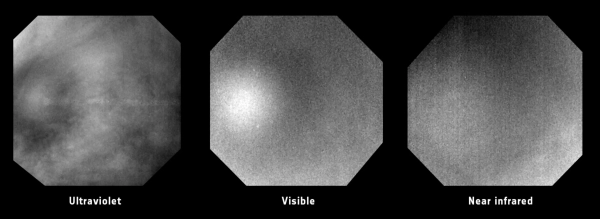
Glorias on Venus / ESA Photo
What about planets in other solar systems?
One such discovery was made on the exoplanet WASP-76b, which is called a “hot Jupiter” in the constellation Pisces. Dr. Olivier Demanjon, lead author of the study on this phenomenon, describes the moment of discovery as something extraordinary:
I was involved in the first detection of the asymmetric light coming from this strange planet – and I've been very curious to know the reason ever since. But when this feature appeared in the data, it was such a special feeling – a special pleasure that doesn't happen every day,
– Olivier Demanjon commented on his discovery.
Scientific exploration is not limited to planetary atmospheres. In his book Invisible Rainbows, Dr. Carpinetti suggests that we can think even more broadly. For example, the extremely energetic light around supermassive black holes can refract on the surrounding material. This creates radiation of different X-ray wavelengths, effectively a kind of “X-ray rainbow.”
Such discoveries remind us that the universe is much more complex and interesting than it seems at first glance, and that familiar earthly phenomena may have fantastic analogues in the far depths of space.
You will also be interested to know: why does the rainbow on Earth have these colors?
The rainbow on Earth has these colors because of the physical properties of light and the atmosphere. Sunlight appears white, but it is actually made up of electromagnetic waves of different lengths. When light passes through water droplets in the atmosphere, it is refracted, reflected inside the droplet, and separated into its individual colors. This phenomenon is called the dispersion of light.
Each color has its own wavelength. Red light has the longest wavelength in the visible spectrum, and violet has the shortest. This causes different colors to bend at different angles. As a result, the human eye sees the familiar sequence of colors: red, orange, yellow, green, blue, indigo, and violet.
In fact, the rainbow is not limited to just seven colors. The spectrum is continuous, and there are a huge number of intermediate shades between the colors. The idea of “seven colors of the rainbow” is largely connected with a historical tradition that dates back to Isaac Newton. He deliberately singled out seven primary colors because he considered the number seven to be “harmonious” – by analogy with the seven notes of the musical scale.
The human eye is also limited by its own biology. We can only see a narrow range of the electromagnetic spectrum – from about 380 to 700 nanometers. Infrared or ultraviolet radiation is invisible to humans without special equipment. That is why a rainbow looks exactly like this to us, although in reality the spectrum is much wider.
How scientists are going to explore Titan: a mission that could see an invisible rainbow
NASA's upcoming Dragonfly mission is generating so much interest. Dragonfly will be the world's first aircraft to operate on the surface of another celestial body as an autonomous drone-helicopter. The mission is scheduled to launch no earlier than 2028, and is expected to arrive on Titan in the mid-2030s, NASA Science writes.
Dragonfly will study Titan's atmosphere, surface chemistry, and methane cycle. The spacecraft will fly between different regions of the moon, analyzing organic compounds and weather phenomena.
The mission is not specifically designed to look for rainbows, but its instruments could help detect atmospheric effects related to the refraction of light in methane droplets. Dragonfly will have spectrometers and cameras capable of operating in various ranges, including infrared. This is what will potentially allow it to record phenomena that the human eye would never see directly.