
Main points
- Archaeologists in Poland have discovered traces of the oldest alcoholic beverages in ceramic fragments dating back to the late Neolithic period.
- Analysis showed that the drinks contained complex mixtures of grains, honey, fruit and tree resin, indicating developed trade networks and the ritual significance of alcohol consumption.
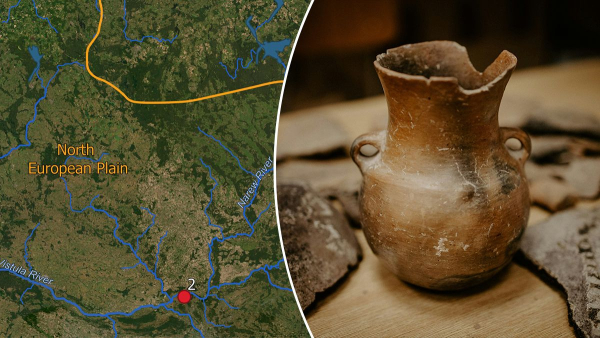
Archaeologists found traces of ancient alcohol / Collage 24 Channel / Unsplash / Esri, DigitalGlobe, GeoEye / A. Gajo).
Archaeologists in what is now Poland have discovered artifacts that reveal previously unknown aspects of the lives of people in the late Neolithic era. Chemical analysis of 4,500-year-old ceramics has provided a glimpse into the world of ancient rituals, where drinks played a key role in social interaction.
What were ancient bowls filled with?
The unique discovery was made during the analysis of ceramic fragments found in Suprasl, in Northern Podlasie, and Skrzeszów in the Masovian Lowland. These finds are associated with the so-called Bell Beaker Culture phenomenon, which existed around 2800 – 1800 BC. Researchers from the University of Warsaw and the Łódź University of Technology used the method of gas chromatography combined with mass spectrometry (GC-MS) to identify molecular residues on the walls of the vessels, writes Arkeonews.
Thirteen pottery fragments from more than 40 artifacts were selected for analysis. Because this method is destructive (meaning the sample must be destroyed for analysis), the researchers took samples weighing only 5 grams for analysis. The results showed that at least 9 of the 13 vessels examined once contained fermented beverages.
The chemical profile of the finds turned out to be extremely complex:
- Archaeologists have found traces of lactic, acetic, and levulinic acids, which are markers of fermentation or ethanol breakdown. In particular, levulinic acid is a product of the fermentation of sugars, while acetic acid may indicate the oxidation of ethanol.
- In addition, azelaic acid, which is found in wheat and barley, and vanillin were found in the samples. The presence of vanillin may indicate heat treatment of the malt, for example, during its drying or roasting.
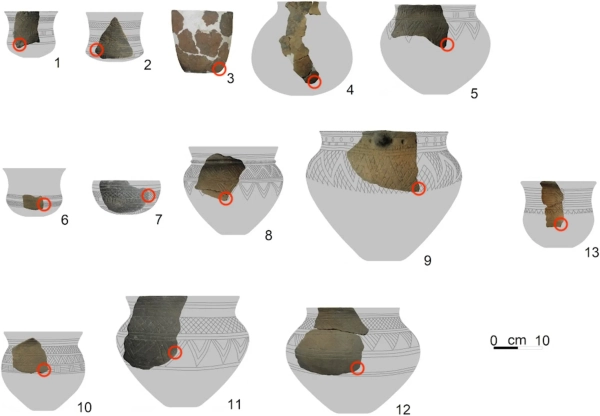
Ceramics with marked sampling locations for chemical analysis / Image by Dariusz Manasterski and other authors
Interestingly, the ancient drinks were not similar to modern beer in its classical sense. Scientists describe them as complex mixtures or “northern grog.” The composition of such a “potion” included not only cereals, but also honey, fruits and tree resins.
In particular, the presence of benzoic acid may indicate the addition of berries, such as cherries or raspberries. The use of wood resin probably helped preserve the drink and gave it a specific aroma.
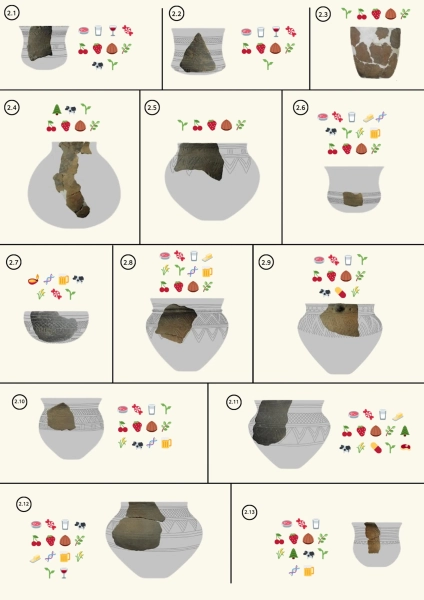
Vessel contents based on identified biomarkers / Image by Dariusz Manasterski and other authors
Where did people get the ingredients from?
The discovery is particularly significant because 4,500 years ago, the territory of northeastern Poland was covered in dense forests, so local communities were not actively engaged in agriculture. The study, published in Archaeometry, concluded that the ingredients for alcohol production, including grain, could have been supplied through trade networks from Kuyavia or Chełmno Land, located 300 to 650 kilometers away. Transportation most likely took place via waterways – the Vistula and its tributaries, in particular the Narew River.
Why did they do that?
The finds from Skrzeszów, dating from the early phase of the Třinec Cultural Community, indicate that the tradition of drinking such beverages continued into the Early Bronze Age. The use of alcohol was an integral part of ritual and social life. The finds demonstrate that alcohol was not consumed in a domestic context – all the samples examined come from burial and ritual complexes, and not from ordinary settlements or kitchens.
The primary function of alcohol during this period was to accompany funerary rites. Vessels containing fermented beverages were placed in graves or ritual objects as part of symbolic offerings.
In addition to its religious significance, alcohol served as a “social glue” that held communities together. The use of such drinks during ceremonies helped to strengthen bonds between groups, negotiate alliances, and mark the social status of the participants. In some cases, alcohol may even have had medicinal or medical purposes, as evidenced by the complexity of the drink's recipes.
You may also be interested in: What do we know about alcohol in the ancient world?
Alcohol has been with humanity for much longer than states, writing, or even agriculture. Modern archaeological research shows that people began deliberately creating fermented beverages as early as the hunter-gatherer era, thousands of years before the emergence of the first cities. The oldest evidence of alcohol production dates back to about 13,000–11,000 years ago, although people probably knew about the natural fermentation of fruit or honey even earlier.
First evidence of alcohol use
One of the oldest evidences of intentional alcohol production is considered to be the finds from the Rakefet Cave in modern-day Israel. There, archaeologists discovered starch residues and traces of fermentation in stone pits belonging to the Natufian culture. The age of the find is estimated at about 13,000 years. Researchers suggest that local residents made primitive beer from wild cereals for ritual feasts and burials.
Another extremely important site was the Neolithic complex of Gobekli-Tepe in modern-day Turkey. It is about 11,500 years old. In large stone vessels, archaeologists found traces of calcium oxalate, a substance that occurs during the fermentation of grain. Some tanks could hold up to 160 liters of liquid. Researchers believe that early beer was brewed here from wild cereals for mass rituals and celebrations. Some archaeologists even suggest that the need for a large amount of grain for alcohol could have been one of the impetuses for the development of agriculture, according to the specialized website gobekli-tepe.com.
The first reliable evidence of winemaking appears later:
- In the mountains of modern-day Georgia, archaeologists have found pottery approximately 8,000 years old with chemical residues of grape wine.
- Wineries of almost the same age were discovered in the territory of modern Iran and Armenia.
- The Arena-1 cave in Armenia became especially famous, where an ancient winery about 6,000 years old was found – with grape presses, fermentation vessels, and drinking bowls.
- The oldest known complex alcoholic beverage was found at the Chinese site of Jiahu. There, a vessel about 9,000 years old contained traces of a fermented mixture of rice, honey, and fruit. This is one of the earliest known examples of a complex alcoholic recipe, rather than just random fermentation. The drink likely resembled something between mead, wine, and brew.
Alcohol in Mesopotamia
When the first civilizations of Mesopotamia appeared, alcohol had already become part of the economy, religion and everyday life. A special role was played by the Sumerians – a people who lived in Southern Mesopotamia about 6-5 thousand years ago. It was the Sumerians who left the first written mentions of beer. On clay tablets, archaeologists found recipes and descriptions of brewing, as well as the famous “Hymn to Ninkasi” – the goddess of beer. This is actually the oldest written recipe for beer in the world, writes National Geographic.
Alcohol among the Sumerians
Sumerian beer was significantly different from modern beer. It was thick, cloudy, and more like fermented porridge. It was often drunk through long straws so as not to swallow the remains of the grain. The basis was barley and special bread, which was first baked and then soaked for fermentation. For the Sumerians, beer was not entertainment, but a basic food product and part of the salary. Workers, in particular, temple builders, received beer rations.
Alcohol in Egypt
In ancient Egypt, brewing became almost industrial. Archaeologists have discovered a huge brewery in Abydos, which is about 5,000 years old and capable of producing more than 20,000 liters of the drink in a single cycle. Beer was probably used during religious ceremonies and royal funerals. The Egyptians improved the recipes by adding honey, dates, and aromatic herbs. Beer was also considered an everyday drink there and was often safer than water.
Alcohol among the Greeks and Romans
Among the ancient Greeks and Romans, wine was the main alcohol. In Greece, its consumption became an important element of the culture of symposiums – intellectual and political feasts. The Romans spread winemaking throughout the Mediterranean and Western Europe. They laid the foundation for many winemaking traditions in France, Italy and Spain.