
Main points
- The Perseverance rover took a self-portrait on the rim of Jezero Crater, using the WATSON camera to capture 61 frames, which were later combined into a single image.
- Perseverance explores ancient rocks, searches for traces of ancient life, analyzes the climate and weather of Mars, and tests technologies for future human flights to Mars.
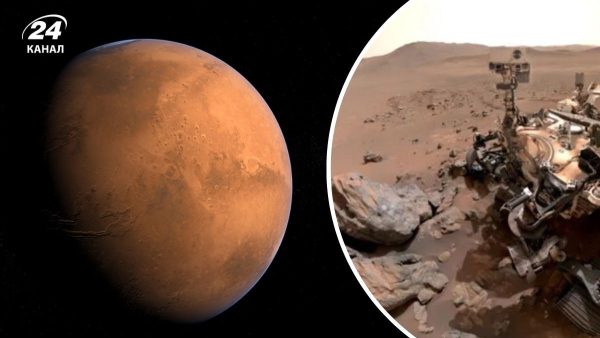
NASA published a striking self-portrait of Perseverance / Collage of Channel 24 / Photo by Depositphotos / NASA
NASA has released a new self-portrait from the Mars rover Perseverance, taken deep in the depths of Jezero Crater. The spectacular shot is more than just a pretty postcard from Mars — it's helping scientists study some of the Red Planet's oldest rocks.
The image was taken on March 11, on the 1797th sol of the mission, NASA noted. The photo was taken in the Lac de Charmes area, which was one of the most distant points on the rover's route since landing on Mars in February 2021.
What can you see in the photo?
In the foreground of the frame is the Arethusa outcrop. It was there that the rover previously cleaned the surface of the rock with a special tool, removing the top layer of rock for further spectroscopic analysis.
This approach allows researchers to study the internal structure of ancient Martian rocks and look for signs that liquid water and potentially microbial life may have existed in the crater billions of years ago.

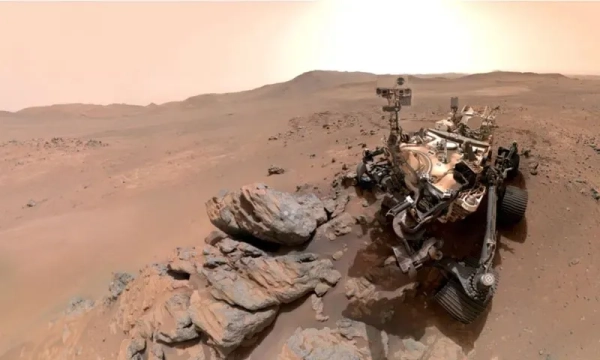
Perseverance took a selfie on Mars / NASA photo
The selfie itself was created in a rather complicated way. The WATSON camera, mounted on a robotic arm about 2.1 meters long, took 61 separate frames from different angles . After that, special algorithms on Earth combined the photos into a single composition. During the shooting, the robotic arm moved according to a special scheme so that it was not visible in the final image.
The new self-portrait has not only artistic but also practical value. Engineers use such images to assess the condition of the body, wheels and scientific equipment after several years of work in the extreme conditions of Mars. Temperatures on the planet can drop below -90 degrees Celsius, and fine dust gradually damages the rover's mechanical elements.
The selfie also captures Perseverance's progress through an ancient Martian delta. The rover is currently exploring geological structures on the western edge of Jezero Crater, a region considered one of the most promising places to search for traces of ancient life on Mars.
What I see in this image is a great image of what are probably the oldest rocks that we will be exploring on this mission,
– said Ken Farley, one of the leading participants in the Perseverance project from the California Institute of Technology in Pasadena.
The rover has already begun its sixth Earth year of operation on the Red Planet and continues to send back both scientifically important data and impressive images of Martian landscapes.
What is Perseverance doing on Mars?
The main goal of the Perseverance mission is to search for traces of ancient life on Mars and study the geological history of Jezero Crater. Scientists believe that billions of years ago there was a lake with a river delta here, and therefore the region could be suitable for microbial life.
The rover is studying ancient sedimentary and volcanic rocks, analyzing the chemical composition of rocks, and collecting samples of Martian soil. Some of these Perseverance has already sealed in special containers for a future mission to return the samples to Earth. This should help scientists conduct much more precise laboratory studies in terrestrial conditions.
In addition to searching for possible biosignatures, the rover is studying Mars' climate and weather, surface structure, and atmospheric features using a suite of scientific instruments, including the RIMFAX ground-penetrating radar, the SHERLOC and PIXL spectrometers, and the MEDA weather station.
It was thanks to these systems that scientists were able to explore hidden geological layers beneath the surface of the Jezero crater and even record electrical discharges in the Martian atmosphere – a kind of “mini-lightning” that occur during dust storms, as Reuters reported.
Another important task for Perseverance is to prepare for future human missions to Mars. During the mission, the rover already tested the MOXIE experiment, which produced oxygen from carbon dioxide in the Martian atmosphere. This was the first successful example of producing breathable oxygen directly on another planet.
What's the latest news on the Mars rover mission?
The last few months have been particularly productive for Perseverance. NASA recently announced that the rover has received a new autonomous navigation system, which is already being called an analogue of “GPS for Mars.” Now the device can determine its own location much more accurately without the constant help of operators from Earth. This allows it to move faster and overcome complex routes with fewer stops.
Also in early 2026, Perseverance made its first trip with an artificial intelligence-planned route, as Phys.org reported. The generative AI system analyzed the surface terrain, found a safe path between rocks and slopes, and independently formed a route.
NASA considers this an important step towards more autonomous space missions of the future.
The rover is also continuing to explore the western rim of Jezero Crater, where scientists are finding increasingly unusual rocks. Among the latest discoveries is the striped rock “Freya Castle,” which NASA says may indicate complex volcanic or metamorphic processes in Mars' distant past.
Another important discovery is related to the RIMFAX ground-penetrating radar. Using subsurface scanning, Perseverance revealed buried river structures and ancient delta layers that may be even older than those visible on the surface.
Scientific American emphasizes that this strengthens the hypothesis that water existed in the Jezero crater for a long time, and conditions for life could have persisted there for hundreds of millions of years.
New panoramic images of Mars, which NASA published in the spring of 2026, also aroused particular interest. They demonstrate the diversity of the terrain and help scientists better understand the geological evolution of the Red Planet.