
Main points
- Scientists have found that over the past 60 years, the area of hypersaline waters in the southern Indian Ocean has shrunk by about 30% due to global warming.
- Weakening ocean currents could lead to an increase in extreme weather events, increased winter storms in Europe, and threats to marine ecosystems.
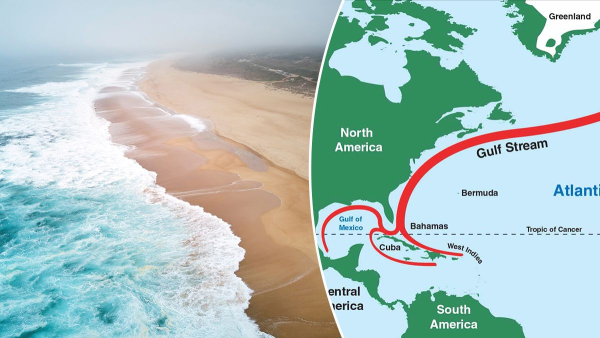
Is a global trend breaking? / Collage by Channel 24
One of the saltiest regions of the world's oceans has seen a dramatic decrease in salinity. The changes have been happening for decades, but the pace is so rapid that scientists are already talking about a possible impact on global currents and the climate balance.
What does decreasing salinity mean for global ocean circulation?
The study found that over the past 60 years, the area of hypersaline waters in the southern Indian Ocean off the west coast of Australia has shrunk by about 30 percent. The region has traditionally been characterized by high salinity due to a dry climate and the predominance of evaporation over precipitation. Now the situation is changing, writes the Daily Mail.
A team from the University of Colorado at Boulder has recorded that desalination is happening at an extremely rapid rate, the most significant increase in the proportion of freshwater in the Southern Hemisphere. The authors estimate that the amount of freshwater added each year is equivalent to about 60 percent of the volume of Lake Tahoe (151 cubic kilometers).
On a consumption scale, this corresponds to drinking water reserves that would last the entire US population for more than 380 years.
The reason is not local rains. Modeling has shown that global warming plays a key role. Rising temperatures are changing the structure of surface winds over the Indian and tropical Pacific oceans.
New wind patterns are “pushing” currents to transport more water from the so-called Indo-Pacific freshwater basin to the southern Indian Ocean.
The average salinity of the ocean is about 3.5 percent, but regional differences shape a powerful global system of heat and water exchange – the thermohaline circulation. It works like a giant conveyor belt: warm and relatively fresh surface waters move from the Indo-Pacific region to the Atlantic, where they cool, become saltier and denser, and sink to the depths.
How is the Gulf Stream related to this?
A key part of this mechanism is the Atlantic Meridional Overturning Circulation (AMOC), which includes the well-known Gulf Stream. It is this system that largely ensures the mild climate in Western Europe.
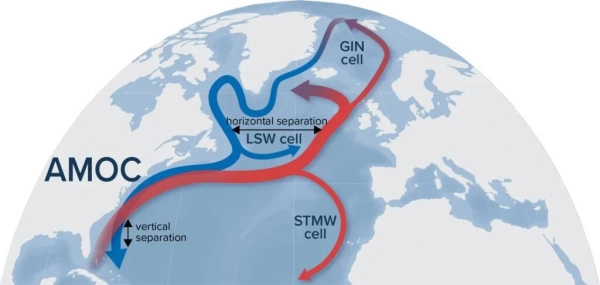
AMOC diagram / Image Globalchoices.org
The decrease in salinity has a direct physical effect: less salty water is less dense. It remains in the upper layers and mixes less well with the deep masses. The increase in stratification weakens vertical mixing – the process that transfers heat and nutrients between layers of the ocean. As a result, surface waters can heat up even more, and the depths – receive less oxygen and nutrients, says a study in the journal Nature Climate Change.
Scientists have previously warned that the melting of Greenland and Arctic ice is slowing the AMOC by bringing fresh water into the North Atlantic. Now, this is being compounded by the expansion of desalination zones in other parts of the ocean. If the trend continues, it could change the balance of the entire global circulation.
What are the risks?
The consequences are not limited to air temperature.
- Weakening currents could lead to an increase in extreme weather events, increased winter storms in Europe, and sharper temperature fluctuations.
- In addition to climate risks, marine ecosystems – plankton and seagrasses, which are at the base of ocean food chains – may be at risk.
Changes in salinity are not an isolated phenomenon, but a signal of a restructuring of the global water cycle. And this signal is getting louder and louder.