
Main points
- A new crater with a diameter of 225 meters has been discovered on the Moon, which was probably formed in the spring of 2024.
- The new crater destroyed or damaged previous craters within a radius of two diameters from its edge, confirming theoretical models.
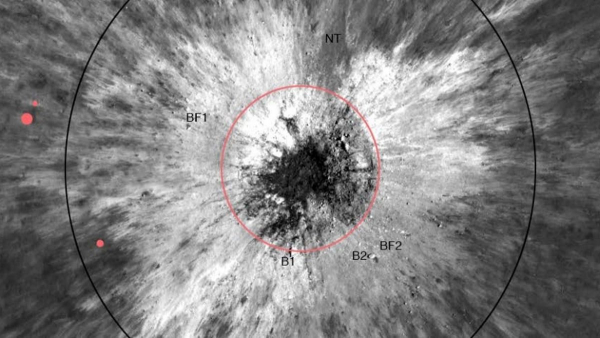
NASA orbiter records rare impact on the Moon / MS Robinson and other study authors
Scientists analyzing images from NASA's orbiter have discovered a crater on the Moon that is extremely rare to form. But its impact on the surrounding terrain is no less surprising.
What was found on the Moon?
Our moon doesn't have a dense atmosphere to protect its surface, so meteorites regularly leave new marks on it. However, what NASA's Lunar Reconnaissance Orbiter has recorded is a phenomenon on a completely different scale, writes IFLScience.
Astronomer Mark Robinson, principal investigator for the LRO project and operating the LROC camera, announced the new discovery at the Lunar and Planetary Sciences Conference in Texas. The corresponding article was later published on the website of the Universities Space Research Association.
During a routine analysis of images taken at different times, the team discovered a new crater measuring 225 meters in diameter and about 43 meters deep. The impact most likely occurred in late spring 2024.
For comparison: the largest crater previously discovered by the LRO mission was an object with a diameter of only 70 meters – and even that, according to calculations, should have formed about once every 139 years. The new crater turned out to be three times larger.
Bright streaks are clearly visible around it – ejections of lunar soil and rocks that were scattered at the moment of impact. Researchers compared the characteristics of these ejections with predictions from scientific models.
In particular, the models predicted that the sizes of rock fragments would follow a power law distribution, and the maximum size of individual blocks would be between 4 and 12 meters. Actual observations confirmed these predictions: the largest fragment discovered was about 11 meters across.
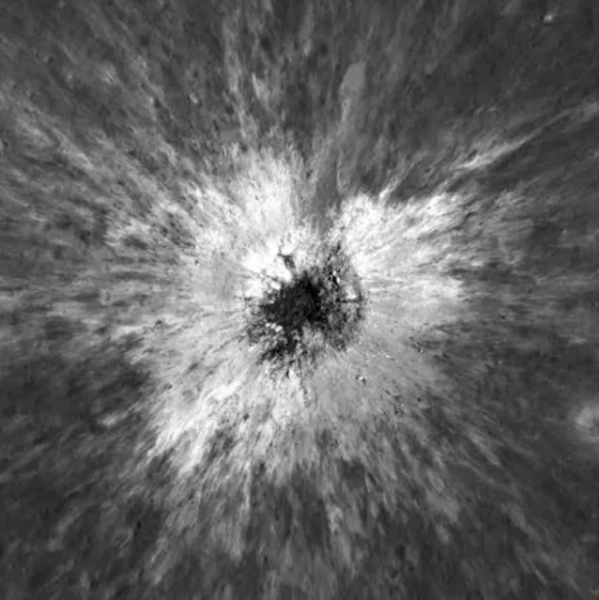
Impact site / Photo by MS Robinson and other study authors
But the most interesting thing is the impact of the new crater on the surrounding terrain. Despite the fact that a new crater appeared on the Moon, the total number of craters in that area decreased. The powerful ejection of material completely “obliterated” or seriously damaged all previous craters within about two radii from the edge of the new one.
Of the two surviving craters, both are located almost at the very edge of this zone – and even they have undergone significant changes. The rest, including those up to 40 meters in diameter, have been destroyed or so degraded that they are invisible in the images.
The researchers note that this is consistent with theoretical models that predicted the destruction of previous craters in the zone of continuous ejecta within two radii from the edge of the new one.
Lunar Reconnaissance Orbiter
The Lunar Reconnaissance Orbiter has been orbiting the Moon for nearly 17 years, the longest lunar orbital mission in history. It was thanks to its constant observation of the surface that scientists were able to capture this event and obtain “before” and “after” images with meter-accuracy.
According to the team, this unique pair of images provides a rare opportunity to test existing models of crater formation on real data – and the results of this test have been encouraging.