
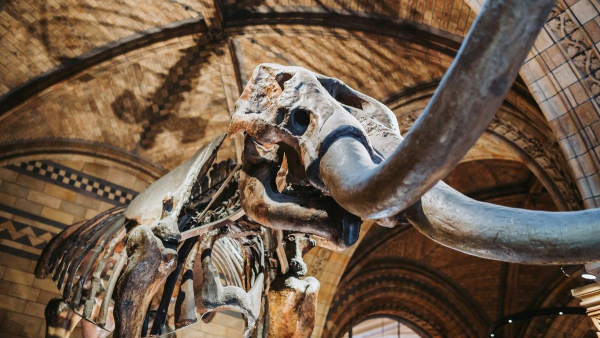
Mammoth from Alaska turned out to be a sea giant / Unsplash
Scientific archives sometimes hide secrets that have been waiting for decades to be revealed. What was once thought to be the only evidence of the last mammoths on the planet has turned out to be a completely different story after detailed analysis. The discovery has forced researchers to not only revisit old reports, but also ask new questions.
A 70-year-long mistake: who really had a skeleton?
This story began in the middle of the last century, writes ScienceAlert. In 1951, the famous archaeologist Otto Geist, during an expedition to the interior of Alaska, in a prehistoric region called Beringia, discovered fossilized vertebrae. Based on the appearance of the bones and the place of discovery, Geist concluded that they belonged to woolly mammoths of the species Mammuthus primigenius. At that time, such an assumption seemed quite logical, because the bones of large fauna of the late Pleistocene were often found in this region, and the size of the vertebrae clearly indicated a representative of the elephant family.
After the discovery, Geist transferred the finds to the University of Alaska Museum of the North, where they were kept in the archives for over 70 years. Only recently, modern technology has allowed scientists to radiocarbon date these artifacts, and the results have been truly shocking.
The bones turned out to be too young for a woolly mammoth. Carbon isotopes recorded in the ancient remains indicate an age of 2,000 to 3,000 years. This creates a huge discrepancy, because mammoths, according to science, became extinct about 13,000 years ago, despite some isolated populations that managed to survive until the 4,000-year mark.

Mammoth fossils dating to the Late Holocene from interior Alaska would be a stunning find: the youngest fossil mammoth ever recorded. If accurate, these results would be several thousand years younger than the last evidence of mammoths in eastern Beringia,
– commented Matthew Wooller, a biogeochemist from the University of Alaska in Fairbanks.
Before completely rewriting the chronology of the giant extinction, the researchers decided to check the correctness of the species identification. Radiocarbon dating and related stable isotope data were the first signs that something was wrong.
The analysis showed much higher levels of the isotopes nitrogen-15 and carbon-13 than would be expected from a terrestrial, herbivorous animal. Such chemical signatures are much more common in the ocean and accumulate in the bodies of marine creatures.
Because the deep interior of Alaska is not known for its abundance of seafood, no previously found mammoth from eastern Beringia had this chemical composition.
This was our first indication that the samples likely came from a marine environment,
– said Wooller.
Experts on mammoths and whales confirmed that it was impossible to identify the species based on appearance alone, so ancient DNA analysis was needed. Although the samples were too degraded for nuclear DNA analysis, scientists were able to extract mitochondrial DNA. Comparisons with samples from the North Pacific right whale (Eubalaena japonica) and the lesser whale (Balaenoptera acutorostrata) finally put everything in its place.
How did they end up there?
When analysis of two samples told scientists that the mammoth bones were actually whales, another mystery emerged: how did the remains of two whales over 1,000 years old end up in the depths of Alaska, more than 400 kilometers from the nearest coastline?
Researchers are considering several versions:
- The first is the “oceanic migration of whales” through ancient bays and rivers, which seems unlikely due to the enormous size of these animals and the shallowness of Alaska's waters.
- Another option is that ancient people could have transported the bones from the coast, although no such evidence has been found for this region before.
- Finally, a scientific error cannot be ruled out: Otto Geist's collections came from all over Alaska, so the museum could have mixed up exhibits as early as the 1950s.
Ultimately, this issue may never be fully resolved,
– concluded the team of scientists.
However, the results of their work, which appeared in the Journal of Quaternary Science, have already helped to cross these specimens off the list of contenders for the title of “the last mammoths on Earth.” Thus, modern science has once again proven the importance of critically reviewing even those facts that were considered indisputable for decades.