
Main points
- On March 13, 2026, the Earth will be hit by a minor G1-level magnetic storm caused by a coronal hole on the Sun.
- The aurora borealis will only be visible at high latitudes.
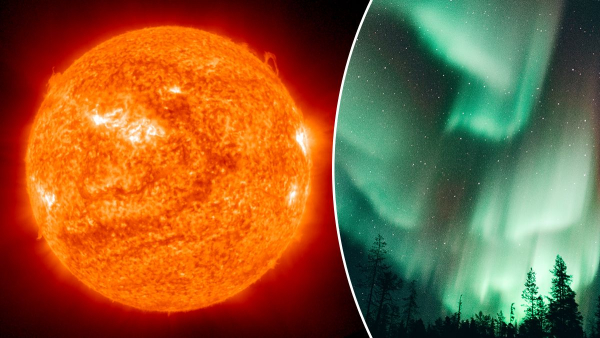
Magnetic storm March 13 and 14, 2026 / Collage by Channel 24/Unsplash/SolarHam/SDO
On March 13, 2026, instruments on Earth began recording weak activity in the planet's magnetosphere. The warning of a magnetic storm came at the last moment.
What will the magnetic storm be like on March 13?
Fortunately for terrestrial technology, the storm will be insignificant – only G1. On the other hand, this is bad news for everyone who would like to enjoy the aurora borealis. Disturbances of this level manifest themselves only in the far north, so you should not count on a spectacle this time, writes 24 Kanal .
According to SolarHam, the fault for the disturbance lies with a long coronal hole that stretches across the visible disk from the northern hemisphere to the southeastern edge. This is the same coronal hole that was present last month. It has rotated with the Sun and now, according to the rules, has been given a new number.
Here is a comparison between February 13th and today's March 13th:
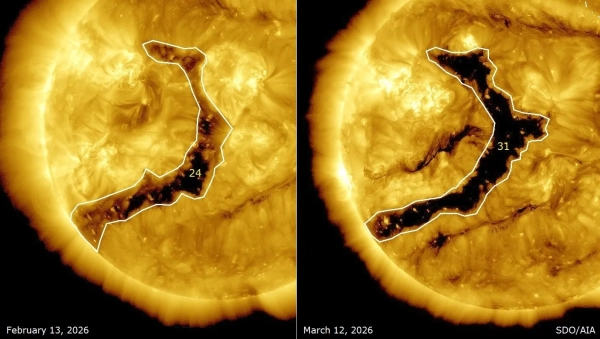
Coronal hole comparison between February 13 and March 13 / Photo SolarHam/SDO
These holes in the Sun's atmosphere, through which the solar wind escapes at a higher speed, can open for short periods of time or remain open for weeks, changing shape and size. They are visible only in the extreme ultraviolet (EUV) and soft X-ray ranges of the spectrum, but not in the visible. In images in these ranges, they appear as dark areas in the solar corona due to the lower density and temperature of the plasma compared to the surrounding environment. Thus, conventional telescopes are not sufficient to see coronal holes.
This situation is very similar to the last time, when a minor G1 storm was observed on February 15. At that time, the high-speed stream reached Earth a few days after the coronal hole passed through the center of the visible solar disk. The same result is predicted this time on March 13-14, according to NOAA data. Auroras in high latitudes could appear as early as this evening or over the weekend.
At the time of publication, there is no magnetic storm yet, and the Kp index, which shows the total amount of solar wind in contact with the Earth's magnetosphere, is less than 3, according to SpaceWeatherLive. For a G1 storm to begin, the Kp index must be 5, according to the Space Weather Prediction Center.