
Main points
- Scientists have discovered microscopic structures that indicate the existence of navigation systems in animals 97 million years ago.
- The study revealed complex magnetic configurations that could have been highly accurate navigational tools, allowing animals to orient themselves by the Earth's magnetic field.
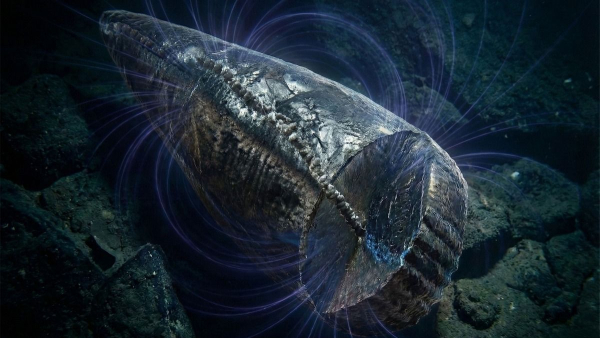
This artist's drawing attempts to imagine what a magnetic structure might have looked like when there was an animal growing it / SciTechDaily
Scientists have discovered microscopic structures with unique properties in marine sediments dating back to the time of the dinosaurs. They are not like random minerals and hint at complex biological mechanisms that we now understand arose much earlier than previously thought. The discovery changes our understanding of the evolution of animal orientation in space.
How did “built-in GPS” appear in ancient ocean dwellers?
An international team of researchers from the University of Cambridge and the Helmholtz-Zentrum Berlin in Germany has analyzed mysterious magnetic fossils that are about 97 million years old. These microscopic objects, preserved in sediments of the North Atlantic, are shaped like spears, needles, spindles and balls. Each structure is no larger than a bacterial cell, but its origin is clearly biological, writes SciTechDaily.
Previously, scientists could not say for sure why these formations existed. Some considered them protective elements, a kind of spikes. However, a new study showed otherwise. Using magnetic tomography, researchers have created for the first time three-dimensional images of the internal magnetic structure of these fossils. It turned out that they have a complex configuration, optimized for the perception of the Earth's magnetic field.
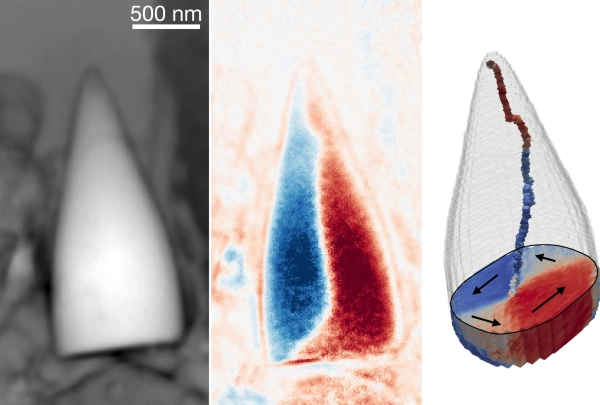
Image of fossil identified by researchers / Photo by Rich Harrison
Inside each particle, the magnetic moments are twisted around a central axis, forming a vortex-like structure. This geometry is both extremely stable and sensitive. It allows it to respond to even minimal changes in the strength and inclination of the magnetic field. In fact, it is an ideal biological sensor, capable of determining not only direction but also position on a global scale.
Co-author of the study, Professor Richard Harrison, explains that such particles could have worked as a highly accurate navigational tool. Long before the advent of birds, they allowed other creatures to determine latitude by the tilt of the magnetic field and respond to changes in its strength associated with longitude.
This means that the ability to navigate long distances arose long before the appearance of modern birds and fish, much earlier than we always believed.
In comparison, magnetotactic bacteria also use magnetite, but their particles are 10 to 20 times smaller. The new magnetic fossils are much larger and show a much more complex organization. This suggests an evolutionary step from primitive alignment in the field to a true “magnetic map” of the environment.
Who exactly grew these structures in their bodies remains a mystery. Scientists suggest that it could have been a migratory marine animal, numerous and widespread in the oceans of the Cretaceous period. Among the possible candidates are eels, which appeared around the same time and still migrate thousands of kilometers, guided by the Earth's magnetic field. It is known that their tissues contain magnetite, but the exact mechanism of navigation has not yet been directly recorded.
The results, published in the journal Communications Earth & Environment, show that “giant” magnetic fossils are a key link between bacterial magnetoreception and the sophisticated navigation systems of modern animals. In fact, this is the oldest direct evidence that animals used the Earth's magnetic field as a navigation tool almost a hundred million years ago.