
Main points
- Light poles in the Kharkiv region appear in the winter due to the combination of frosty and humid air.
- This rare optical phenomenon is related to halos, but requires more unique conditions.
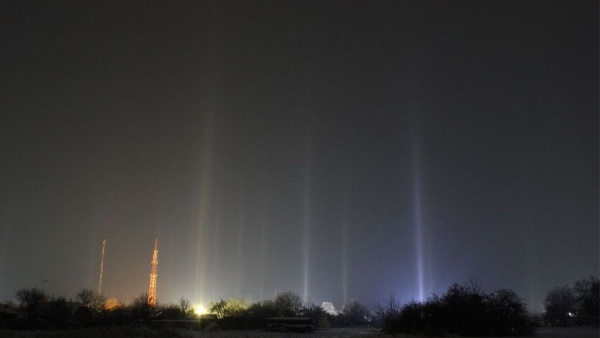
Rare winter light pillars over the Kharkiv region / Collage by Channel 24
An optical phenomenon has appeared over the winter sky of the Kharkiv region that looks like something out of a science fiction movie. Vertical streaks of light seem to hang in the air, changing the usual perception of the night landscape.
Why do pillars of light appear in the sky?
Ruslan Tytarenko shared his many years of photo collection. All photos were taken between 2009 and 2026 from almost the same point in the Kharkiv region, writes the channel Universe in Your Pocket.
According to the author of the photos, the light pillars are not a regular occurrence and may not appear for years. Sometimes they are clearly visible to the naked eye, and in other cases they are only captured by a camera with a long exposure.
Light pillars are observed exclusively in winter. They require a rare combination of conditions to appear.
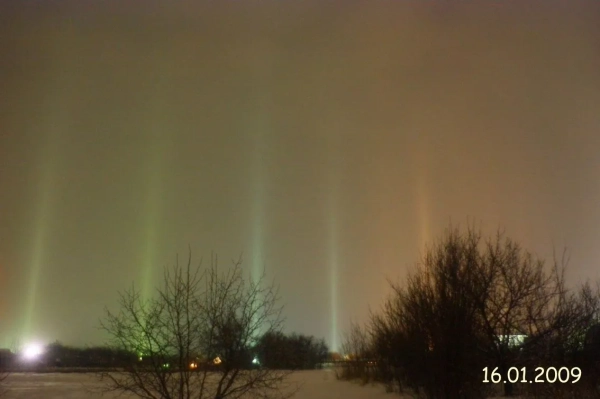
Light poles over the Kharkiv region in 2009 / Photo by Ruslan Tytarenko

Light poles over the Kharkiv region in 2014 / Photo by Ruslan Tytarenko

Light poles over the Kharkiv region in 2015 / Photo by Ruslan Tytarenko
In the cold, humid air, tiny, flat, hexagonal ice crystals form. They slowly sink and orient themselves horizontally almost simultaneously. This structure allows them to reflect light from ground lights, the Moon, or the Sun, creating vertical columns of light rather than large circles around the light sources as is usually the case.
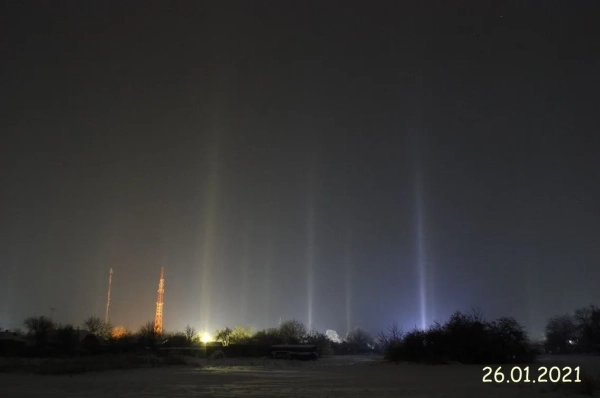
Light poles over the Kharkiv region in 2021 / Photo by Ruslan Tytarenko
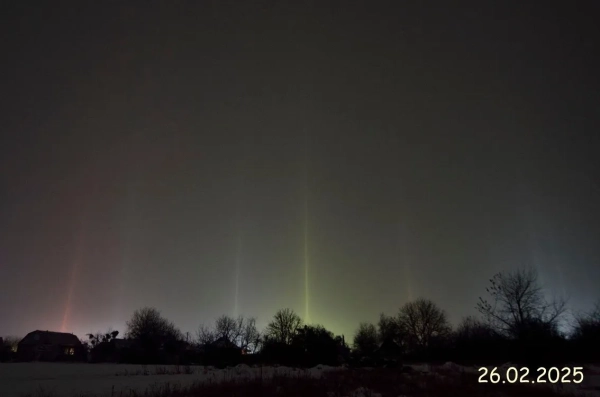
Light poles over the Kharkiv region in 2022 / Photo by Ruslan Tytarenko
The situation becomes especially striking when the light pillar seems to have no visible source and is “detached” from the ground. In such cases, the illusion becomes extremely surreal, and the phenomenon itself can easily be confused with something inexplicable.
Light pillars are actually related to the halo phenomenon. Halos generally form in thin ice clouds at altitudes of 5,000 to 13,000 meters. These are cirrus or cirrus-stratified clouds that create an almost imperceptible veil of ice crystals in the sky. Unlike a rainbow, where light refracts in water droplets, in the case of a halo, it passes through the crystalline structure of ice, notes the Weather & Radar Ukraine website.
For Ukraine, such atmospheric effects occur infrequently. A lunar halo usually looks pale and almost colorless, because the human eye does not distinguish colors well at night. Often, the appearance of a halo is associated with the approach of moist atmospheric fronts and weather changes, although this rule does not always work. Light pillars remain an even rarer and more demanding phenomenon, requiring almost ideal winter conditions.
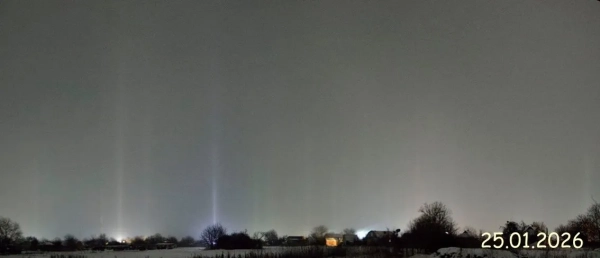
The latest observations of light poles, taken on January 25, 2026 / Photo by Ruslan Tytarenko