
Main points
- Archaeologists have discovered a large burial mound in Cumbria that may be the burial site of Viking Ivar the Boneless, with its dimensions consistent with elite burials.
- A geophysical scan of the mound is planned to confirm the presence of a structure resembling a ship's hull.
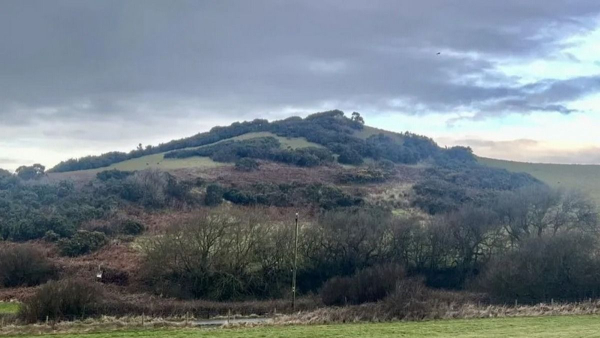
According to archaeologist Steve Dickinson, a Viking ship and the remains of Ivar the Boneless may be located on the top of the hill. / Steve Dickinson
A mound has been discovered in northwest England that may be linked to one of the most enigmatic figures of the Viking Age. New evidence from archaeology and medieval texts has revived questions about the burial site of a warlord whose death left more questions than answers.
Where is Ivar the Boneless buried?
For more than a thousand years, historians and archaeologists have been unable to determine where Ivar the Boneless, one of the most influential leaders of the Viking Age, was buried. Now, researchers have been drawn to a large mound on the coast of Cumbria, towering over the Irish Sea. Archaeologist Steve Dickinson believes that the legendary leader's ship burial may be hidden under this hill, writes Arkeonews.
The mound is mentioned in medieval sources as Coningeshou, which is usually translated as “King's Hill.” Its dimensions are impressive – approximately 60 meters in diameter and about 6 meters high. Such parameters correspond well with the elite Viking burials known in Scandinavia and Northern Europe.
Dickinson emphasizes that the location of the mound by the sea is not accidental. For the Vikings, the coast was a key element of their worldview, trade and warfare. It was there that rulers and military leaders, who were associated with sea power and travel between worlds, were most often buried.
The surrounding landscape lends additional weight to the hypothesis. Dozens of smaller mounds are located next to the main mound – an estimated 39. By analogy with other known Viking necropolises, such accompanying burials could have belonged to warriors, relatives, or warriors from the ruler’s personal guard.
Excavations have not yet been carried out, but the area has already recorded finds typical of the noble environment of the Vikings. These are massive iron rivets from ships and lead weights, which were used to weigh silver in the monetary system of the time. These artifacts do not prove the existence of a ship burial in themselves, but they fit well into the context of a possible burial of a ruler.
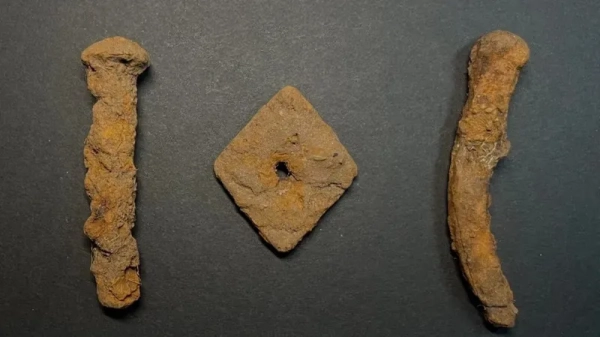
Metal ship rivets have already been found in this area / Photo by Steve Dickinson
Who was Ivar the Boneless?
Ivar the Boneless was a key figure of the 9th century, writes the BBC. He is associated with the Great Heathen Army that devastated the Anglo-Saxon kingdoms, as well as with the capture of York and the formation of Dublin as a powerful Scandinavian center.
The origin of his nickname “Boneless” is still controversial. Some researchers suggest a rare bone disease, while others suggest a metaphorical meaning related to flexibility, rituals, or seamanship.
A confirmed burial could provide a unique opportunity to test these theories scientifically, if the human remains are well preserved. However, even if the ship is discovered, it will be difficult to definitively prove that it belongs to Ivar without inscriptions or reliable genetic markers.
The study should be
Archaeologists are planning to conduct a geophysical scan of the mound in the near future to see if there is a structure beneath the ground that resembles the hull of a ship. If confirmed, it could be the first monumental Viking ship burial found in Britain and significantly change the perception of the Norse presence in the west of England.