
Main points
- The owner of the iPhone 17 Pro Max, ignoring Apple's recommendations, used 122 aggressive charging cycles in 140 days, but the battery capacity remained at 100%.
- Modern lithium-ion batteries are resistant to loads thanks to charge controllers, and software features such as Optimized Battery Charging only slightly reduce degradation.
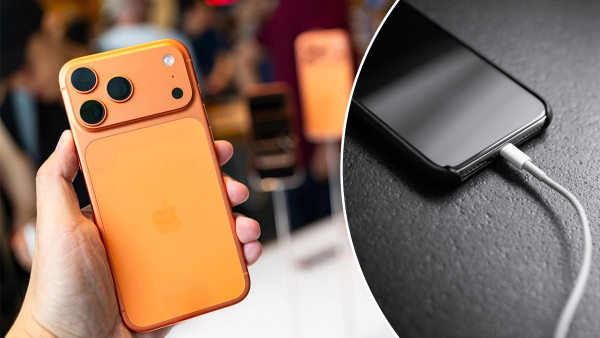
Is charging an iPhone battery to 100 percent harmful? / Collage 24 Channel/Depositphotos
The owner of an iPhone 17 Pro Max deliberately ignored Apple's battery recommendations and used the smartphone without any restrictions. Over four months, the device went through more than a hundred charging cycles. Here's what the battery was like afterwards.
What happened to the battery?
As of February 7, 2026, the smartphone had completed 122 charging cycles in 140 days. The owner turned off the Optimized Battery Charging function and did not limit the charge to 80 percent – each connection ended with a full 100 percent. The device was charged both with a cable and wirelessly, using various adapters and power banks. The smartphone worked in the cold and in direct sunlight, sometimes completely discharged, and sometimes remained connected to power all day. In addition, it was constantly in a thick case, which does not contribute to cooling, the author of the experiment writes in his article for ZDNET.
Despite this operation, the system continues to show 100 percent of the maximum capacity. The reason lies not in the “special” battery, but in the principles of operation of modern batteries and software accounting.
Modern lithium-ion batteries are highly resistant to stress. Most devices have charge controllers installed in them – power management chips that regulate the charging rate, voltage limit and temperature limits. They do not allow the battery to charge or discharge beyond safe limits. It is these hardware mechanisms that play a key role in protecting the battery.
Apple's software features, such as Optimized Battery Charging or the 80 percent limit, work on top of basic protection. They can indeed reduce degradation somewhat, but their effect in the consumer electronics segment is not as significant as is often believed.
According to Apple's own estimates, an iPhone battery is designed to retain up to 80 percent of its original capacity after 1,000 full cycles under ideal conditions. To put it simply, that's about minus one percent every 50 cycles.
Why didn't the indicator change after 122 cycles?
Each battery has a nominal and an actual capacity. The nominal is the value in the technical specifications. The actual is usually slightly higher to compensate for manufacturing variations. Until the actual capacity drops below the nominal, the system will display 100 percent. This is a kind of “honeymoon period” when wear is already occurring, but is not yet recorded by the indicator.
Once the actual capacity crosses the nominal threshold, the indicator will begin to gradually decrease – by about one percent every 50 cycles. That is, the decrease is inevitable, it is just not instantaneous.
Interestingly, the owner's previous smartphone – iPhone 15 Pro Max – was operated as “correctly” as possible: with a limit of 80 percent and a careful charging mode. However, after two years, the battery still lost a significant part of its resource and could not withstand a full day of work without recharging. In practice, the restrictions could only slightly postpone wear and tear, but not change the overall picture.
What conclusions can we draw?
The conclusion is simple: the battery wears out regardless of the usage scenario. Modern protection systems already provide basic security, and additional software features have a moderate but not radical effect. The 100 percent indicator is not the absence of wear, but only the moment when it has not yet exceeded the factory capacity reserve.