
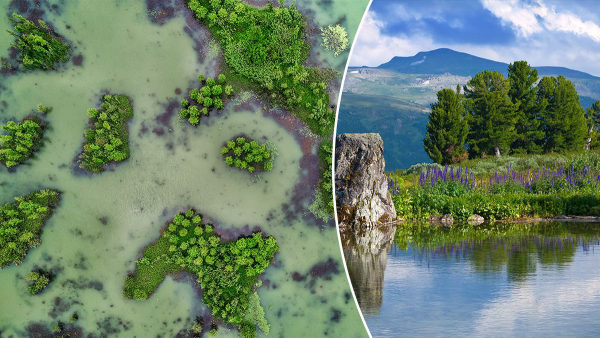
The mystery of the appearance of the first greenery: how the emergence of plants from the ocean changed the fate of the planet / Collage 24 Channel / Freepik
Millions of years ago, Earth was a harsh place where life was limited to water. The surface of the continents remained a dead zone, where rocks and wind ruled. However, at a certain point, nature made an incredible leap that set off a chain reaction of changes. These transformations were so large-scale that they rewrote the rules of existence on our planet forever.
What was the path of the first land inhabitants and how did they survive?
The history of the plant world begins in the water, where over 1 billion years ago, the simplest organisms, similar to modern algae, appeared. These tiny green life forms, which can still be seen today in the form of slime on stones or seaweed on beaches, had a unique ability to photosynthesize, writes 24 Kanal .
Using sunlight, water, and carbon dioxide, they produced sugars and released oxygen as a byproduct. In those distant times, Earth’s atmosphere was almost devoid of this gas, and it was the centuries-long activity of algae and bacteria that led to an event that scientists call the Great Oxygen Explosion. This radically changed the composition of the air and paved the way for the emergence of complex life forms, including animals and humans.
The first steps of life on solid ground
About 500 million years ago, the planet looked very different: the land remained lifeless, although corals, invertebrates and ancient fish already flourished in the oceans. The first plants began to colonize the land in the Ordovician period, approximately 485 – 444 million years ago. Evidence of this is fossilized spores from 470 million years ago, which are very similar to the spores of modern liverworts.
So, about 470 million years ago, the first true plants began to separate from their ancestors, green algae. Their migration to land occurred gradually in the shallow water zone near the coast. Since the conditions in such places were constantly changing – the plants were now under water, now under the scorching sun – they were forced to adapt to the air environment.
This transition was an extremely challenging task. Unlike the aquatic environment, which supported the body and provided easy access to nutrients, land required new evolutionary solutions.
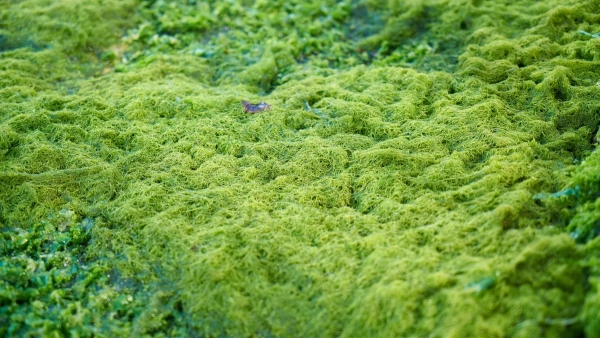
The first plants originated from algae / Photo Freepik
To avoid dying from desiccation, plants developed a special waxy layer known as the cuticle that kept moisture inside. To combat gravity, they developed strong cell walls that allowed them to stand upright, and instead of the roots that would appear later, they developed rhizoids—simple threadlike structures for anchoring in the soil and absorbing minerals.
The first land colonists, such as Cooksonia, were tiny, only 2 to 3 centimeters tall. They resembled modern mosses that grow in humid forests. Despite their small size, they began to break down rocks with their roots, turning them into fertile soil. This process, called weathering, laid the foundation for the development of more complex ecosystems.
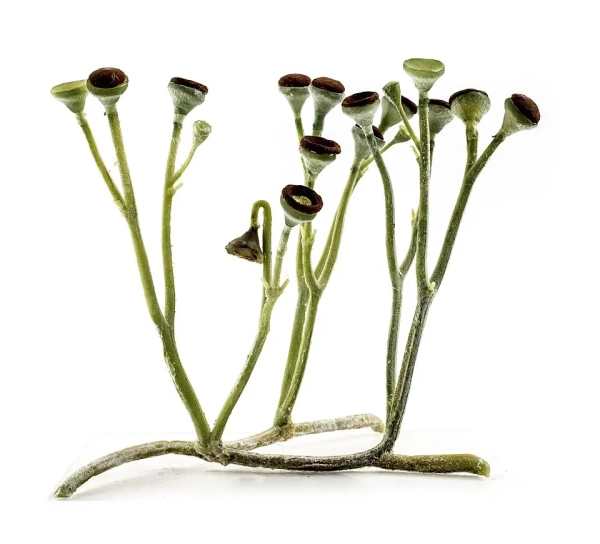
Cooksonia / Image Matteo De Stefano/MUSE
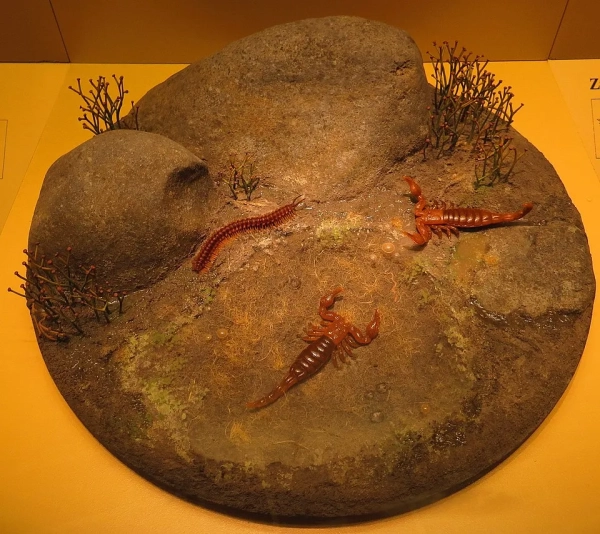
Cooksonia / Photo Ghedoghedo
How trees and the first forests appeared
Over time, plants began to grow upwards to more efficiently spread spores over long distances. During the Silurian period (444–419 million years ago), they became taller and more anatomically complex. When they reached a height of several tens of centimeters, the need arose to efficiently transport water from the ground to the tops.
This gave rise to xylem, the vascular system we know today in its most complex form as wood. In addition, stomata, microscopic pores that allowed carbon dioxide to be absorbed for photosynthesis while preventing excessive water evaporation, appeared on the stems.
One of the most important achievements was branching: the ability to create new shoots allowed plants to cover larger areas and produce more spores.
The real evolutionary explosion occurred in the Devonian period (419 – 359 million years ago). At its beginning, plants remained simple, but by the end of the period, tree-like forms had already covered the planet. The first root systems appeared, which not only fed the plant, but also held it firmly in the ground. At this time, the planet was also covered with huge forests of giant ferns, the height of which reached more than 30 meters. The remains of these ancient forests, under the pressure of time, turned into coal, which humanity still uses as energy today.
The first tree-like plants, such as Eospermatopteris, reached more than 7.5 meters in height and had a trunk base almost 1 meter wide. However, the real breakthrough came with Archaeopteris, a tree with wood and large fern-like leaves that grew up to 30 meters in height. These giants created the first shady forests, but their activities also had unexpected consequences: massive weathering of soils and the release of organic matter into the ocean led to the extinction of half of the marine inhabitants of the time.
Why is coal called the legacy of ancient swamps?
The Carboniferous period (359–299 million years ago) was a time of tropical swamps and an incredible diversity of ecosystems. Complex food chains involving terrestrial herbivores and predators emerged during this time. Giant platypuses such as Lepidodendron dominated the landscape, although they were not as strong as modern trees.
Along with them grew giant tree ferns and horsetails as tall as a multi-story building. Due to the high humidity and specific conditions of that time, a huge amount of plant remains did not decompose, but accumulated and compressed underground. The carbon dioxide that these plants absorbed millions of years ago turned into coal deposits.
By burning fossil fuels today, humanity is releasing energy and carbon that was stored by plants over 300 million years ago.
How seeds helped plants survive global disasters
Reproduction by spores required constant moisture, which limited the spread of plants. Therefore, the next important step was the emergence of seeds about 380 million years ago, in the Devonian period. This allowed plants to reproduce without direct dependence on water and to survive adverse conditions such as drought or cold, mastering arid areas.
As the climate became drier at the end of the Carboniferous period, seed plants gained a significant advantage. In the Permian period, Glossopteris trees with tongue-shaped leaves spread, the fossils of which later helped scientists prove the theory of continental drift.
At the end of the Permian period, life faced the largest extinction in Earth's history, the Great Extinction. Massive volcanic activity caused carbon dioxide levels to rise sharply, causing global warming and the collapse of ecosystems. About 80 percent of marine species and 70 percent of terrestrial vertebrates disappeared. Although flora was also affected, plants were more resilient.
In the Mesozoic Era, the age of dinosaurs, gymnosperms, particularly conifers, became the dominant group, whose growth strategy helped them survive alongside huge herbivorous lizards.
A unique living monument of that era has survived to this day – the ginkgo biloba, the only representative of its kind that has survived millions of years of evolution.
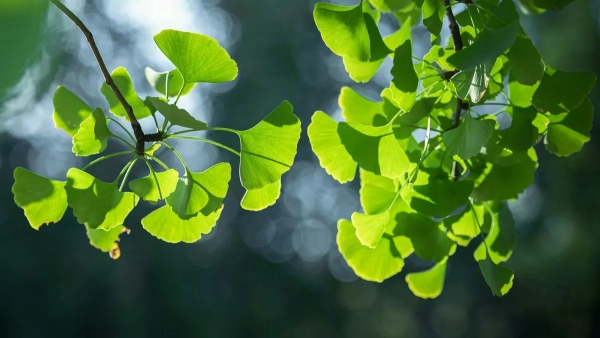
Ginkgo tree leaves / Photo by Tao Yuan
Flowers enter the arena
Finally, about 140 million years ago, flowering plants, or angiosperms, appeared. They attracted animals, insects, and birds to spread pollen, and fruits helped protect and transport seeds over long distances.
Today, these plants form the basis of everything we see around us: from vegetables and fruits to the majestic forests that make the Earth habitable.