
Main points
- Researchers have restored fragments of the oldest star catalog created by the ancient Greek astronomer Hipparchus, using modern technology that has made it possible to see text hidden under layers of ink.
- The detected coordinates of the stars demonstrate impressive accuracy, confirming the advanced methods of measurement and mathematical analysis of ancient astronomers.

Hipparchus' lost star map read after 2,000 years / Collage 24 Channel/Depositphotos/Freepik
Fragments of the oldest known star catalog, created more than two thousand years ago, have been recovered from a manuscript thought lost for centuries. The text had been erased and rewritten, but modern technology has made it possible to see what remained hidden under several layers of ink.
How did science bring an ancient sky map back to life?
This is the work of the ancient Greek astronomer Hipparchus, who is often called the “father of astronomy.” Back in the 2nd century BC, he compiled a map of the starry sky, determined the coordinates of the stars and introduced a scale of stellar magnitudes to estimate their brightness. However, the original star catalog disappeared and was known only from indirect references in later sources, writes Daily Galaxy.
The only material hints of his work were symbols on ancient artifacts, notably the Farnese Atlas, which depicts a celestial sphere decorated with constellations. However, the actual coordinates of the stars were thought to be lost.
That changed after a study of a parchment manuscript from which the original text had been erased and replaced with another. A team led by science historian Victor Gisemberg of the Sorbonne found that remnants of Greek writing had been preserved beneath layers of Syriac religious texts. The results were published in the Journal for the History of Astronomy.
To read the erased lines, researchers used X-rays from a particle accelerator at the SLAC National Accelerator Laboratory. The manuscript, which is about 1,500 years old, was transported to the laboratory in special climate-controlled containers to avoid damage.
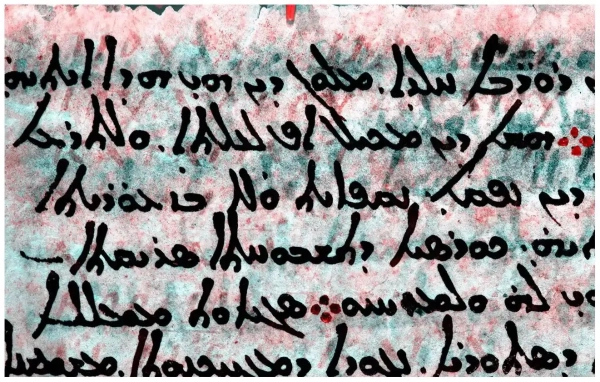
The erased Greek words (in red) are visible under the later Syriac text / Photo by Journal for the History of Astronomy
Scientists scanned 11 pages with ultrashort pulses of X-ray radiation lasting about ten milliseconds. The beam was focused on an area no wider than a human hair. The key was that the ink of the original text differed in chemical composition from later writings. The ink used by Hipparchus was found to have an increased calcium content. This allowed them to separate the ancient layer and restore the text, in order to then read part of the coordinates of the stars.
The manuscript itself is known as the Codex Climaci Rescriptus. It was formed from ten older texts in Greek and Aramaic, and later the religious works of John the Clover were written over them. As a result, Hipparchus' work almost completely disappeared from history.
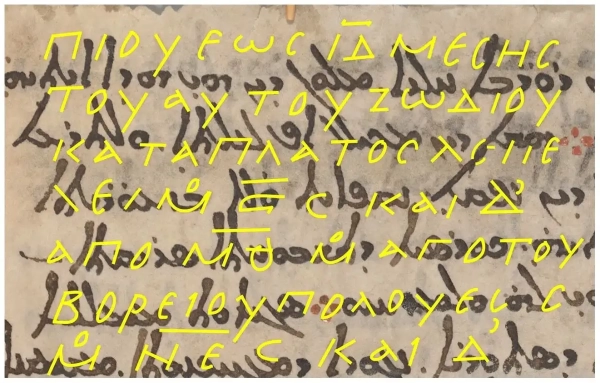
Yellow outlines of Hipparchus' original text based on multispectral image data / Photo Journal for the History of Astronomy
The reconstructed coordinates demonstrate impressive accuracy. For an era when telescopes did not yet exist and observations were made with the naked eye, the calculations turned out to be remarkably close to modern values. This confirms that ancient astronomers possessed advanced methods of measurement and mathematical analysis.
Work continues
The researchers plan to continue their work and try to read as many fragments of the catalog as possible. Each new coordinate is additional evidence of how scientific approaches to describing the Universe were formed in ancient times.
The discovered text not only complements the history of astronomy – it shows that over two thousand years ago, people systematically and accurately described the celestial sphere, laying the foundations of science in the modern sense.